
Before You Accept Another School App: Seven Questions to Ask About Your Child’s Data
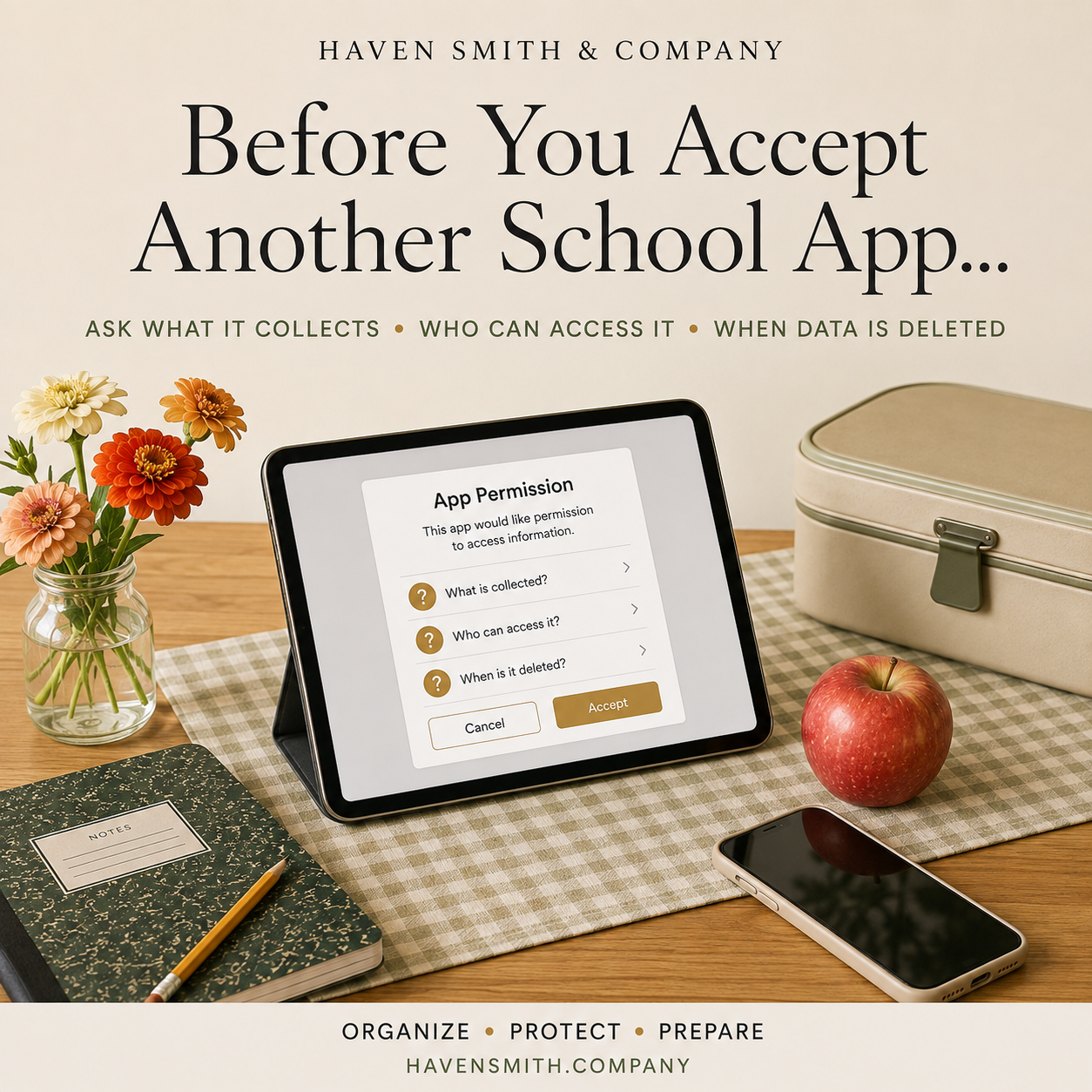
Back-to-school technology can collect names, photographs, locations, messages, learning records and behavioral information. Families deserve to understand what is being used and why.
A new school year can require an entire collection of digital tools.
There may be separate applications for assignments, attendance, transportation, meals, messaging, photographs, sports, healthcare, volunteer coordination and after-school activities.
Some are required by the school. Others are recommended by a teacher, team, parent group or outside provider. Accounts may be created by the school, the parent or the child.
The volume makes it easy to press Accept and move on.
But every application creates another place where information about your child may be collected, stored, shared or retained.
Families need a simple way to understand the system.
If You Read Only One Thing
Do not treat every school-related application as interchangeable. Record what it collects, why it is required, who controls the account and what happens to the data when your child stops using it.
Your Action Steps
Create a school-technology inventory containing:
Application or portal name
Purpose
Child associated with it
School, class or activity
Whether it is required
Whether the school or family created the account
Parent and child usernames
Recovery email or phone number
Privacy-policy link
Date permission was provided
Expected review or deletion date
Do not place passwords inside an unsecured inventory. Record where authorized access is managed.
Then ask seven questions about each application.
1. Is This Application Required and Approved?
Determine whether the application is:
Required by the school or district
Approved for classroom use
Chosen independently by a teacher
Used by a parent organization
Operated by an athletic or extracurricular program
Suggested but optional
Downloaded independently by the child
“School-related” does not always mean “district-managed.”
If the application is required, ask where the school publishes information about approved educational technology and data practices. If it is optional, consider whether the benefit justifies creating another account.
The Department of Education recommends that teachers confirm whether online services are approved by their school or district before using them with student information. Review the Department of Education’s educational-technology guidance.
2. What Information Does It Collect?
An application may collect more than a name and email address.
Possible information includes:
Birth date
School and grade
Photographs and videos
Assignments and performance
Attendance
Behavioral information
Disability or accommodation information
Health information
Messages
Voice recordings
Location
Device identifiers
Browsing or usage activity
Parent contact information
Payment information
Read the privacy notice with one practical objective: identify what enters the system.
Pay special attention when the application requests permissions for the camera, microphone, contacts, photographs, Bluetooth or location.
3. What Educational Purpose Does the Information Serve?
The application should have a clear purpose.
Ask:
Why is this information necessary?
Which feature uses it?
Is the collection required or optional?
Can the feature function with less information?
Is the information used exclusively for education or school operations?
Is the child expected to create public content?
A request for information should be connected to a specific function, not accepted merely because the application requests it.
4. Who Can Access or Receive the Information?
Identify whether information may be available to:
Teachers
School administrators
Other students
Other parents
District personnel
The technology provider
Subcontractors
Analytics providers
Advertising partners
The general public
A classroom photograph, team roster or student profile may have very different visibility depending on the application’s settings.
Ask who controls those settings and whether parents or students can change them.
5. Is the Information Used for Advertising or Profiling?
The FTC revised the Children’s Online Privacy Protection Rule in 2025, strengthening requirements involving children’s information, targeted advertising, third-party disclosures and data retention. Review the FTC’s announcement of the COPPA amendments.
COPPA generally applies to operators of child-directed online services and certain other operators that knowingly collect personal information from children under 13. FERPA applies differently and governs education records maintained by covered schools and institutions.
The laws are not interchangeable, and not every school-related application is governed in exactly the same way.
Parents do not need to become privacy attorneys before the first day of school. They should be able to ask whether their child’s information is used for advertising, product development, profiling or purposes unrelated to providing the requested service.
6. How Long Is the Information Retained?
Information should not remain online indefinitely simply because no one remembered to remove it.
Ask:
How long does the provider retain the information?
Can a parent request deletion?
Can the school request deletion?
Does deleting the application delete the account?
Are backups retained after deletion?
What happens to submitted assignments or media?
Is information anonymized or merely disconnected from the visible profile?
The FTC’s revised COPPA Rule requires covered operators to establish written data-retention policies and limits retaining children’s personal information to the period reasonably necessary for its intended purpose.
7. What Happens When the Child Leaves?
Children change:
Teachers
Classes
Schools
Districts
Teams
Programs
Devices
Email addresses
At the end of the relationship, determine:
Whether the account closes automatically
Whether the family must request deletion
Whether files can be downloaded
Whether photographs remain visible
Whether the school retains the records
Whether the child can continue accessing the account
Whether a parent-owned account should be disconnected
Add an end-of-year review date to your calendar. Do not depend on remembering every application next June.
Understand Your FERPA Rights
FERPA generally gives parents of eligible K–12 students rights concerning access to education records, requests to amend inaccurate records and some control over disclosure of personally identifiable information.
Those rights generally transfer to the student when the student turns 18 or enters a postsecondary institution at any age. Review the Department of Education’s FERPA guidance.
FERPA permits certain disclosures without individual consent, including disclosures to qualifying school officials performing legitimate educational functions. Specific requirements and exceptions can be complex.
If you have concerns about a particular application or disclosure, begin with the school or district’s privacy contact. Seek qualified legal advice when necessary.
Create One Family Record
The purpose of the inventory is not to create fear around educational technology.
It is to create visibility.
A family should be able to determine:
Which applications are active
Why each application exists
Who created the account
How access is recovered
What information it contains
When it should be reviewed
What should happen when it is no longer needed
This is part of the invisible digital work of running a family. Once documented, it becomes easier to review, share and manage.
Resources Outside Haven Smith & Company
Haven Smith & Company Resources
Free Digital Life Management resources:
https://www.havensmith.company/start-hereDigital Safety Course:
https://www.havensmith.company/digital-safetyDigital Life Management Course Bundle:
https://www.havensmith.company/bundleBook a free 15-minute consultation:
https://www.havensmith.company/free-consultation
This article provides general education, not legal advice.