
Every Organization Needs a Digital Offboarding Checklist
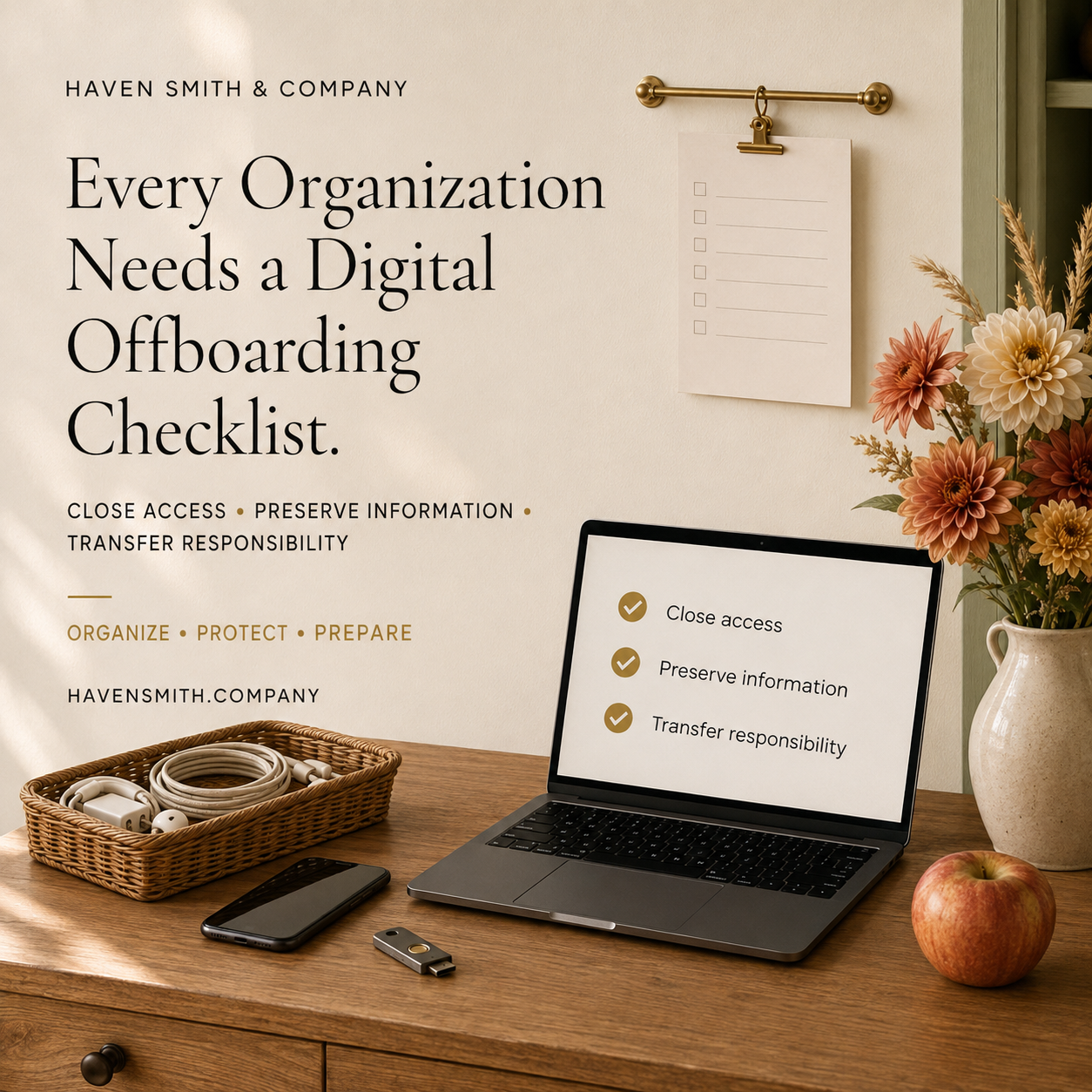
When an employee, contractor, volunteer, board member or vendor leaves, access must end without taking essential information and relationships with them.
A person leaves an organization, and someone remembers to collect the laptop.
But what about the email account? Cloud files? Shared passwords? Website administration? Social-media access? Recurring meetings? Vendor portals? Authentication applications? Customer relationships?
Digital offboarding is not one action. It is a coordinated process that protects the organization while preserving its ability to operate.
That process should be documented before the next departure occurs.
If You Read Only One Thing
Digital offboarding must accomplish two things at once: close the departing person’s access and preserve the organization’s information, relationships and ability to operate.
Your Action Steps
Create a repeatable offboarding checklist covering:
Accounts and systems
Email and calendars
Files and ownership
Devices and storage media
Password-manager access
Shared credentials and recovery methods
Websites and social media
Financial and vendor portals
Customer and partner relationships
Final review and documentation
Assign a primary owner, an authorized backup and a completion deadline for each responsibility.
Offboarding Begins Before the Last Day
Whenever possible, begin the transfer before the person leaves.
Identify:
Current responsibilities
Active projects
Important files
Accounts they administer
Meetings they organize
Vendors and customers they communicate with
Devices they use
Software licenses assigned to them
Shared credentials they know
Recovery methods connected to their phone or email
Work that has not been documented
The goal is not to capture every minor action. It is to ensure that important work, access and knowledge have a clear destination.
Block Access—But Do Not Delete Blindly
Removing an account too quickly can destroy information or interrupt operations.
An organization may need to:
Block sign-in
Revoke active sessions
Reset credentials
Preserve the mailbox
Transfer files
Reassign ownership
Forward new messages
Convert an individual mailbox into a shared mailbox
Retain records for legal, regulatory or operational reasons
Microsoft’s offboarding guidance recommends blocking access, preserving mailbox contents, addressing mobile devices, transferring OneDrive and Outlook data and determining how email should be handled before deleting the user or license. Review Microsoft’s former-employee guidance.
Deleting first and asking questions later can create a second crisis.
Transfer File Ownership
Files should not disappear because they were created in an individual employee’s personal workspace.
Before departure:
Identify important files and folders.
Determine who currently owns them.
Transfer ownership where the platform permits it.
Move organizational records into an organization-controlled location.
Confirm that the successor can open and use them.
Preserve required historical versions.
Remove access that is no longer appropriate.
A shortcut or shared view is not always ownership. Confirm what will happen if the original account is suspended or deleted.
Decide What Happens to Email
A departed person’s email address may continue receiving messages from:
Customers
Donors
Vendors
Professional partners
Government agencies
Subscription services
People who were never informed about the transition
Depending on the organization’s needs and legal obligations, email may need to be:
Preserved
Forwarded
Converted into a shared mailbox
Monitored temporarily
Replaced with an automatic reply
Eventually deleted
Forwarding handles new messages. It does not automatically transfer the full history, calendar, contacts or institutional knowledge contained in the original account.
Reassign Calendars and Recurring Responsibilities
A departure can leave behind:
Recurring meetings
Room reservations
Webinar ownership
Appointment calendars
Shared scheduling pages
Automated reminders
Renewal dates
Publication schedules
Billing deadlines
Cancel, transfer or recreate these items intentionally.
Do not wait until a customer cannot book, a meeting link fails or a renewal lapses.
Recover Devices and Remove Organizational Data
The checklist should cover:
Laptops
Phones
Tablets
Security keys
External drives
Memory cards
Access cards
Printers or scanners
Home-office equipment
If the person used a personal device, determine how authorized organizational information will be removed without accessing or destroying unrelated personal data.
Organizations should establish this process in advance through policies and agreements rather than improvising after someone leaves.
Rotate Shared Credentials
Removing an individual account does not invalidate every credential the person knew.
Review:
Shared passwords
Wi-Fi credentials
Alarm codes
API keys
Recovery codes
Social-media passwords
Website administration
Domain registration
Financial portals
Vendor dashboards
Password-manager collections
Multifactor-authentication devices
Whenever possible, replace shared accounts with individual accounts and role-based permissions. Individual access is easier to revoke and audit.
Remember Contractors, Volunteers and Vendors
Offboarding is not limited to employees.
Organizations should also plan for departures involving:
Independent contractors
Consultants
Temporary staff
Interns
Board members
Committee members
Volunteers
Managed service providers
Bookkeepers
Marketing agencies
Website developers
A person can retain significant access without ever appearing on the employee roster.
Document Completion
An offboarding checklist should record:
The person leaving
Their role
Final date
Checklist owner
Systems reviewed
Access removed
Information transferred
Devices returned
Credentials rotated
Exceptions requiring follow-up
Completion date
The record should avoid containing passwords. It should document that the responsibility was completed.
Integrate Offboarding With Organizational Governance
NIST’s Cybersecurity Framework 2.0 recommends integrating cybersecurity considerations into human-resources processes, including onboarding, role changes and offboarding. Review NIST’s CSF 2.0 implementation examples.
That principle applies even when an organization has no dedicated IT or HR department.
Someone must still own the process.
A five-person business, nonprofit board, professional practice or volunteer organization may have fewer accounts than a corporation—but the departure of one essential person can have a greater proportional effect.
Prepare Before the Next Departure
Do not wait until someone resigns, retires, becomes ill or must be removed urgently.
Build the checklist now.
The organization should know:
What must be secured
What must be preserved
Who performs each action
Who verifies completion
What cannot be deleted immediately
What happens when circumstances are urgent
Effective offboarding is not merely an administrative conclusion. It is part of organizational security, continuity and resilience.
Resources Outside Haven Smith & Company
Haven Smith & Company Resources
Free Digital Life Management resources:
https://www.havensmith.company/start-hereDigital Life Management Course Bundle:
https://www.havensmith.company/bundleBook a free 15-minute consultation:
https://www.havensmith.company/free-consultation
Haven Smith & Company provides education, organization and practical planning guidance. Organizations should consult their IT, cybersecurity, human-resources and legal professionals when appropriate.