
Your Organization’s Most Important Information Cannot Live in One Person’s Head
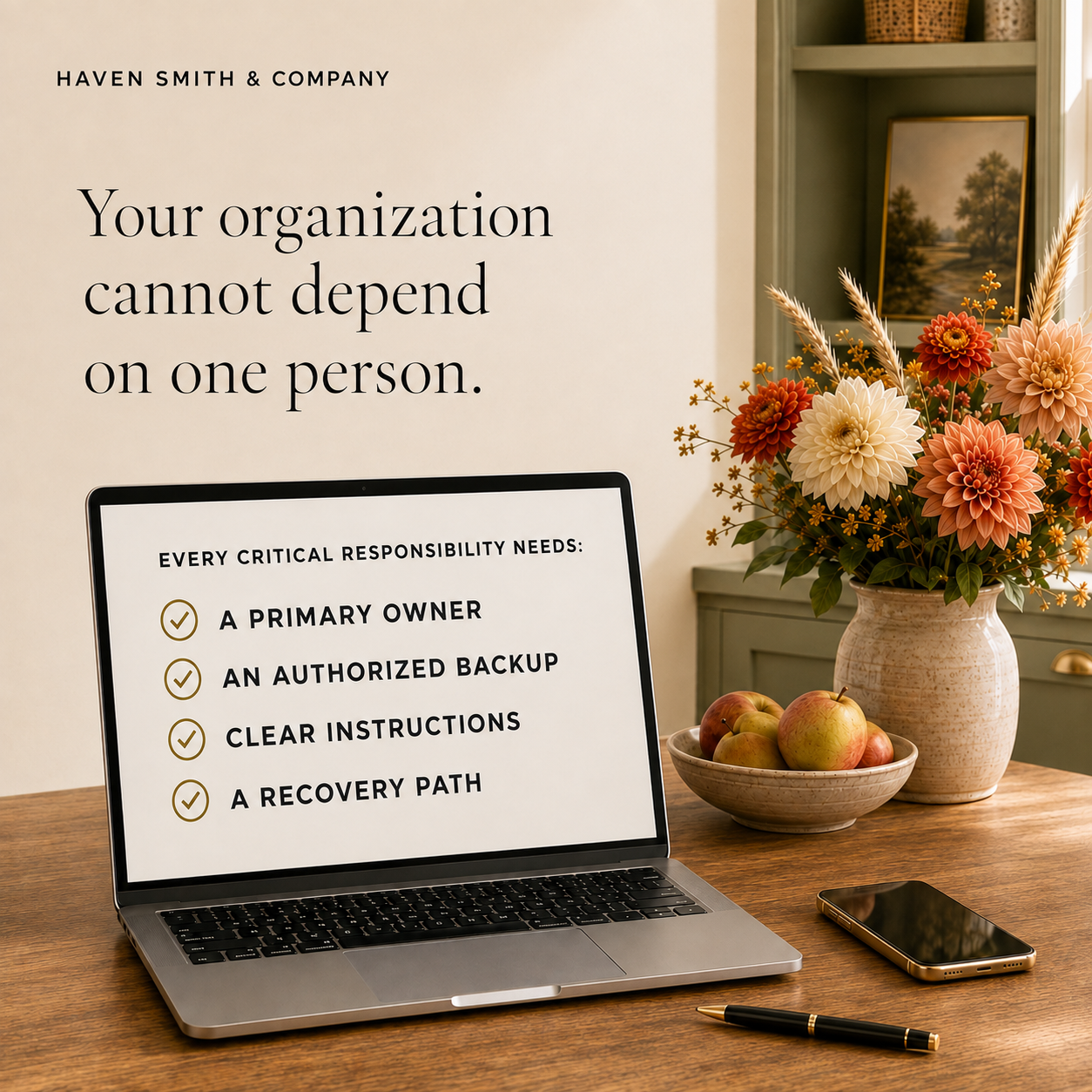
When only one owner, employee, volunteer, or vendor understands a critical digital responsibility, ordinary absence can become an organizational emergency.
Every organization has someone who knows how things work.
One employee runs payroll. A volunteer maintains the membership database. The owner controls the website and domain. An outside consultant administers the email system. One person receives every security alert and authentication code.
As long as that person remains available, the arrangement may appear to work perfectly.
The weakness becomes visible when the person becomes sick, takes a vacation, leaves the organization, changes roles, experiences an emergency, or simply cannot be reached when something important happens.
This is not merely an information-technology problem. It is an organizational continuity problem.
Your organization does not need everyone to know everything or have access to every account. It does need a secure, authorized way to continue critical responsibilities without depending entirely on one person’s memory, personal email address, private phone, or continued availability.
If You Read Only One Thing
For every critical digital responsibility, your organization should know who owns it, who can provide authorized backup, where the instructions are maintained, and how access can be recovered without depending entirely on one person.
Your Action Steps
Identify one digital responsibility that only one person fully understands.
Name the person who normally owns that responsibility.
Select an appropriate, authorized backup.
Document the systems, accounts, vendors, devices, and information involved.
Record where approved instructions are maintained.
Confirm that access and recovery do not depend on one person’s private email address, phone, or memory.
Ask the backup person to review the process and identify what is missing.
Repeat the exercise with one additional responsibility each week.
Important Work Often Becomes Invisible
Consider what would happen if the person who normally handles payroll were suddenly hospitalized.
Would someone else know:
Which payroll service the organization uses?
When payroll must be submitted?
Which records must be reviewed?
Who has authority to approve it?
How authorized access would be obtained?
Whom to contact if something goes wrong?
The same questions apply to your website, domain, email, accounting platform, customer records, scheduling system, newsletter, social-media accounts, cloud storage, security tools, backups, and other digital responsibilities.
When someone performs these tasks reliably, the work can become almost invisible. Other people see the result without understanding the systems, knowledge, decisions, and access required to produce it.
The organization may not recognize the dependency until the person is unavailable.
The “Only Person Who Knows” Problem
This problem does not involve employees alone.
The only knowledgeable person may be:
The founder or owner
A partner
An office manager
A board member
A volunteer
A relative helping informally
An accountant or bookkeeper
A website developer
An information-technology consultant
A managed-service provider
A marketing contractor
A former employee who never transferred responsibility completely
The missing information is not necessarily a password. It may be knowledge about:
Which account controls a service
Who legally or contractually owns the account
Which email address receives notices
Which device receives authentication requests
Where recovery codes are maintained
When a subscription renews
Which payment method is connected
What steps must be completed
Which records must be preserved
Who may authorize a change
How to contact the vendor
How the organization can recover access
Your organization may technically own its information while still being unable to locate, access, understand, or use it.
Seven Digital Responsibilities to Examine
1. Email, Domains and Websites
Who controls your domain registration, website account, email environment and renewal settings?
An organization can lose control of its online presence when a domain is registered through a contractor’s personal account or renewal notices are sent to a former employee’s email address.
Document:
The registrar and hosting provider
The organization’s account owner
Administrative roles
Renewal dates and payment arrangements
The approved recovery process
Vendor-support information
Your website and domain should not depend on someone remaining reachable indefinitely.
2. Financial Operations
Who can appropriately continue invoicing, payroll, bill payment, expense management and financial reporting?
Financial continuity does not mean circulating banking passwords or giving unrestricted access to multiple people. It means establishing appropriate authority, separation of duties, review procedures and backup responsibilities.
Document what must occur, when it must occur, who may approve it, and how an authorized substitute could proceed.
3. Customer, Client, Member or Donor Information
Where is this information maintained? Who administers the system? Can the organization export or recover its own records?
Identify:
The primary system
Administrative ownership
Approved users and roles
Backup or export procedures
Privacy and retention requirements
Vendor contact information
The process for removing access when someone leaves
The person who uses the database every day should not be the only person who understands it.
4. Scheduling and Communications
Who controls your shared calendars, appointment system, business phone number, newsletter platform, social-media accounts and public announcements?
If the usual person were unavailable, could the organization:
Contact customers or clients?
Cancel or reschedule appointments?
Respond through the business phone number?
Publish an urgent notice?
Access shared calendars?
Continue necessary internal communications?
A communication channel is not dependable if it belongs primarily to one individual rather than the organization.
5. Devices, Software and Vendors
Many organizations do not have a complete record of the technology they use.
One person may know which applications are essential, what they cost, when they renew and whom to call for support. A critical subscription may be attached to that person’s payment card or personal email account.
Create a basic inventory of:
Applications and services
Business purpose
Account ownership
Administrative contacts
Cost and renewal timing
Payment responsibility
Vendor-support information
Data export and termination procedures
6. Security and Account Recovery
Who receives security alerts? Who can respond if an account is compromised? Where are recovery codes maintained?
An organization can have multifactor authentication enabled and still create a continuity problem if every prompt is sent to one employee’s personal phone.
Review:
Administrative and recovery email addresses
Authentication devices
Recovery codes
Security-alert recipients
Password-manager administration
Incident-response contacts
Procedures for suspected compromise
CISA recommends that small and medium-sized organizations establish fundamental cybersecurity practices rather than treating security as a one-time technology purchase. Review CISA’s small-business cybersecurity resources.
7. Backups and Critical Records
What information is backed up? Where is it maintained? Who can restore it?
A backup has limited practical value when no authorized person can locate it, access it, or explain how restoration works.
Confirm:
Which information is included
How frequently it is backed up
Where copies are stored
Who administers the system
How restoration is performed
When restoration was last tested
Do not assume that a green checkmark or active subscription proves that your critical information could be recovered successfully.
Redundancy Does Not Mean Everyone Gets Access
Continuity planning is not an instruction to give every employee every password.
Organizations still need to preserve:
Least-necessary access
Role-appropriate authority
Individual accountability
Secure credential management
Separation of sensitive responsibilities
Privacy and confidentiality
Documented recovery procedures
Prompt removal of unnecessary access
The goal is not unrestricted access.
The goal is to avoid helplessness when one specific person is unavailable.
A secure continuity arrangement might involve an authorized backup administrator, organization-managed password manager, documented recovery process, sealed emergency instructions, appropriate executive authority, or assistance from a contracted provider.
The correct arrangement depends on the organization, the sensitivity of the information, applicable law, contractual obligations and the responsibility involved.
Create a Digital Continuity Map
Start with a simple document or spreadsheet. For each critical responsibility, record the following information:
FieldQuestion to AnswerResponsibilityWhat must continue?Primary ownerWho normally handles it?Authorized backupWho may step in?Systems involvedWhich accounts, applications or devices are required?InstructionsWhere is the approved procedure maintained?Access methodHow is authorized access provided or recovered?External supportWhich vendor or adviser may need to help?Time sensitivityHow long can the responsibility remain interrupted?Last review or testWhen was the process last verified?
This map should not become an unsecured collection of passwords.
It should show the organization what exists, who is responsible, where approved instructions are maintained, and whether an authorized continuity process exists.
Test the Process
Documentation can appear complete to the person who wrote it while remaining unusable to everyone else.
Ask the authorized backup person to review one responsibility without receiving informal explanations from the usual owner.
Can the backup person determine:
What needs to be done?
When it must happen?
What authority is required?
Which systems are involved?
How approved access would be obtained?
Who can provide external assistance?
How completion would be verified?
Missing information discovered during a test is not a failure. It is the reason for testing.
The Small Business Administration recommends identifying and documenting critical functions and processes as part of business-continuity planning. Review the SBA’s business-continuity guidance.
NIST’s Cybersecurity Framework also treats cybersecurity as a broader organizational responsibility involving governance, identification, protection, detection, response and recovery. Read the NIST Cybersecurity Framework 2.0 Small Business Quick-Start Guide.
Start With One Responsibility
Do not attempt to document your entire organization in one afternoon.
Choose the responsibility that would cause the greatest disruption if its usual owner were unavailable. Spend 30 minutes identifying:
The primary owner
The authorized backup
The systems involved
The location of the instructions
The approved access or recovery process
The external support contact
The maximum acceptable interruption
Then have the backup person review it.
Repeat the exercise with one additional responsibility each week. Within a few months, your organization will understand its critical digital dependencies far better than it does today.
Build Organizational Knowledge That Can Continue
A dependable organization does not assume that its most knowledgeable person will always be available.
It creates secure and appropriate ways for essential knowledge, authority and access to continue when circumstances change.
That is part of Digital Life Management for every business, professional practice, nonprofit, association and institution:
Organize essential information.
Protect it appropriately.
Prepare people to continue important responsibilities.
Review the system as staff, vendors and technology change.
Your organization’s most important information cannot live in one person’s head—and its ability to operate should not depend on that person always being there.
Resources Outside Haven Smith & Company
Haven Smith & Company Resources
Free Digital Life Management resources:
https://www.havensmith.company/start-hereDigital Organization Course:
https://www.havensmith.company/digital-organizationDigital Safety Course:
https://www.havensmith.company/digital-safetyDigital Life Management Course Bundle:
https://www.havensmith.company/bundleBook a free 15-minute consultation:
https://www.havensmith.company/free-consultation
Haven Smith & Company provides practical education, tools, and guidance to help individuals, families, professionals, businesses, and institutions organize, protect, and prepare their digital lives with confidence.