
Why an Apple Legacy Contact Is Not a Complete Digital Estate Plan
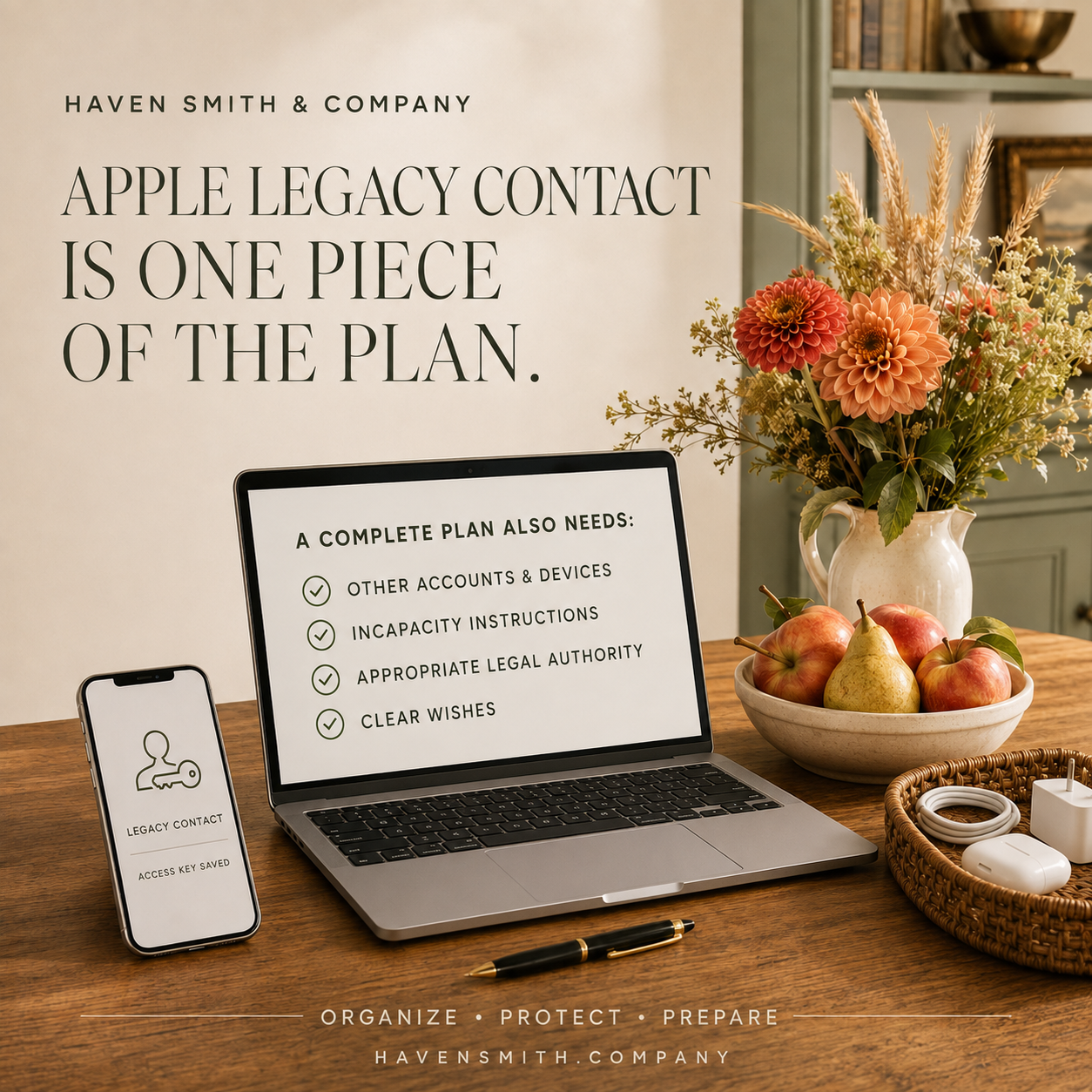
Apple can help someone access certain account data after your death—but it cannot organize the rest of your digital life, document your wishes, or prepare someone to help during incapacity.
Apple’s Legacy Contact feature provides a secure way to give someone access to certain information stored in your Apple Account after your death.
It is worth setting up.
But naming a Legacy Contact does not create a complete digital estate plan. It does not cover every type of Apple data, accounts held by other companies, locally stored information, incapacity planning, or the instructions and legal authority someone may need to manage your digital responsibilities.
Think of Apple’s Legacy Contact as one platform-specific component within a much larger plan.
If You Read Only One Thing
Naming an Apple Legacy Contact answers one question: who may request certain Apple data after your death? It does not explain what you own, what should happen to it, how someone can help during incapacity, or how the rest of your digital life will be managed.
Your Action Steps
Add an Apple Legacy Contact.
Tell the person that you selected them.
Confirm that they received the access key.
Print a copy of the key and store it securely with your estate-planning documents.
Inventory the important accounts, devices, files, subscriptions, and digital property outside Apple.
Document what should be preserved, transferred, memorialized, closed, or deleted.
Ask a qualified estate-planning attorney whether your will, trust, and power of attorney include appropriate digital-asset and electronic-communications authority.
What an Apple Legacy Contact Can Do
Apple allows you to name one or more people as Legacy Contacts for your Apple Account.
After your death, a Legacy Contact may be able to request access to information such as:
Photographs
Messages
Notes
Files stored in iCloud
Device backups
Other eligible Apple Account data
The person does not need to own an Apple device or have an Apple Account when you select them.
To request access, the Legacy Contact generally needs two things:
The unique access key created when you selected them
Your death certificate
Apple reviews the request and verifies the documentation. If the request is approved, the Legacy Contact receives a special Apple Account that can be used to access the eligible information.
Apple describes Legacy Contact as the easiest and most secure way to give someone you trust access to certain Apple Account data after your death. It is a useful feature, and adding one should be part of your digital legacy preparation. Review Apple’s Legacy Contact instructions.
It Does Not Include Everything in Your Apple Account
Apple specifically excludes several important categories from Legacy Contact access.
Your Legacy Contact cannot access:
Passwords stored in iCloud Keychain
Passkeys stored in iCloud Keychain
Payment information
Purchased movies
Purchased music
Purchased books
Subscriptions purchased through your Apple Account
This means that naming a Legacy Contact does not provide someone with a complete password-management or account-access solution.
For example, your Legacy Contact may receive access to eligible photographs, notes, and files without receiving the passwords necessary to manage your financial accounts, household services, social-media profiles, business systems, or other third-party services.
Your digital estate plan still needs to identify what exists, where important information is maintained, and how the appropriate people can obtain authorized access.
Apple Cannot Manage the Rest of Your Digital Life
Most people’s digital lives extend far beyond one Apple Account.
Important accounts and property may be distributed across:
Google and Microsoft accounts
Personal and business email
Social-media platforms
Financial institutions
Payment services
Cloud-storage providers
Online subscriptions
Website domains
Business applications
Digital storefronts
Cryptocurrency or other digital property
Files stored locally on computers, phones, tablets, and external drives
Each provider can establish its own account settings, terms, access procedures, and documentation requirements.
Apple’s Legacy Contact feature cannot provide access to information held by another company. It also cannot explain how all these accounts relate to your household, family, business, finances, or estate.
A complete digital estate plan must consider the entire digital environment—not only the person’s primary phone or cloud account.
It Is Designed for Death—not Incapacity
This is one of the most important limitations to understand.
An Apple Legacy Contact requests access after the account owner has died and generally must submit a death certificate. The feature does not create a system for helping someone who is alive but unable to manage their digital responsibilities.
That might happen because the person is:
Hospitalized
Injured
Cognitively impaired
Temporarily unavailable
Experiencing a prolonged emergency
Otherwise unable to manage important accounts or information
A complete plan should address both questions:
What should happen to my digital life after my death?
How could an authorized person help me while I am still living?
Incapacity planning may require practical instructions, account-recovery preparation, emergency information, and properly drafted legal documents. A post-death platform setting cannot replace those arrangements.
The Access Key Still Has to Be Available
Selecting a Legacy Contact is not enough if the person cannot locate the access key.
Apple recommends confirming that your contact received the key. You can send it through Messages, provide a PDF or screenshot, or print a physical copy. Apple also recommends keeping a printed copy with your estate-planning documents.
Your Legacy Contact generally needs both the key and your death certificate to begin the request. Apple explains the access process here.
After adding a contact:
Tell them what the designation means.
Confirm that they received the key.
Print a backup copy.
Store it securely with relevant documents.
Review the designation when relationships or estate plans change.
Do not assume that sending the key once means it will remain available indefinitely.
Access Is Time-Limited
Apple says eligible account data remains available to Legacy Contacts for three years after the first Legacy Contact request is approved. After that period, the account is permanently deleted.
This creates a practical responsibility for the contact: important information may need to be identified, downloaded, preserved, or appropriately distributed during that access period.
Apple also allows you to name multiple Legacy Contacts. Any one of them may independently make decisions about the account data after your death, including permanently deleting it.
That does not mean you should avoid naming multiple contacts. It means the decision should be intentional. Choose people you trust and make sure everyone understands your wishes.
Access Does Not Provide Instructions
Receiving account access does not tell someone what to do with the information.
A useful digital estate plan should explain:
Which accounts and files matter
Where important information is maintained
Who should manage different responsibilities
What should be preserved
What should be transferred
What should be memorialized
What should be closed or deleted
Which subscriptions should be canceled
Which records may be needed by an executor, trustee, family member, or business partner
The goal is not to place every password inside an unsecured document.
The goal is to create a reliable inventory, appropriate access preparation, clear instructions, and a process the right person can follow.
Platform Settings and Legal Documents Should Work Together
Digital access can be affected by platform settings, terms of service, privacy law, and estate-planning documents.
The Revised Uniform Fiduciary Access to Digital Assets Act, adopted in some form by many states, addresses fiduciary access to online accounts. It can restrict access to the content of electronic communications unless the account owner provided appropriate consent. Read the Uniform Law Commission’s overview.
California law also recognizes directions made through qualifying online tools. Under California Probate Code section 873, a direction made through an online tool that the user can modify or delete may override a contrary direction in a will, trust, power of attorney, or other record. Read California Probate Code § 873.
That is one reason platform settings and estate-planning documents should be reviewed together rather than treated as unrelated tasks.
Haven Smith & Company can provide education, organization, inventories, and practical planning guidance. Consult a qualified attorney for legal advice about your will, trust, power of attorney, fiduciary access, and electronic communications.
One Useful Piece of a Complete Plan
Adding an Apple Legacy Contact is a meaningful step. Complete Digital Life Management requires more.
Your plan should also address:
What you have
Where it is maintained
How it is protected
Who should be responsible
What authority they may need
What you want to happen
How someone could help during incapacity
How the plan will be reviewed and updated
Apple provides one valuable access tool. Your digital estate plan provides the larger map.
Resources Outside Haven Smith & Company
Haven Smith & Company Resources
Free Digital Life Management resources:
https://www.havensmith.company/start-hereDigital Legacy & Estate Planning Course:
https://www.havensmith.company/digital-legacy-estate-planningDigital Life Management Course Bundle:
https://www.havensmith.company/bundleBook a free 15-minute consultation:
https://www.havensmith.company/free-consultation
Haven Smith & Company provides practical education, tools, and guidance to help individuals, families, professionals, businesses, and institutions organize, protect, and prepare their digital lives with confidence.