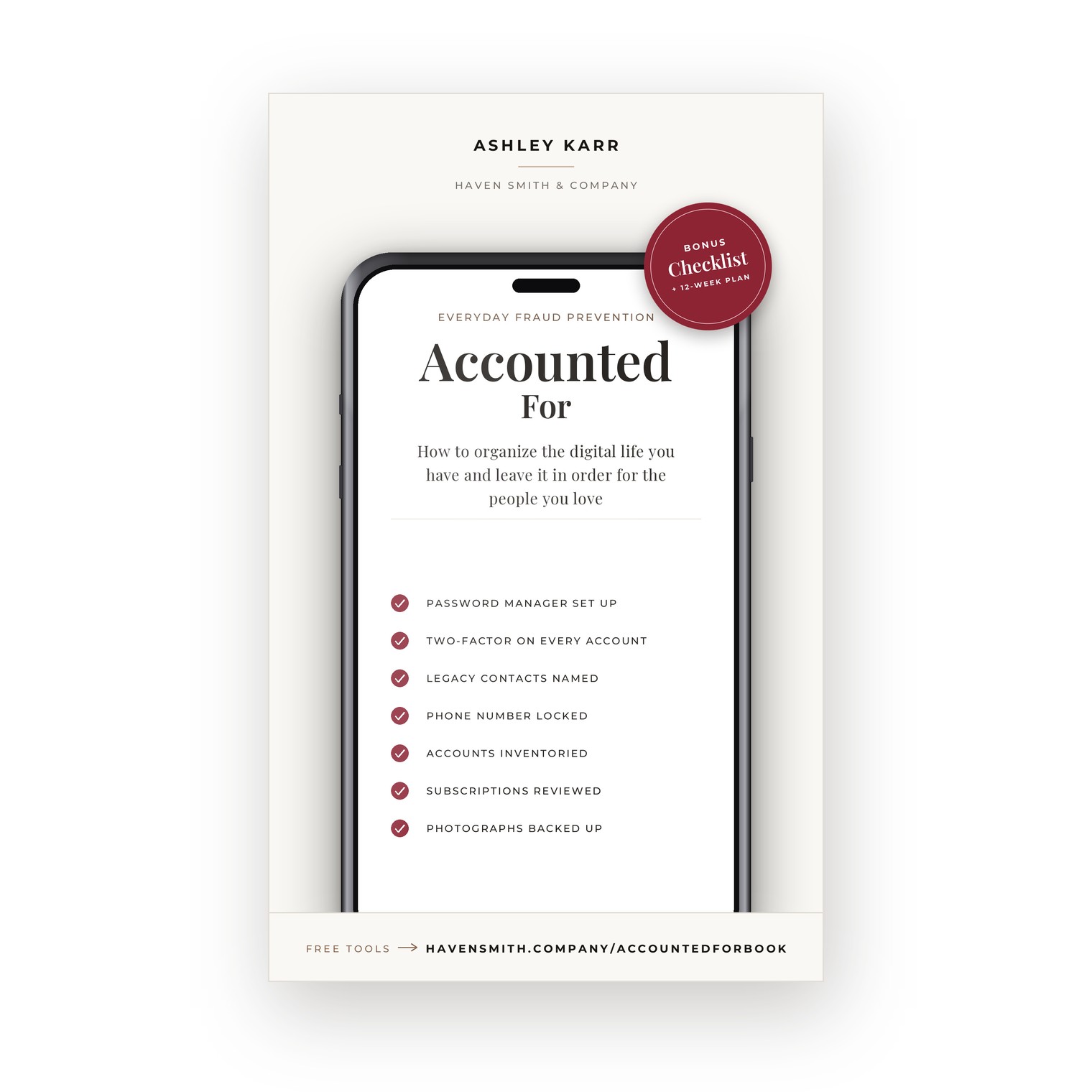
The cover of Accounted For by Ashley Karr, with a phone showing a checklist.

1 / 4

Accounted For

Organize the digital life you have and leave it in order for the people you love.

Choose your license
What each license covers

Every license comes with the same files. The license says who may use them.

Personal is for your own home. Use the files for yourself and your family.

Commercial is for one facilitator, coach, or teacher who uses the files with clients, a class, or a team. Choose one seat for each person who leads.

Extended commercial lets you put the files inside something you sell, like a course, a program, or a client kit.

Buying for a whole firm, a school, or a shop? Ask for a quote on my contact page.

$19

Your download link arrives by email the moment you pay: an EPUB for your phone, tablet, or e-reader, and a PDF. You have seven days to change your mind.

Insidethe book
  • Your accounts
  • Your money
  • Your files and photographs
  • Your devices
  • Passwords
  • Two-step sign-in
  • Your phone number
  • Credit freezes
  • The scams that keep working
  • The first twenty-four hours
  • Legacy contacts
  • Beneficiaries
  • The people you trust
About the book

Organize the digital life you have and leave it in order for the people you love.

Nobody designs a digital life. It accumulates, one account at a time, over twenty years, while everyone is busy: a few hundred logins, photographs in four places, subscriptions renewing quietly, and one email address that can reset all the rest. The arrangement holds, right up until somebody else has to find one specific thing in a hurry.

Accounted For is one method rather than a pile of tips. Three pillars, Organize, Protect, and Prepare, and two phases: a first cleanup, twelve weeks at about two hours a week, and then a short rhythm that keeps it true. Each week takes one territory, accounts, money, files, devices, and people, and asks a single question of it. There is a placement rule for everything you write down, a ranked list of the protections worth doing first, a chapter written to be read in a panic, and a complete checklist at the back.

Ashley Karr is a human factors engineer and principal product designer who has spent twenty years inside banks and technology companies building the systems your life runs on, including fraud prevention work at JPMorgan Chase. She writes for people who do not work in technology and have no wish to.

The goal is not that you will be careful. The goal is that a specific person, on a specific bad day, can find a specific thing without you. That is the most practical form of love available, and the book is a route to it.

And you never have to do a step alone. Honest IT support is the companion to Accounted For and to the Everyday Fraud Prevention System. When a step in Accounted For needs a hand, you book thirty minutes on Google Meet and we do that step together.

Every part, in order

Organizing is how it starts. The handover is how it ends.

  1. Part One · WelcomeYou learn why none of this is your fault and the one question at the heart of the whole book.

    You learn what the Everyday Fraud Prevention System is, why a digital life is so hard to keep in order, and how to use the book. Everything turns on one question: who does this account for?

  2. Part Two · OrganizeYou find what you have, including the accounts you forgot.

    You spend one week each on your digital accounts, your financial accounts, your files and data, and your devices and people. The method is inventory, then edit, then store and record.

  3. Part Three · ProtectYou close the doors that matter most first.

    You set up strong passwords and two-step sign-in, lock the phone number that controls everything else, and secure the accounts that can reset all the others. This part ends with the scams that keep working and what to do in the first twenty-four hours.

  4. Part Four · PrepareYou decide who gets what, when, and how.

    You set up legacy contacts, beneficiaries, and trusted people, and you write your wishes down where your family and your executor will find them. Until the event you choose, nothing changes hands.

  5. Part Five · What comes nextA short habit keeps all of it true.

    You get weekly, monthly, quarterly, and yearly reviews, plus a chapter to open when life changes: a marriage, a new baby, a parent who needs help, a business, a loss.

  6. In the back · The appendicesThe checklists and schedules sit in one place, ready to use.

    The back of the book holds the complete checklist, the maintenance schedule, and a guide to which accounts go where.

By the last page

What is true when you finish.

  • Every online account you own is written down in one place you can find.
  • Your passwords live in a manager you trust, and you are not the backup.
  • The accounts that hold your money take more than a password to open.
  • Your phone number is locked against being moved to somebody else’s phone.
  • Your credit is frozen at all three bureaus, which stops a stranger opening a new account in your name.
  • Your photographs are in one place you can name, and they are backed up.
  • The subscriptions you pay for are the ones you want.
  • Apple, Google, and Facebook know who to let in when you cannot say so yourself.
  • The accounts that take a beneficiary have the right one on them.
  • Your wishes for each account are written somewhere your family and your executor will find them.
  • There is a printed record your people can pick up and act on.
  • A short monthly habit keeps all of it true.
Ashley Karr, smiling, in a sunny home office
Meet the author

Hi, I’m Ashley.

I have worked for more than twenty years in accessibility, fraud prevention, cybersecurity, and product research and design. I helped create many of the systems our day-to-day lives depend on: banking, payments, identity, and fraud protection. One of my roles was vice president of product research at JPMorgan Chase, and I hold a master’s degree in human factors and systems engineering.

I write books, teach, and build good products. Whatever brought you here, I’m glad you came.

Ashley

Read my story
The details

What you get, and how it arrives.

Format
An EPUB and a PDF
Length
About 260 pages
Delivery
A download link by email, the moment you pay
Accessibility
An EPUB that passes the EPUBCheck and Ace accessibility checks, and a tagged PDF
Licenses
Personal $19, commercial $49 a seat, or extended commercial $199
Refund
Seven days to change your mind
Before you ask

You have questions, and we have plain answers.

  1. What do I get when I buy it?

    An EPUB for your phone, tablet, or e-reader, and a PDF. Your download link arrives by email the moment you pay.

  2. Can I read some of it first?

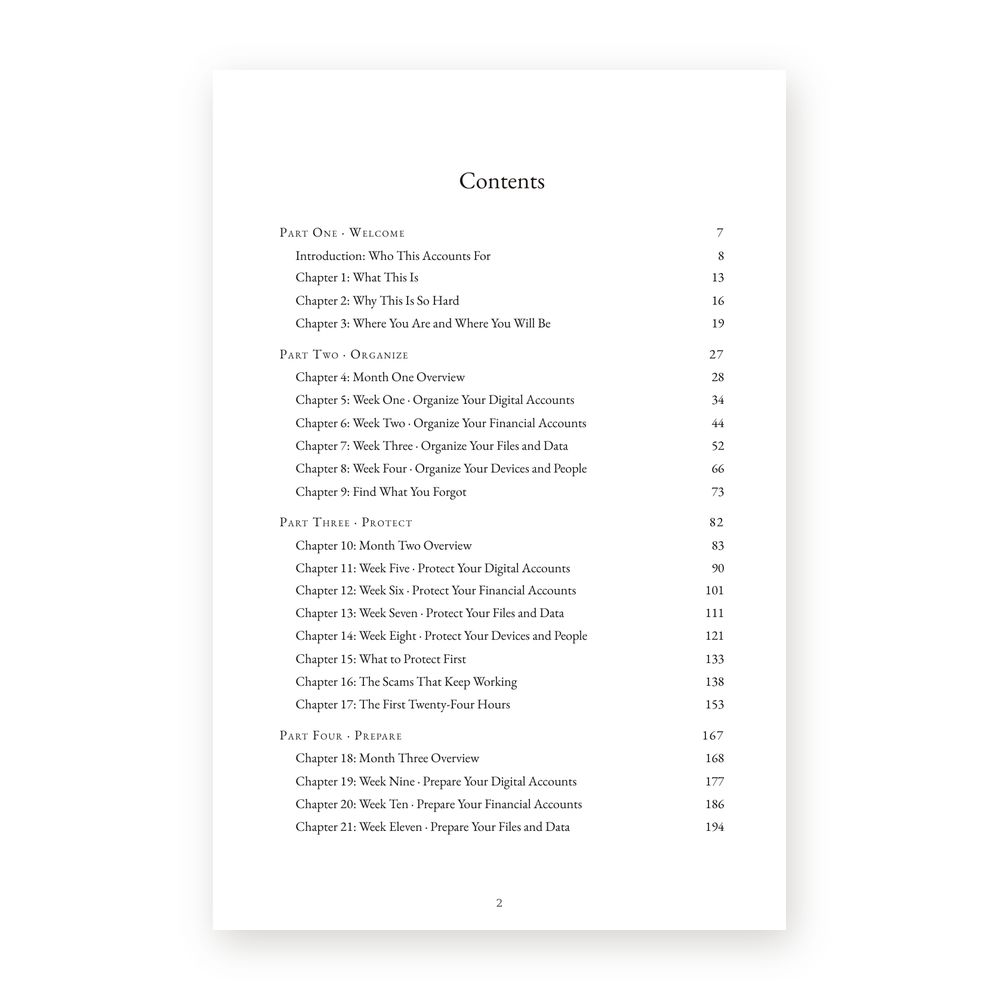
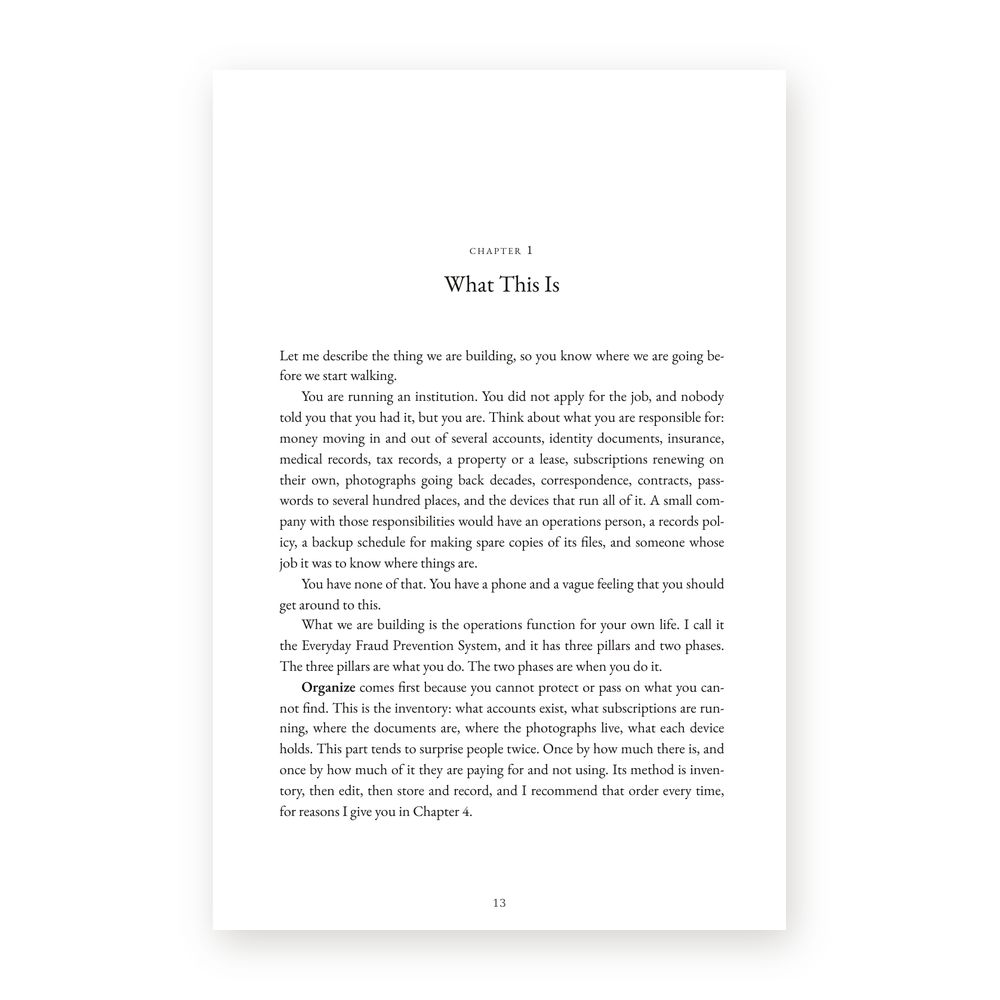
    Yes. Select Peek inside, under the pictures at the top of this page, to read the table of contents and Chapter 1.

  3. Is it for people who are not technical?

    Yes. Nothing is assumed. Every term is explained the first time it appears, and every step says what to tap and what you should see when it worked.

  4. How long does it take?

    As long as you like. The book is laid out as twelve weeks, one month each to organize, protect, and prepare, and the twelve weeks are a guide, not a deadline.

  5. What if I only have one hour?

    Read Chapter One and then freeze your credit. The book says so plainly and tells you where to start if that is all you ever do.

  6. Does it cover what happens to my accounts when I pass away?

    Yes. Part Four covers legacy contacts on Apple, Google, and Facebook, beneficiaries, trusted people, and writing your wishes down somewhere your family and your executor will find them.

  7. I already own the Everyday Fraud Prevention System. Do I need the book?

    No. The book is the System written as a book, for someone who would rather read it than work through the guides.

  8. What if I need help with a step?

    Book an Honest IT support session. It is the companion to Accounted For and to the Everyday Fraud Prevention System. For thirty minutes on Google Meet, you and I work through that step together, and you keep the mouse.

  9. Is it legal or financial advice?

    No. Accounted For is practical education about organizing, protecting, and preparing your digital life. It does not replace an attorney, a financial advisor, or a tax professional.

Peek inside

Accounted For

Contents

  1. Part One · Welcome
  2. Introduction: Who This Accounts For
  3. Chapter 1: What This Is
  4. Chapter 2: Why This Is So Hard
  5. Chapter 3: Where You Are and Where You Will Be
  6. Part Two · Organize
  7. Chapter 4: Month One Overview
  8. Chapter 5: Week One · Organize Your Digital Accounts
  9. Chapter 6: Week Two · Organize Your Financial Accounts
  10. Chapter 7: Week Three · Organize Your Files and Data
  11. Chapter 8: Week Four · Organize Your Devices and People
  12. Chapter 9: Find What You Forgot
  13. Part Three · Protect
  14. Chapter 10: Month Two Overview
  15. Chapter 11: Week Five · Protect Your Digital Accounts
  16. Chapter 12: Week Six · Protect Your Financial Accounts
  17. Chapter 13: Week Seven · Protect Your Files and Data
  18. Chapter 14: Week Eight · Protect Your Devices and People
  19. Chapter 15: What to Protect First
  20. Chapter 16: The Scams That Keep Working
  21. Chapter 17: The First Twenty-Four Hours
  22. Part Four · Prepare
  23. Chapter 18: Month Three Overview
  24. Chapter 19: Week Nine · Prepare Your Digital Accounts
  25. Chapter 20: Week Ten · Prepare Your Financial Accounts
  26. Chapter 21: Week Eleven · Prepare Your Files and Data
  27. Chapter 22: Week Twelve · Prepare Your Devices and People
  28. Chapter 23: What to Prepare First
  29. Part Five · What Comes Next
  30. Chapter 24: The Rhythm, Rules, and Reviews
  31. Chapter 25: Life Events
  32. Chapter 26: Organizing Is Loving
  33. Resources
  34. Appendices · Reference
  35. Appendix A: The Complete Checklist
  36. Appendix B: The Twelve-Week Plan
  37. Appendix C: The Maintenance Schedule
  38. Appendix D: Which Accounts Go Where

Chapter 1: What This Is

Let me describe the thing we are building, so you know where we are going before we start walking.

You are running an institution. You did not apply for the job, and nobody told you that you had it, but you are. Think about what you are responsible for: money moving in and out of several accounts, identity documents, insurance, medical records, tax records, a property or a lease, subscriptions renewing on their own, photographs going back decades, correspondence, contracts, passwords to several hundred places, and the devices that run all of it. A small company with those responsibilities would have an operations person, a records policy, a backup schedule for making spare copies of its files, and someone whose job it was to know where things are.

You have none of that. You have a phone and a vague feeling that you should get around to this.

What we are building is the operations function for your own life. I call it the Everyday Fraud Prevention System, and it has three pillars and two phases. The three pillars are what you do. The two phases are when you do it.

Organize comes first because you cannot protect or pass on what you cannot find. This is the inventory: what accounts exist, what subscriptions are running, where the documents are, where the photographs live, what each device holds. This part tends to surprise people twice. Once by how much there is, and once by how much of it they are paying for and not using. Its method is inventory, then edit, then store and record, and I recommend that order every time, for reasons I give you in Chapter 4.

Protect comes second because once you know what you have, you can see where it is exposed. This is passwords, two-factor (a second check on top of your password, such as a code sent to your phone), the phone number that controls everything else, the accounts that can reset all the others (usually your email, where the "forgot password" links arrive), the places where someone could step in and be you. This is the part I know best, and it is the part that pays for itself fastest. Its method is configure, recover, monitor: set the protections, know your own way back in, and watch for changes.

Prepare comes third because the first two make it possible. This is the handover: the planned, controlled transfer of your accounts and records to the right person when a specific event happens. When you pass, yes, but also a serious illness or a hospital stay, a child turning eighteen, the sale of a business, or leaving a job that holds accounts in your name. Until that event, nothing changes hands. When it comes, the people you chose get what you decided, in the way you decided. Its method is consider, decide, then document and share: think through the situations, decide what should happen, write it down, and tell the right people.

Then the two phases, which are about timing rather than content.

The first phase is the cleanup. One pass through all three pillars, start to finish. It is the bulk of this book, and I built it to run across twelve weeks: one month for each pillar, one week at a time. The twelve weeks are a guide, not a deadline.

The second phase is the rhythm. The short recurring work that keeps the cleanup true and the three pillars useful. A life that was organized in March and never touched again is a life that was organized in March. Things change. You open accounts, you close them, you move, people change roles in your family. The rhythm is what carries your work forward.

Underneath all of it is one idea, and if you take nothing else from this book, take this.

The goal is not that you will be careful. The goal is that on a specific bad day, a specific person can get to a specific thing because you set it up that way.

That is a test you can apply to any decision in this book. Write down who that person is. Then ask, of each thing you own: if something happened to me, would the handover I set up get this to the right person? Not could they eventually work it out. Would the handover work?

When the answer is yes, that item is accounted for. When the answer is no, you have found your next task.

That is the long form of the question I gave you in the introduction. Who does this account for? Hold up any account, any file, any password, any arrangement you have made, and ask it. When you can name the person, you almost always know what to do with the thing.

A word about what finished looks like, because I do not want you chasing something that does not exist. There is no finished. There is no afternoon where you close the laptop and the whole thing is complete forever. What exists is a state of good enough: the important things are findable, the dangerous gaps are closed, and your written record of it all is current enough that the person you named could pick it up when the time comes.

You are aiming for a house that is tidy enough, not a museum.

Keep reading Accounted For.

The whole book arrives by email the moment you pay, as an EPUB and a PDF.