
A Backup You Have Never Restored Is Only a Promise
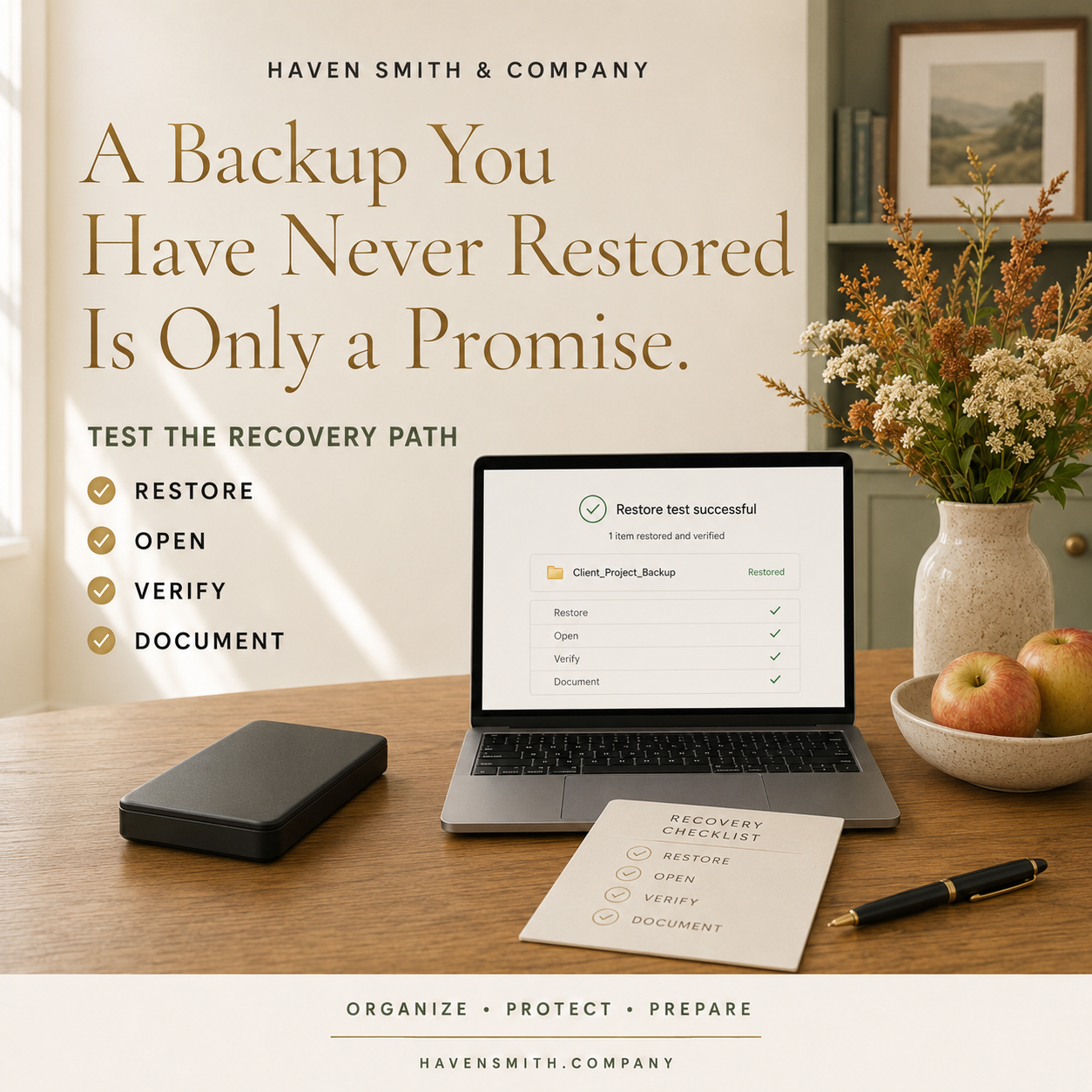
Organizations do not know whether a backup works until someone retrieves the information, opens it and confirms that it is complete.
Many organizations can confidently say that backups are running.
Far fewer can say when they last restored information from those backups.
A dashboard may display a green checkmark. An automated email may report that the backup completed successfully. Files may appear inside the expected storage location.
Those signals are useful, but they do not prove that the organization can recover its information after accidental deletion, hardware failure, ransomware, account loss, or another disruption.
A backup is tested through restoration.
If You Read Only One Thing
A backup is not proven by the message saying it completed. It is proven when authorized people can restore usable information within the time the organization needs it.
Your Action Steps
Identify the organization’s most critical information.
Name the primary person responsible for backups.
Name an authorized backup person.
Select a small, representative group of files.
Restore those files to a separate testing location.
Open and inspect the restored information.
Confirm that permissions, versions, and dates are correct.
Document the test and any failures.
Correct the problems.
Schedule the next restoration test.
Why a Backup Can Fail Quietly
A backup process may appear successful while the resulting information is:
Incomplete
Corrupted
Outdated
Encrypted without an available key
Stored under an inaccessible account
Missing important folders
Connected to the same compromised environment
Owned by a former employee
Dependent on software the organization no longer uses
Available too slowly for operational needs
The organization may not discover the problem until recovery becomes urgent.
Synchronization Is Not Necessarily an Independent Backup
Synchronization services are excellent for making current information available across devices and collaborators.
However, synchronization can also carry changes across the connected system.
If a file is:
Deleted
Overwritten
Corrupted
Encrypted by malware
Changed accidentally
that change may synchronize.
Version history, recycle bins, and provider restoration features may help, but they can have time limits and service-specific restrictions. For example, Microsoft says permanently deleted OneDrive files cannot be recovered after they leave the Recycle Bin. Microsoft’s OneDrive restoration guidance.
An independent backup should provide a separate recovery path.
Decide What Must Be Recoverable
Not every file carries equal importance.
Begin by identifying information the organization needs to:
Serve customers or constituents
Receive and make payments
Meet legal or contractual obligations
Continue essential operations
Contact staff, clients, and vendors
Restore systems
Prove ownership or authorization
Maintain institutional knowledge
Protect the people it serves
The Federal Trade Commission recommends that businesses maintain inventories of hardware, software, data, and services. FTC cybersecurity guidance for small businesses.
A backup plan built without an inventory can protect large quantities of low-value material while overlooking one critical database or account.
Assign Responsibility
Every backup process should have:
A primary owner
An authorized backup owner
Clear instructions
A review schedule
A restoration process
A recovery path if the primary account owner is unavailable
Avoid allowing one employee, contractor, founder, or technology provider to be the only person who understands the system.
Document:
Which systems are backed up
How often backups occur
Where copies are maintained
Who receives failure notifications
Where encryption keys are secured
How restoration is initiated
Who must authorize a full recovery
Conduct a Small Restoration Test
A restoration test does not have to begin with a dramatic simulation.
Select representative information, such as:
One ordinary working document
One folder containing several file types
One older version of a changed file
One critical record from an independent backup location
Restore the information into a separate testing location. Do not overwrite the working copy.
Then verify:
Does the file open?
Is the content complete?
Is it the expected version?
Are the dates and names intact?
Can the correct people access it?
Can unauthorized people access it?
Does specialized software still read it?
Is the restoration process documented clearly enough for another person?
A successful download that produces an unreadable file is not a successful restoration.
Test the Credentials and Keys
The data may be intact while the recovery process remains unusable.
Confirm that the organization can locate and use:
Backup-account credentials
Multifactor-authentication methods
Encryption keys
Recovery codes
Administrative access
Vendor contact information
Required software licenses
Device or storage instructions
Do not place all these elements in an unsecured document. The organization needs a protected access process that more than one authorized person understands.
Consider the 3-2-1 Guideline
CISA recommends the 3-2-1 backup guideline:
Three copies of important information
Two different types of storage
One copy maintained off-site
The appropriate implementation will depend on the organization’s systems, obligations, resources, and risks. The principle is to prevent one failure from destroying every copy.
CISA also recommends testing backups regularly. CISA’s business-backup guidance.
Define How Quickly Recovery Must Happen
An organization may be able to recover its information eventually and still experience a serious operational failure.
Ask:
How long could we operate without this information?
How much recent work could we afford to lose?
Which functions must return first?
Who decides when restoration begins?
How will staff and customers receive updates?
A one-day restoration may be acceptable for archived photographs and unacceptable for a system that controls daily payments or appointments.
Record the Test
Document:
Test date
Systems tested
Files restored
Backup source
Person conducting the test
Time required
Problems discovered
Corrective action
Date of the next test
A failed test is useful if it exposes a weakness before an emergency.
The goal is not to produce a perfect report. It is to convert assumed resilience into demonstrated resilience.
Resources Outside Haven Smith & Company
Haven Smith & Company Resources
Digital Safety Course:
https://www.havensmith.company/digital-safetyDigital Organization Course:
https://www.havensmith.company/digital-organizationDigital Life Management Course Bundle:
https://www.havensmith.company/bundleBook a free 15-minute consultation:
https://www.havensmith.company/free-consultation