
Build a Family Digital Emergency File Before You Need It
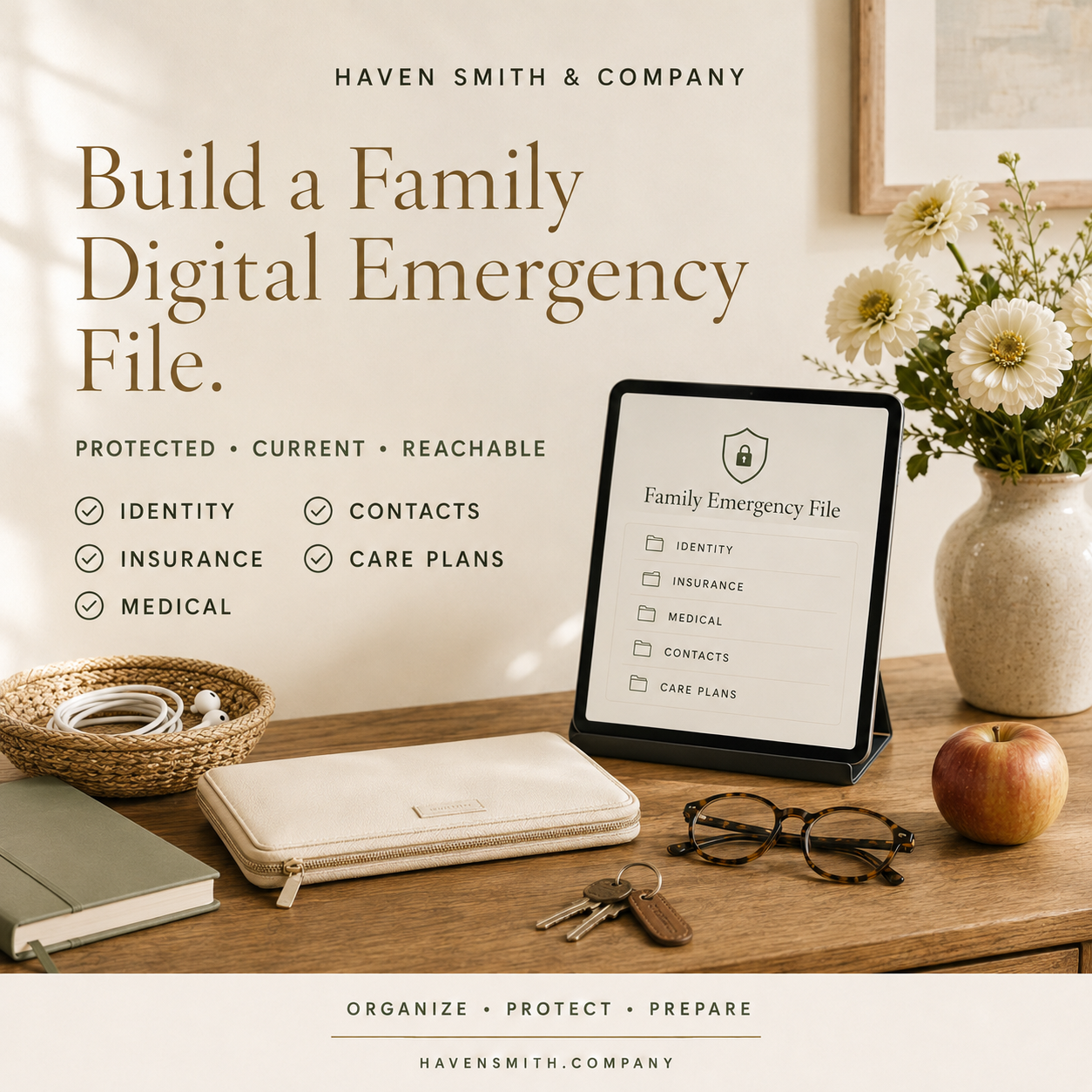
A protected collection of essential records can help your family respond to evacuation, hospitalization, displacement, financial disruption, or another emergency.
During an emergency, families may need information that normally lives in several different places.
Identification may be inside a wallet or filing cabinet. Insurance policies may be available only through an online account. Medication information may be stored in a health portal. School contacts may be inside an application on one parent’s phone. Estate documents may be held by an attorney. Account information may depend on the memory of one person.
A family digital emergency file brings the most important information into one protected, understandable system.
It is not a folder containing every record the family owns. It is a deliberate collection of the information people may need quickly when ordinary routines are interrupted.
If You Read Only One Thing
Emergency information is useful only if the right person can locate it, access it, understand it and trust that it is current.
Your Action Steps
Create a protected emergency folder.
Add a simple household-information summary.
Collect essential identity, insurance, medical, household, and family records.
Include contact information for important institutions and professionals.
Create a family communication plan.
Protect sensitive information appropriately.
Maintain copies in separate secure locations.
Tell the appropriate trusted person how to locate the file.
Review it at least annually and after major life changes.
Why September Is a Good Time to Prepare
September is National Preparedness Month, an annual effort encouraging families and communities to prepare for emergencies and disasters.
FEMA’s Emergency Financial First Aid Kit helps households organize critical financial, medical, and household information. Review FEMA’s Emergency Financial First Aid Kit.
The Consumer Financial Protection Bureau also recommends establishing a way to locate important documents quickly and maintaining protected copies in separate locations. Review the CFPB’s disaster-preparation guidance.
Your family does not need to wait for a regional disaster. The file can also help during:
Hospitalization
Injury
Sudden travel
Temporary displacement
A house fire
A lost device
A caregiving emergency
A parent’s incapacity
The death of a family member
Begin With a Household Summary
Create a short document containing:
Household members
Home address
Primary telephone numbers
Emergency contacts
Insurance contact information
Medical considerations
School or childcare contacts
Pet information
The location of additional records
This summary serves as the map. It should explain what information exists and where more detailed records are maintained.
Identity and Family Records
Depending on your household, useful records may include protected copies of:
Driver’s licenses
Passports
Birth certificates
Marriage certificates
Divorce and custody documents
Adoption records
Social Security cards
Immigration records
Military identification
Guardianship documents
These documents contain sensitive personal information. Do not place them in an unprotected shared folder or distribute them more broadly than necessary.
Medical Information
Consider including:
Health-insurance cards
Medication list
Allergies
Diagnoses relevant to emergency care
Physician contact information
Pharmacy information
Medical-device information
Advance healthcare documents
Contact information for caregivers
The emergency file does not have to contain an entire medical history. Concentrate on information that could affect immediate decisions or continuity of care.
Insurance and Household Records
Collect current information for:
Homeowners or renters insurance
Automobile insurance
Health insurance
Life insurance
Disability insurance
Property records
Vehicle registrations
Mortgage or landlord contact information
Utility providers
Home-security services
Include policy numbers and official contact information, but avoid collecting unnecessary credentials.
Financial Information
A useful emergency file can identify:
Financial institutions
Credit-card issuers
Investment providers
Mortgage or loan servicers
Employer benefits contacts
Tax professional
Financial advisor
Insurance agent
The file does not need to contain complete account passwords or expose every account number.
The goal is to help an authorized family member understand which institutions must be contacted and where protected account information is maintained.
School, Childcare, and Caregiving Information
Families with children or dependent adults may need:
School and childcare contact information
Authorized pickup information
Health and accommodation plans
Caregiver instructions
Transportation contacts
Current schedules
Custody or guardianship information
Important application and portal names
Do not assume that every adult who might respond in an emergency knows which application contains the school schedule or where a child’s medical authorization is stored.
Include a Communication Plan
The family should know:
Who will contact whom
Which out-of-area person can serve as a central contact
Where household members will meet
How children will be collected
Who can care for pets
How to communicate if cellular service is unreliable
Which relatives or neighbors may need assistance
FEMA provides a fillable family emergency plan that can support this conversation. Create a family plan through Ready.gov.
Protect the File
The protection method should reflect the sensitivity of the information.
Consider:
A strongly protected cloud-storage account
Multifactor authentication
An encrypted external drive
A password-protected archive
A protected password-manager record
A secure physical copy
Limited sharing with designated trusted people
Avoid sending the entire file through ordinary email or storing it in an unrestricted household folder.
Also avoid placing the only copy on a drive stored inside the home. A fire, flood, theft, or evacuation could make both the original documents and local digital copy unavailable.
Test Access
A family emergency file should be tested.
Ask the intended person to locate:
The household summary
Insurance information
The medical list
The family communication plan
Confirm that the person can open the files without receiving access to unrelated private information.
Testing frequently reveals practical problems:
The wrong email address has access.
The folder belongs to an old account.
Multifactor authentication depends on one unavailable phone.
A scan is unreadable.
A document has expired.
Nobody remembers the encryption password.
These are planning problems that can be corrected before an emergency.
Review the File
Review it:
Every year
After moving
After changing insurance
After a birth, marriage, divorce, or death
After changing schools
After a major diagnosis
After replacing important devices
After revising the estate plan
After changing emergency contacts
Preparation is not the creation of a folder. It is the creation of a reliable process your family can use.
Resources Outside Haven Smith & Company
Haven Smith & Company Resources
Free Digital Life Management resources:
https://www.havensmith.company/start-hereDigital Organization Course:
https://www.havensmith.company/digital-organizationDigital Legacy & Estate Planning Course:
https://www.havensmith.company/digital-legacy-estate-planningDigital Life Management Course Bundle:
https://www.havensmith.company/bundleBook a free 15-minute consultation:
https://www.havensmith.company/free-consultation