
Your Executor Needs a Digital Map—Not a Password List
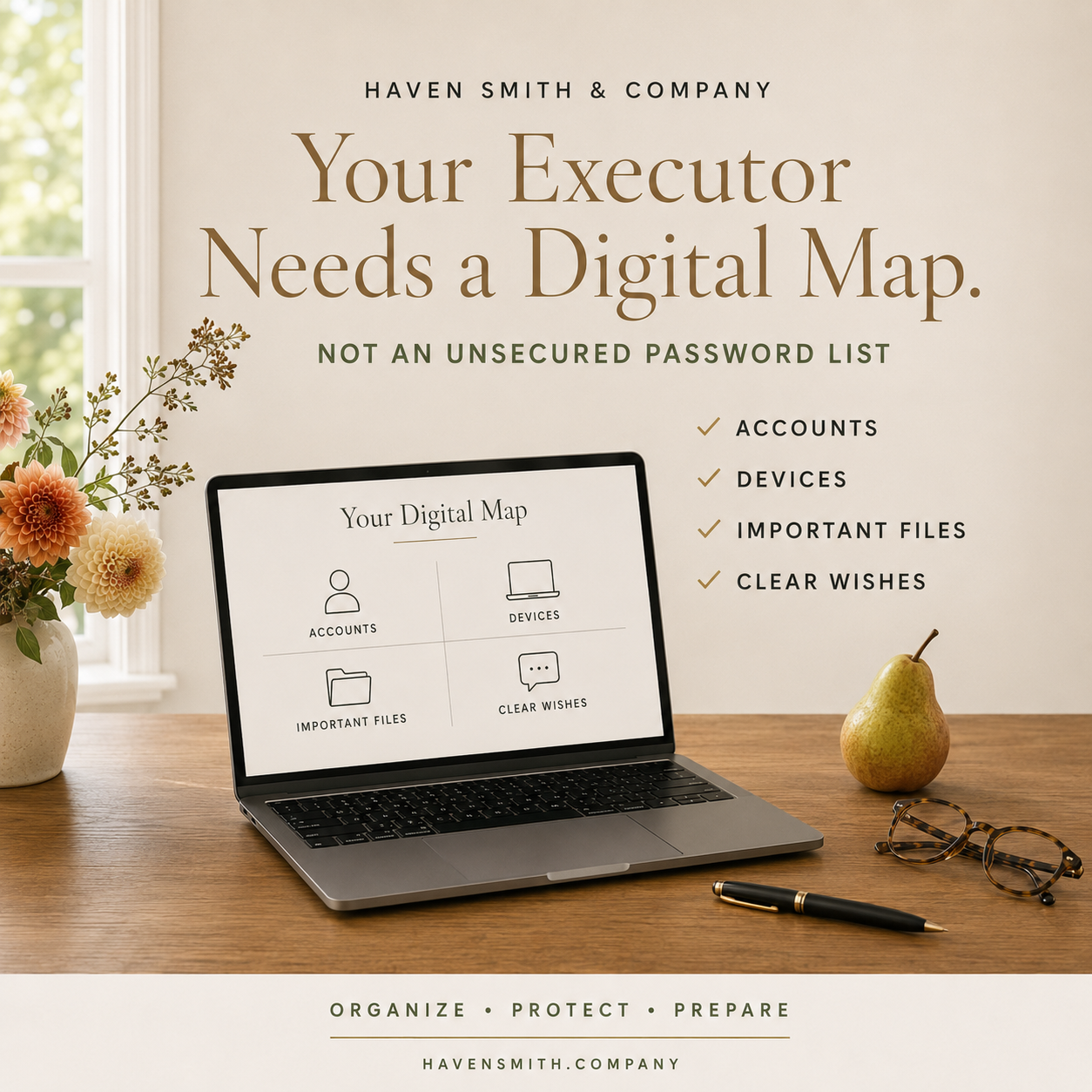
A useful digital estate plan explains what exists, where it is maintained, who is responsible and what should happen without placing every credential in an unsecured document.
When people begin thinking about digital estate planning, they often assume they should create a document containing every username and password they possess.
That document may appear helpful. It may also become outdated quickly, expose sensitive credentials, fail to explain what the accounts contain, and create the false impression that knowing a password automatically provides lawful authority to use an account.
Your executor needs more than credentials.
They need a map of your digital life, instructions about your wishes, an appropriate access process, and legal authority coordinated with platform rules and estate-planning documents.
If You Read Only One Thing
Your executor needs a reliable map of your digital life, but access must still be secure, intentional and legally authorized.
Your Action Steps
Create an inventory of important accounts, devices, files, services, and digital property.
Explain why each item matters.
Document what should be preserved, transferred, memorialized, closed, or deleted.
Identify the person or role responsible for each category.
Keep sensitive access preparation separate from the inventory.
Review the online legacy and inactive-account tools you have configured.
Ask a qualified estate-planning attorney whether your documents provide appropriate digital-asset and electronic-communications authority.
Why a Password List Is Not a Complete Plan
A password list answers only one narrow question: what credential was associated with an account when the list was last updated?
It does not explain:
Whether the account is still active
What information it contains
Whether it has financial or sentimental value
Whether other people depend on it
Whether it should be preserved or deleted
Whether the password has changed
Whether multifactor authentication is required
Whether using the credential is legally authorized
Whether the platform provides a formal post-death process
A list also becomes a concentrated security risk. Anyone who finds an unprotected copy may receive access to email, financial information, photographs, medical portals, cloud files, and identity information.
Begin With a Digital Map
A useful digital map identifies the major parts of your digital life without turning the document itself into a key to every account.
Possible categories include:
Accounts and Communications
Primary and secondary email
Social-media profiles
Messaging services
Online communities
Telephone and internet accounts
Devices and Storage
Computers
Phones
Tablets
External drives
Cloud-storage services
Photograph libraries
Home-network equipment
Financial and Digital Property
Online banking and investment access
Payment services
Cryptocurrency
Domain names
Monetized websites
Digital storefronts
Royalties or online income
Loyalty and rewards accounts
Household and Personal Responsibilities
Utilities
Insurance portals
Medical accounts
Subscription services
Education accounts
Travel programs
Home-security systems
Smart-home services
Business and Professional Systems
Business email
Websites and domains
Client records
Financial systems
Scheduling and payment platforms
Intellectual property
Administrative accounts
You do not need to document every disposable login. Concentrate first on accounts connected to money, identity, family history, legal responsibilities, business operations, or irreplaceable information.
Explain Why Each Item Matters
An account name alone provides little context.
For each important item, document:
The provider
The account’s purpose
The type of information or property it contains
Where related records are maintained
Who may need to know about it
Whether it creates an ongoing obligation
What you want to happen
For example:
Family photograph library: Contains approximately 20 years of family photographs. Preserve the original files, provide copies to the children, and do not delete the library until two verified copies exist.
That instruction is more useful than a password written beside the words “photo account.”
Document Your Wishes
Your digital map should distinguish among different outcomes.
You may want an account or asset to be:
Preserved
Transferred
Downloaded
Distributed
Memorialized
Archived
Closed
Deleted
Your wishes may differ by account. You might want photographs preserved, a professional profile memorialized, subscription services canceled, business assets transferred, and private drafts deleted.
Access alone does not communicate those choices.
Separate the Map From Access Preparation
The inventory should tell the authorized person what exists and where to begin.
Sensitive access preparation should be maintained through an appropriately protected process. Depending on the situation, this might involve:
A password manager with an established emergency-access process
Recovery information maintained securely
Platform legacy tools
Access keys stored with estate documents
Instructions held by an attorney or other trusted professional
Device information maintained in a protected location
Do not place raw passwords, recovery codes, device passcodes, and sensitive identity information inside an ordinary document shared through email.
Legal Authority Still Matters
Possessing a credential is not the same as having legal authority.
The Revised Uniform Fiduciary Access to Digital Assets Act addresses access by executors, trustees, conservators, and agents acting under powers of attorney. It distinguishes among digital assets, account catalogues, and the content of private electronic communications.
The Uniform Law Commission explains that a fiduciary may not receive the content of private communications without the user’s consent. Review the Uniform Law Commission’s RUFADAA overview.
California Probate Code section 873 also recognizes qualifying directions made through online tools. When the tool allows the user to modify or delete the direction, that online instruction can override a conflicting direction in a will, trust, power of attorney, or other record. Read California Probate Code § 873.
That is why platform settings and legal documents should be reviewed together.
Your Executor May Need More Than One Kind of Authority
Different responsibilities may involve different people and documents.
An executor may manage the estate after death. A trustee may manage trust property. An agent under a power of attorney may help during life. A business partner or administrator may have responsibility for organizational systems.
A complete plan should consider:
Death
Incapacity
Temporary emergencies
Business continuity
Family responsibilities
Naming someone in one role does not automatically prepare them for every situation.
Review the Map Regularly
Review the digital map:
At least annually
After changing your primary email
After replacing important devices
After opening or closing financial accounts
After major family changes
After starting or closing a business
After revising your estate plan
After changing the people you trust
The map does not need to be perfect before it becomes useful.
Begin with the ten digital responsibilities that would create the greatest confusion, expense, or loss if nobody knew they existed.
Resources Outside Haven Smith & Company
Haven Smith & Company Resources
Digital Legacy & Estate Planning Course:
https://www.havensmith.company/digital-legacy-estate-planningDigital Life Management Course Bundle:
https://www.havensmith.company/bundleFree Digital Life Management resources:
https://www.havensmith.company/start-hereBook a free 15-minute consultation:
https://www.havensmith.company/free-consultation
Haven Smith & Company provides education and practical planning support, not individualized legal advice. Consult a qualified attorney regarding your estate documents, fiduciary authority, and electronic communications.