
Digital Safety Is More Than Choosing Better Passwords
A Practical Course for Protecting the Accounts, Devices, Information, and Access Points That Matter Most
Use a strong password. Make it unique. Turn on multifactor authentication.
This is useful advice, but it leaves many important questions unanswered.
Which accounts deserve the most protection? What happens if you lose access to your primary email? Are your recovery phone numbers and email addresses current? Which devices remain authorized to access your accounts? Where are your authentication backup codes? Are your important files backed up? Would you recognize unusual account activity?
A strong password cannot protect an account when someone already has access to a trusted device. Multifactor authentication cannot help you recover an account if you lose the only device connected to it. A password manager can improve the way you handle passwords, but it cannot update old recovery information or decide which accounts deserve your attention first.
Better passwords are part of digital safety. They are not a complete digital safety plan.
Digital safety is the ongoing work of protecting the accounts, devices, information, recovery paths, and access points that support your life. A practical digital safety course can help you understand how those pieces connect, put appropriate protections in place, prepare for recovery, and establish manageable review habits.
You do not need to become a cybersecurity expert. You need to understand the digital resources you rely on and the decisions that help keep them available to you.
Why Password Advice Receives So Much Attention
Passwords are part of nearly every conversation about online account protection, and for good reason.
Weak or reused passwords can create unnecessary exposure. If the same password is used across several accounts, a compromise involving one service may create problems elsewhere. A unique password limits how far one exposed credential can travel.
Password advice is also easy to communicate. A short checklist can tell someone to create longer passwords, avoid reuse, and consider a password manager. These are practical improvements, but they address only one part of account access.
A password cannot:
Update outdated recovery information
Protect an unlocked device
Create a backup of important records
Remove old authorized devices
Identify unexpected account activity
Preserve authentication codes after a phone is lost
Monitor financial or identity information
Determine which accounts are connected
Prepare a response to an access problem
This does not make passwords less important. It means that password practices belong inside a broader digital safety plan.
Your Accounts Are Connected
Online accounts rarely operate independently.
Your primary email address may receive password-reset links for financial services, healthcare portals, cloud storage, shopping accounts, social media, and business platforms. Your phone number may receive authentication codes and recovery messages. A trusted device may remain signed in to several important accounts at once.
These connections create a hierarchy.
A routine entertainment account does not usually carry the same responsibilities as a primary email account, financial account, password manager, mobile phone account, or cloud account. Some accounts provide access to information. Others can be used to recover or reset additional accounts.
Digital safety begins with understanding those relationships.
Consider what could happen if access to one important account were lost. Would it affect only that service, or would it interrupt access to several other parts of your digital life? Could the account be used to reset credentials elsewhere? Does it contain sensitive records or control an important communication channel?
These questions help identify which accounts deserve attention first.
Trying to improve every account at once can become overwhelming. Identifying high-priority accounts creates a more practical place to begin.
Your Primary Email Is More Than a Communication Tool
Your primary email account is often one of the most important access points in your digital life.
It may receive password-reset links, security alerts, financial messages, healthcare information, purchase receipts, business correspondence, and identity-verification requests. It may also reveal which services you use and provide a path to changing credentials on other accounts.
That makes email protection larger than choosing a strong password.
A practical review of your primary email account may include:
The uniqueness of the password
The authentication method connected to the account
Recovery email addresses
Recovery phone numbers
Authorized devices
Active sessions
Automatic forwarding rules
Email filters
Security notifications
Backup codes
Other available recovery options
An unexpected forwarding rule, for example, could send copies of certain messages elsewhere without changing the password. An old device may remain authorized long after it has stopped being used. A recovery address may belong to an email account that is no longer accessible.
Reviewing these connections helps you understand how the account is protected and how you would regain access if a problem occurred.
Multifactor Authentication Is Important, but It Requires Planning
Multifactor authentication adds another form of verification beyond a password.
Depending on the account, that additional verification may come from an authentication application, hardware security key, device prompt, passkey, or text message. The available options and their relative strengths vary by service.
Enabling an additional factor can make unauthorized access more difficult, but the decision should not end there. You also need to understand what happens if the factor becomes unavailable.
If your phone contains your authentication application, receives your text messages, stores your passkeys, and provides access to your email, losing that phone could affect several accounts at once. If there is no backup method, stronger authentication may also make your own recovery more difficult.
A complete authentication review may consider:
Which method each important account supports
Which method is currently configured
Whether a backup method is available
Where backup codes are stored
Whether a secondary hardware key is appropriate
Which devices are trusted
Whether recovery contact information remains current
What the service requires during recovery
The goal is not to turn on every available feature without understanding it. The goal is to configure protections you can use and recover.
Your Devices Are Access Points
Phones, computers, tablets, smartwatches, and other connected devices often provide direct access to accounts and information.
A device may contain signed-in email accounts, saved credentials, passkeys, financial applications, authentication tools, healthcare portals, personal messages, photographs, documents, cloud-storage access, and business applications.
In many cases, the device is already trusted. Someone who can open it may not need to enter every account password again.
Device protection may include:
A strong screen lock
Current software updates
Device encryption
Location features
Remote-lock or remote-erase capabilities
Reliable backups
A record of the device
A plan for replacement or disposal
Older devices also deserve attention. A phone or computer that is no longer used may still contain personal information or remain connected to accounts. Before a device is donated, recycled, sold, or discarded, its information and account connections should be reviewed.
Protecting an account password while overlooking devices that are already signed in leaves an important gap.
Recovery Is Part of Protection
People often think about account recovery only after they lose access.
By then, the available options may depend on decisions made months or years earlier. A recovery email may be outdated. A phone number may have changed. Backup codes may never have been saved. A trusted device may have been replaced.
Preparing for recovery means reviewing those paths while you still have access.
A recovery review may include:
Current recovery email addresses
Current recovery phone numbers
Authentication backup codes
Secondary hardware security keys
Trusted or authorized devices
Service-specific recovery instructions
Device backups
Important account-support information
Appropriate emergency contacts
Protection helps prevent unauthorized access. Recovery helps you regain authorized access.
Both are necessary.
Recovery planning does not guarantee that every account problem will be simple. Each provider has its own policies and verification requirements. Preparing available recovery options, however, can give you more ways to demonstrate that the account belongs to you.
Backups Protect Access to Your Information
Account protection and information protection are related, but they are not the same.
An account may remain secure while a device fails. You may retain access to a cloud account but accidentally delete an important file. A synchronized service may carry an unwanted deletion across several devices. A phone may be lost before new photographs have been copied elsewhere.
Backups preserve another copy of information you may need.
A practical backup review should answer several questions:
Which information needs to be backed up?
Where is the primary copy stored?
Where is the backup copy?
How frequently is the backup updated?
Does the backup depend on the same account or device as the original?
Could you access it after a device failure?
Have you checked whether the backup can be restored?
Not every file carries the same importance. Financial records, family photographs, business documents, legal information, and other difficult-to-replace materials may deserve particular attention.
A backup should not be treated as complete simply because an application was installed or a setting was turned on. The important question is whether the information could actually be recovered when needed.
Monitoring Is Not the Same as Worrying
Digital safety does not require watching every account every hour.
Monitoring means establishing reasonable ways to notice changes, review important activity, and respond when something deserves attention.
Depending on your circumstances, monitoring may include:
Reviewing account-security alerts
Checking active sessions
Removing devices you no longer use
Reviewing financial statements
Checking credit information
Confirming that recovery details remain current
Reviewing applications with account access
Checking whether important backups are completing
Responding to notices about data breaches
Watching for unfamiliar changes to important accounts
Some alerts require action. Others simply confirm a change you made yourself. Knowing which notifications your important accounts provide can make those messages easier to evaluate.
Monitoring should be proportionate to the account and the responsibility it carries. A primary email account or financial service may deserve more frequent review than an account used for a routine subscription.
The purpose is not constant vigilance. It is to create enough visibility to notice when something changes.
The Protect Method
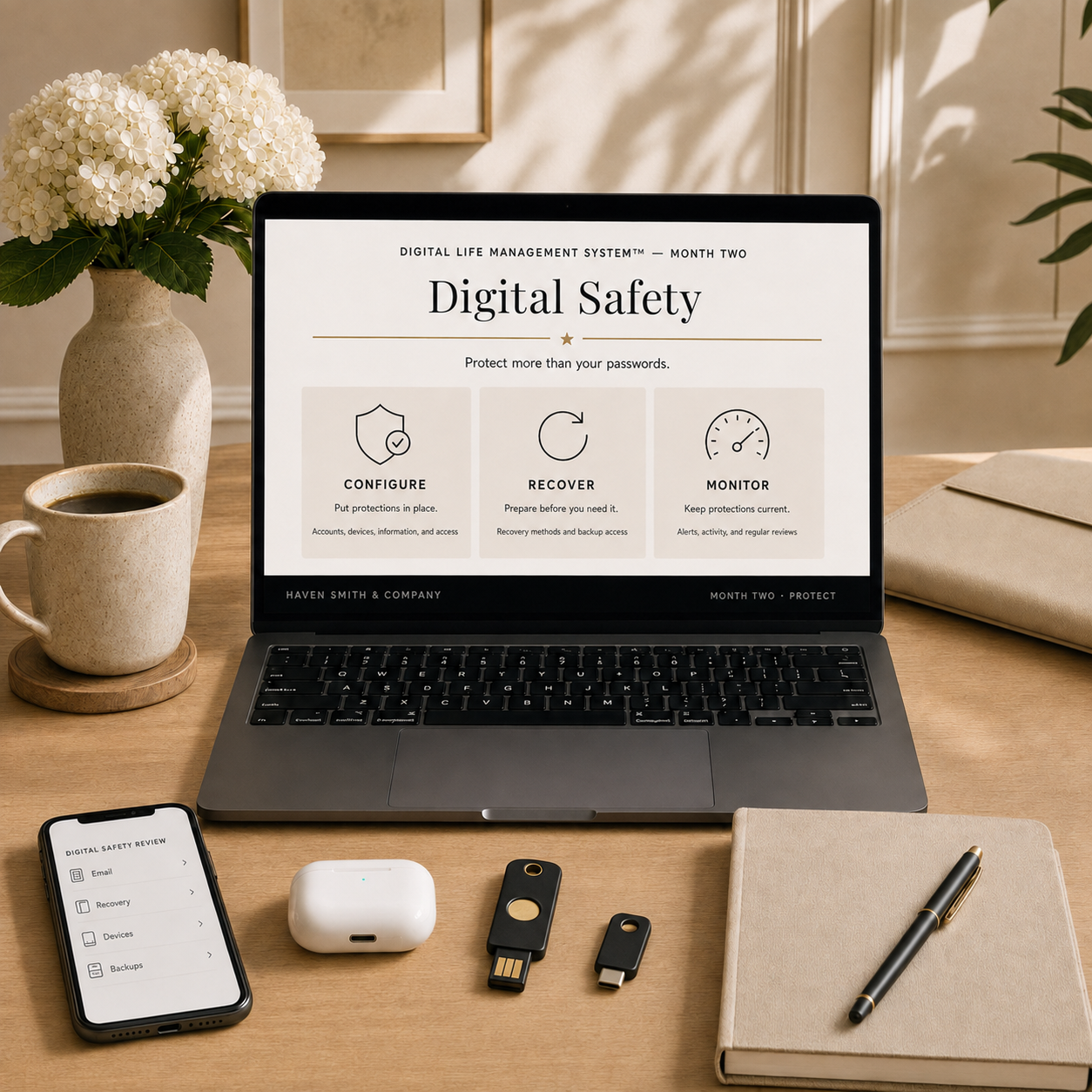
Digital Safety is the second pillar of the Digital Life Management System™ and Month Two of the initial cleanup.
The Protect method has three stages: Configure, Recover, and Monitor. Together, they provide a practical structure for strengthening digital safety without reducing the subject to a single tool or setting.
Configure: Put Protections in Place
The Configure stage helps you identify important accounts, devices, information, and access points and review the protections connected to them.
This may include improving password practices, reviewing authentication methods, strengthening your primary email account, configuring device protections, updating recovery information, and establishing backups.
The appropriate protection depends on the resource. A high-priority account may deserve different safeguards than a routine account. A business device may require different decisions than a personal tablet.
Configure is about selecting and applying protections based on what you manage.
Recover: Prepare Before You Need It
The Recover stage helps you consider what would happen if you lost access to an account, device, or important information.
This may include saving authentication backup codes, reviewing recovery contact information, preparing secondary access methods, understanding service-specific recovery requirements, and confirming that important information is backed up.
Recovery preparation is most useful while your accounts and devices remain available. Waiting until access has already been lost may limit the options you can configure.
Monitor: Keep Protections Current
The Monitor stage helps you maintain the protections you have established.
Accounts change. Devices are replaced. Phone numbers and email addresses are updated. New applications receive account access. Backups stop completing. Services change the protection and recovery options they provide.
Monitoring helps you notice those changes and keep your protections aligned with your current digital life.
[Explore the Digital Safety Course]
What You Will Learn in the Digital Safety Course
The Digital Safety course guides you through the Protect pillar of the Digital Life Management System™.
It helps you look beyond individual password changes and consider the larger relationships between accounts, devices, information, authentication, recovery, backups, and monitoring.
The course is designed to help you:
Identify the accounts and access points that matter most
Understand how important accounts connect
Evaluate password and authentication practices
Strengthen protection around your primary email
Review account and device recovery options
Prepare backup authentication methods
Examine devices as access points
Consider how important information is backed up
Establish practical monitoring habits
Create a plan for ongoing digital safety maintenance
You do not need advanced technical knowledge. The course explains the subject in practical terms so that you can understand your options and make appropriate decisions about your own digital life.
[Buy the Digital Safety Course]
What the Course Will Not Do
The Digital Safety course provides professional education. It does not provide technical cybersecurity services, forensic investigation, penetration testing, malware removal, device repair, data recovery, legal advice, or financial advice.
The course will not require you to provide Haven Smith & Company with passwords, authentication codes, or unrestricted access to your accounts.
You will learn how to review and improve your own practices. You remain responsible for making changes, storing sensitive information appropriately, and deciding which protections fit your circumstances.
If you are dealing with an active account compromise, identity theft, stolen device, financial loss, or suspected malware, contact the affected service providers and the appropriate financial institution, mobile carrier, law-enforcement agency, identity-theft specialist, cybersecurity professional, attorney, or other qualified expert.
Educational planning is useful, but it is not a substitute for immediate incident response.
Is the Digital Safety Course Right for You?
The course may be a good fit if you:
Rely on many online accounts and devices
Want to improve digital safety without becoming a technical expert
Have never reviewed your recovery information
Use one primary email address for many important services
Want to understand authentication options
Manage both personal and business accounts
Need a more organized approach to backups and monitoring
Have completed Digital Organization and are ready for Month Two
Prefer guided education you can apply independently
You do not need to fix every area at once. The course helps you identify priorities and work through protections in a more structured way.
When a Digital Life Strategy Session May Be a Better Starting Point
A Digital Life Strategy Session may be more appropriate if you have several connected concerns and cannot determine what deserves attention first.
A session may also be useful if you manage complicated family or business access, support another person’s digital responsibilities, are preparing for a major transition, or need personalized guidance before choosing a course or service.
A Strategy Session is not emergency cybersecurity or fraud response. If an active incident is occurring, contact the relevant institutions and qualified specialists immediately.
If no active incident is underway and you need help understanding your broader digital safety priorities, a Strategy Session can help you identify an appropriate starting point.
[View Digital Life Strategy Sessions]
How Digital Safety Fits Into the Three-Month Cleanup
Digital Safety is Month Two of the initial cleanup.
Month One, Digital Organization, helps you identify the accounts, files, devices, records, applications, and responsibilities you manage. That inventory makes it easier to see what requires protection.
Month Two, Digital Safety, helps you configure protections, prepare recovery paths, and establish monitoring practices.
Month Three, Digital Legacy and Estate Planning, helps you prepare important information for emergencies, incapacity, family needs, and the future.
The individual Digital Safety course is appropriate for someone who wants to focus specifically on the Protect pillar. The Digital Life Management Course Bundle is designed for someone who wants to complete the full Organize, Protect, and Prepare sequence.
[Explore the Digital Life Management Course Bundle]
Digital Safety for Small-Business Owners
Small-business owners often manage both personal and business accounts, devices, applications, records, and financial responsibilities.
A business may depend on email, cloud storage, payment services, accounting tools, social media, a website, customer platforms, vendor accounts, and mobile devices. In many cases, the owner personally manages access to nearly all of them.
This can create questions that extend beyond password strength:
Which accounts are essential to business operations?
Are business accounts connected to personal email addresses?
Which devices can access company information?
Who controls recovery methods?
What happens if the owner is unavailable?
Are former employees or contractors still authorized?
Where are backup codes and recovery information stored?
Which information is backed up?
Who reviews alerts and account activity?
The Digital Safety course provides a useful foundation for evaluating these responsibilities. A business with more complex access, compliance, or technical needs may also require personalized guidance and specialized professional assistance.
Digital Safety Requires Maintenance
Protections do not remain current automatically.
You may replace a phone, change an email address, open new accounts, adopt new applications, or stop using old services. A trusted device may remain authorized. A backup may stop completing. A recovery number may become outdated. An account that once seemed routine may grow more important.
Digital safety maintenance may include reviewing:
High-priority accounts
Recovery email addresses and phone numbers
Authorized devices
Authentication methods
Security alerts
Important backups
Financial and identity information
Applications with account access
Old accounts and devices
Stored backup codes
Some reviews may be appropriate monthly, while others can be completed quarterly or annually. The schedule should reflect the importance of the account, how frequently it changes, and the responsibilities it carries.
The goal is not permanent perfection. It is to keep your protections aligned with the digital life you actually have.
Protect More Than Your Passwords
Digital safety is not one setting you turn on or one product you purchase.
It is the ongoing work of configuring protections, preparing for recovery, monitoring important activity, and reviewing your choices as your digital life changes.
Passwords remain important. They are simply not the entire picture.
Your email, phone number, devices, authentication methods, recovery information, backups, and account connections all contribute to your digital safety. Understanding those relationships helps you focus on the protections that matter most.
The Digital Safety course gives you a practical way to begin. It guides you through the Protect method so that you can evaluate important accounts, strengthen access, prepare recovery options, and establish monitoring habits without becoming a cybersecurity expert.
Build a More Protected Digital Life
Learn how to protect the accounts, devices, information, and access points that support your everyday life.
[Buy the Digital Safety Course]
Ready to complete the full three-month cleanup?
[Explore the Digital Life Management Course Bundle]
Need help identifying what deserves attention first?
[View Digital Life Strategy Sessions]
Frequently Asked Questions
Is a strong password enough to protect an account?
No. A strong, unique password is an important protection, but authentication, recovery methods, authorized devices, email security, monitoring, and other connected access points also matter.
What is a digital safety course?
A digital safety course teaches adults how to protect important accounts, devices, information, recovery paths, and access points. It provides practical education without requiring advanced technical expertise.
Is this a cybersecurity course?
The course covers practical personal digital safety and overlaps with some cybersecurity topics. It does not provide technical cybersecurity training or professional cybersecurity services.
Do I need to share my passwords?
No. You should not provide Haven Smith & Company with your passwords, authentication codes, or unrestricted account access to complete the course.
What is multifactor authentication?
Multifactor authentication requires another form of verification in addition to a password. Available methods may include authentication applications, hardware security keys, device prompts, passkeys, or text messages.
What happens if I lose my authentication device?
Your recovery options depend on the account and the methods prepared in advance. Backup codes, trusted devices, secondary security keys, current recovery contact information, and service-specific recovery processes may help you regain access.
Does the course cover account recovery?
Yes. Recover is one of the three stages of the Protect method. The course helps you consider recovery contact information, backup authentication methods, trusted devices, and other steps that may support authorized access.
Does the course cover fraud and scams?
The course addresses fraud awareness where it connects to account protection and digital safety. Separate Haven Smith & Company courses and workshops explore fraud and scams in greater depth.
Is the course appropriate for small-business owners?
Yes. Small-business owners often manage personal and business accounts, devices, applications, recovery paths, and sensitive information. More complex business needs may also require a Digital Life Strategy Session or assistance from an appropriate specialist.
What is the difference between the Digital Safety course and the Course Bundle?
The Digital Safety course focuses on the Protect pillar. The Digital Life Management Course Bundle includes the complete three-month initial cleanup: Digital Organization, Digital Safety, and Digital Legacy and Estate Planning.