
How to Prepare Your Digital Life for Emergencies, Incapacity, and the Future
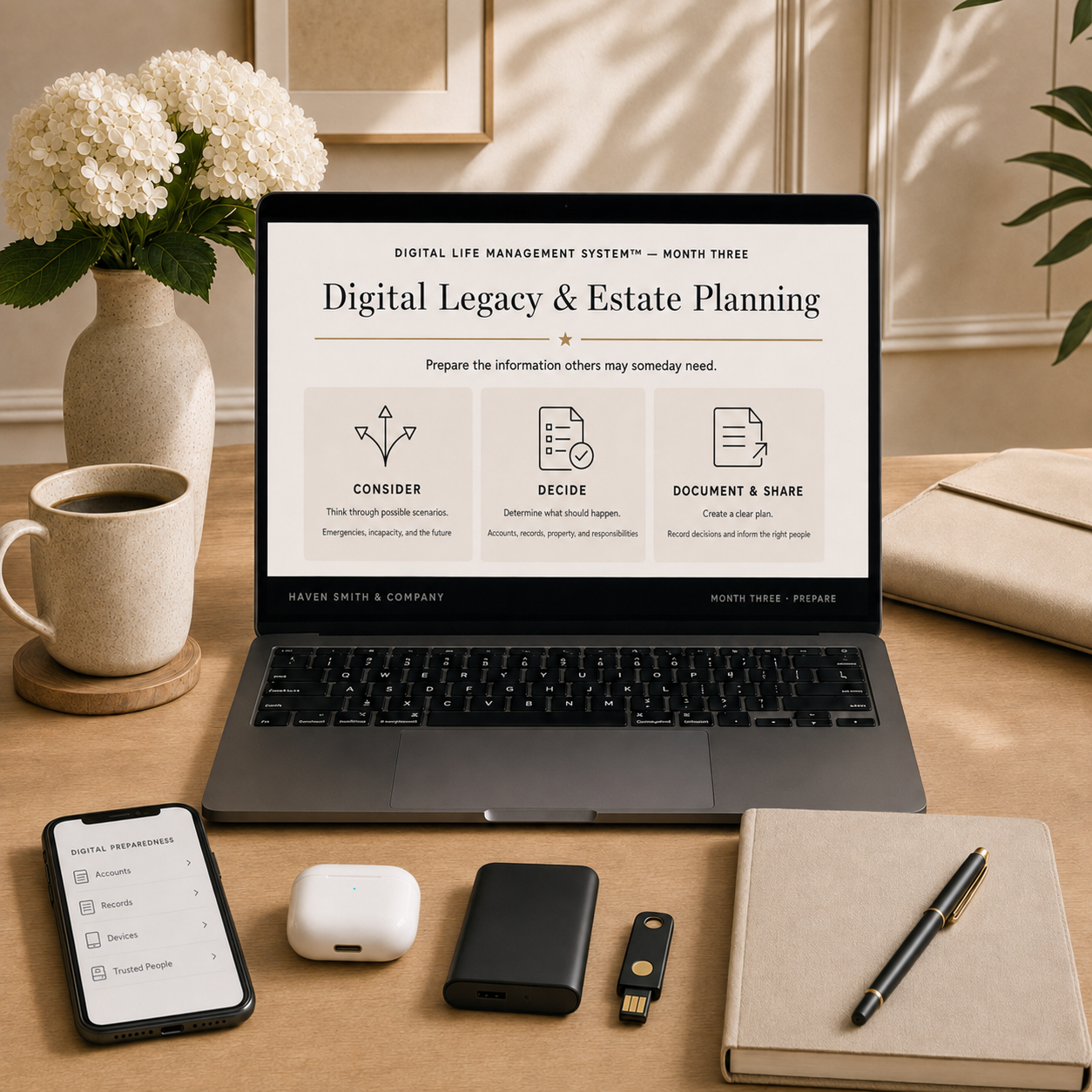
A Practical Digital Legacy and Estate Planning Course for the Accounts, Records, Information, and Digital Property You Leave Behind
If you could not manage your digital life tomorrow, would someone you trust know what needed attention?
That person may not need access to everything. They may not need your passwords, and they may not need to act immediately. But would they know which accounts, records, devices, subscriptions, and responsibilities matter? Would they know where important information is stored, which professionals to contact, or what you would want to happen?
Most people have never been asked to answer these questions.
They manage financial accounts, healthcare portals, household records, cloud storage, email, photographs, devices, subscriptions, and business services every day. Over time, the knowledge of how those pieces fit together becomes concentrated in one person’s memory.
That arrangement may work until the person who holds the knowledge becomes unavailable.
A digital life plan may become useful during an emergency, illness, incapacity, extended absence, business interruption, or future estate administration. Preparing one is not about giving someone unrestricted access to your life. It is about making sure important information and decisions can be found when they are needed.
Digital Preparedness Is Not Only About Death
Digital legacy and estate planning are often discussed as end-of-life subjects. Death is one reason to prepare, but it is not the only one.
Someone else may need information during:
A medical emergency
A temporary incapacity
A prolonged illness
An extended absence
International travel
A lost or damaged device
An account-access problem
A business interruption
A family or household transition
Permanent incapacity
Estate administration after death
The information needed during a short-term emergency may be very different from what is needed after death.
A family member assisting during a hospitalization may need to locate insurance information, care instructions, household contacts, school details, pet-care information, and a schedule of important responsibilities. They may not need access to an entire digital archive.
Someone assisting during a long-term incapacity may need to coordinate with healthcare providers, financial professionals, attorneys, employers, business partners, and service providers. That work may require legal documents and clearly organized supporting information.
An executor or trustee may eventually need to identify accounts, digital property, business responsibilities, records, subscriptions, and provider procedures.
A useful plan considers these differences rather than treating every scenario as though it requires the same information or access.
One Person Often Holds the Household Together
In many households, one person knows how nearly everything works.
That person knows which bills are paid automatically, which email address is connected to each service, where insurance documents are stored, how to access healthcare portals, which subscriptions need attention, and where the family’s tax and property records can be found.
They may also know:
Which devices contain important files
Where photographs are backed up
How school or caregiver accounts are managed
Which professional contacts should be called
Which services renew automatically
Where legal documents are stored
Which household tasks recur each month
What information belongs to the family and what belongs to a business
The problem is not simply that another person lacks the passwords.
The larger problem is that the knowledge has never been organized. Someone stepping in may not know what exists, what requires attention, what can wait, or where to begin.
A plan that exists only in one person’s memory is difficult for anyone else to use.
Digital Life Management helps turn personal knowledge into organized information. It gives the appropriate people a clearer way to understand what needs attention without automatically giving them unrestricted access to everything.
Your Digital Estate Is Larger Than Digital Assets
The term “digital assets” is often associated with cryptocurrency, online businesses, domain names, or other property with financial value.
Those resources may be part of a digital estate, but the complete picture is much larger.
Your digital estate may include:
Email accounts
Financial portals
Healthcare accounts
Government services
Cloud storage
Computers and mobile devices
Personal and business records
Social media profiles
Subscriptions
Online payment services
Loyalty programs
Websites and domain names
Digital photographs and videos
Creative work
Business platforms
Administrative responsibilities
Recovery information
Professional contacts
Some items may have financial value. Others matter because they provide access, contain important records, preserve memories, support a business, or require someone to take action.
An email account may not be valuable in the traditional sense, but it may connect to financial services, cloud storage, business platforms, and account-recovery processes. A collection of family photographs may not create income, but it may be deeply important to the people who inherit it.
A useful digital estate plan must therefore address more than property. It must also account for information, access, responsibilities, and personal meaning.
Access Is Not the Same as Authority
One of the most important distinctions in digital estate planning is the difference between access and authority.
Access is the technical ability to enter an account, open a device, or use a service. Authority is the legal or contractual right to manage information, make decisions, transfer property, or close an account.
A person may possess a password without having the authority to use it. Another person may have legal authority as an executor, trustee, conservator, or agent but still need to follow a provider’s procedures before receiving information.
The Uniform Law Commission explains that the Revised Uniform Fiduciary Access to Digital Assets Act addresses fiduciary access when an account owner dies or loses the ability to manage an account. It also distinguishes between managing certain digital property and accessing electronic communications, where user consent may be required. The specific law and its application depend on the jurisdiction and circumstances. Uniform Law Commission: Revised Uniform Fiduciary Access to Digital Assets Act
Service-provider rules matter too. Meta states that a Facebook legacy contact cannot log in to a memorialized account or read the account holder’s messages. The contact receives a limited set of management capabilities rather than the original user’s full access. Meta: About Legacy Contacts
This is why digital preparation should be coordinated with an estate-planning attorney and other appropriate professionals.
Your legal documents, digital inventory, provider settings, and storage arrangements should support one another. Sensitive credentials should be protected appropriately, and you should not assume that placing a password in a document gives another person permission to use it.
Estate-planning laws and provider policies change. Ask your attorney how digital property, fiduciary authority, account access, and sensitive credentials should be addressed in your own plan.
Begin With an Inventory
It is difficult to prepare information that has never been identified.
A digital life inventory gives you a practical overview of the accounts, records, devices, property, storage locations, and responsibilities that may require attention.
Your inventory might include:
Important online accounts
Primary and secondary email addresses
Computers, phones, tablets, and storage devices
Cloud-storage services
Categories of personal and business records
Digital property
Subscriptions and recurring payments
Professional contacts
Household responsibilities
Backup locations
Recovery methods
Provider-specific legacy settings
The inventory does not need to contain every password. Its purpose is to make your digital life visible.
It should help you answer questions such as:
What do I manage?
Where is important information stored?
Which items have financial, legal, practical, or personal importance?
Which accounts provide access to other accounts?
Which responsibilities would continue if I were unavailable?
Which professionals or trusted people may need to be contacted?
Which decisions have not yet been made?
The Digital Life Management Workbook™ is designed for this purpose. It is a living spreadsheet for tracking accounts, records, devices, and digital responsibilities. It is not a paper estate-planning document and does not replace a will, trust, power of attorney, or other legal instrument.
[Explore the Digital Life Management Workbook™]
The Prepare Method
Digital Legacy and Estate Planning is the third pillar of the Digital Life Management System™ and Month Three of the initial cleanup.
The Prepare method has three stages: Consider, Decide, and Document & Share.
These stages help you move from a vague belief that you “should get everything together” to a clearer plan for the information and responsibilities you actually manage.
Consider: Think Through Possible Scenarios
The first stage is to consider when another person might need information.
You do not need to predict every possible event. You do need to think beyond one scenario.
Consider what may be required during:
A short-term emergency
Temporary incapacity
A long-term illness
Permanent incapacity
Death
A business interruption
A lost or inaccessible device
An extended absence
A family transition
Ask what another person would need to know in each situation.
Someone assisting temporarily may need a list of urgent household responsibilities and professional contacts. Someone acting under a power of attorney may need different records and documentation. An estate representative may need information about accounts, property, subscriptions, and provider procedures.
The appropriate person may also change depending on the responsibility. The person who assists with household information may not be the person who handles business matters, legal documents, or digital property.
Considering several scenarios helps you identify those distinctions before you begin documenting instructions.
Decide: Determine What Should Happen
Once you have considered the situations that may arise, you can begin making decisions.
These decisions may include:
Which accounts should remain active
Which accounts should eventually be closed
Which subscriptions should be canceled
Which photographs and files should be preserved
Which business responsibilities must continue
Which records should be retained
Which digital property may need to be transferred
Which professionals should be contacted
Who should receive particular information
What should remain private
What another person should know during an emergency
Some decisions can be recorded in a personal inventory. Others belong in legal documents, business-continuity materials, provider settings, or instructions prepared with an attorney.
Not every decision belongs in the same place.
A password list, legal estate plan, emergency record, and digital inventory serve different purposes. Combining everything into one document may expose sensitive information or make the plan difficult to maintain.
The course helps participants identify which decisions need to be made and when assistance from another professional may be appropriate.
Document & Share: Make the Plan Usable
A decision that has never been recorded may be difficult for another person to follow.
Documentation might include:
An inventory of important accounts
A record of devices
A list of storage locations
A summary of recurring responsibilities
Professional contact information
Notes about provider-specific legacy settings
The location of legal documents
Instructions for locating protected credentials
Information about important digital property
An Emergency Information Record for immediate needs
The word “share” does not mean emailing passwords or giving several people unrestricted access to your accounts.
It means ensuring that the appropriate people know:
That a plan exists
Where permitted information is stored
Which responsibilities may require attention
Which professionals should be contacted
What documentation or authority may be required
How to locate the next appropriate instruction
The goal is to make the plan findable without making private information unnecessarily available.
[Explore the Digital Legacy and Estate Planning Course]
Provider-Specific Legacy Tools Can Support the Plan
Some account providers offer settings that allow users to make choices in advance.
Apple allows an account holder to designate one or more Legacy Contacts. Apple states that a Legacy Contact generally needs both the generated access key and proof of death to request access, and that some information—such as Keychain passwords and passkeys—is excluded. Apple Support: How to Add a Legacy Contact
Google’s Inactive Account Manager allows a user to designate people who may be notified or receive selected account data after a chosen period of inactivity. The account holder can choose which categories of data to share, and some information cannot be shared through the feature. Google Account Help: About Inactive Account Manager
Meta allows a user to choose a legacy contact for a main Facebook profile or request deletion after death. A legacy contact’s permissions are limited and do not include logging in as the deceased user or reading private messages. Meta: What Happens to Your Facebook Account After Death
These tools can be useful components of a plan, but they are not interchangeable. Each provider establishes its own settings, documentation requirements, limitations, and procedures.
A provider feature also does not replace an estate plan or complete digital inventory. It addresses one account. Your digital life may include dozens of accounts, devices, records, responsibilities, and forms of property.
Review current provider instructions directly and coordinate important decisions with your attorney.
What Information May Be Needed During an Emergency?
Not every important detail belongs in a digital estate inventory.
During an emergency, someone may need immediate access to practical information such as:
Emergency contacts
Healthcare information
Insurance details
Medication or care information
Household responsibilities
Pet-care instructions
School or caregiver information
Property information
Important bill schedules
Professional contacts
The location of legal and financial documents
Instructions for contacting an employer or business partner
Information about essential devices
The Digital Life Management Workbook™ and Emergency Information Record serve different purposes.
The Digital Life Management Workbook™ is a spreadsheet for maintaining an inventory of accounts, records, devices, and digital responsibilities over time.
The Emergency Information Record is a paper record for immediate information someone may need during an emergency.
A digital inventory may be detailed and updated as your accounts and devices change. A paper emergency record should make essential information easier to locate when a phone, computer, internet connection, or primary account is unavailable.
Both can support preparedness, but neither replaces legal documents or professional advice.
Digital Legacy Includes Personal Meaning
A digital legacy is not only administrative.
Photographs, videos, messages, writing, family history, creative work, websites, and online communities may represent an important part of your life and work.
Consider:
Which collections should be preserved
Whether files are organized well enough for another person to understand
Who should receive personal digital materials
Whether important work exists only inside an online account
Whether family photographs are backed up
What should remain private
Whether preferences for memorialization or deletion should be recorded
Whether creative or business property has ownership considerations
Digital photographs are a common example. A family may have thousands of images spread across phones, computers, old drives, social platforms, and cloud services. If no one knows where the complete collection is stored, valuable photographs may be overlooked even when several partial copies exist.
Preparation helps you distinguish between information another person should preserve, information they may need to administer, and information that should remain private.
Small-Business Owners Have Additional Responsibilities
For a small-business owner, digital preparedness may be part of business continuity and succession planning.
A business may depend on:
Domain names
Website hosting
Business email
Payment platforms
Accounting services
Customer records
Vendor accounts
Social media
Cloud storage
Business devices
Intellectual property
Software subscriptions
Contracts and licenses
Administrative calendars
Employee or contractor access
If the owner becomes unavailable, someone may need to understand which services are essential, which responsibilities are urgent, and which professionals should be contacted.
This does not necessarily mean another person should receive unrestricted access in advance. It means the owner should identify the accounts and responsibilities on which the business depends and coordinate an appropriate continuity plan.
Ownership, succession, privacy, regulated information, fiduciary responsibility, and legal authority require advice from the appropriate legal, financial, compliance, and technical professionals.
The Digital Legacy and Estate Planning course can help the owner organize the questions and supporting information. It does not create the legal or financial plan.
What You Will Learn in the Digital Legacy and Estate Planning Course
The Digital Legacy and Estate Planning course guides you through the Prepare pillar of the Digital Life Management System™.
It helps you understand the scope of your digital estate, consider when another person may need information, make important decisions, and document your plan appropriately.
The course is designed to help you:
Understand what may be included in a digital estate
Identify accounts, records, devices, information, responsibilities, and digital property
Consider emergencies, temporary incapacity, permanent incapacity, and death
Distinguish between technical access and legal authority
Identify decisions that still need to be made
Document important digital responsibilities
Coordinate supporting information with an existing estate plan
Prepare appropriate information for trusted people
Protect sensitive credentials while making the plan usable
Establish regular review habits
The course does not require you to complete every decision at once. Some questions can be answered as you work through the material. Others may need to be discussed with an attorney, financial professional, business adviser, or family member.
[Buy the Digital Legacy and Estate Planning Course]
What the Course Will Not Do
The course provides professional education about Digital Life Management. It does not create or revise a will, trust, power of attorney, healthcare directive, business-succession plan, tax plan, or other legal or financial document.
It does not provide legal, financial, tax, cybersecurity, or fiduciary advice. It does not determine whether a particular person has authority to access an account, manage property, or act on someone else’s behalf.
The course also does not require you to give Haven Smith & Company your passwords, authentication codes, private records, or unrestricted account access.
Work with an estate-planning attorney and other appropriate professionals when addressing fiduciary authority, estate documents, ownership, succession, tax consequences, regulated information, and other specialized matters.
Is the Course Right for You?
The course may be a good fit if you:
Manage most of your household’s digital responsibilities
Want to prepare information for a spouse, partner, adult child, or other trusted person
Are completing or updating an estate plan
Own a small business
Support a parent or family member
Are preparing for surgery, travel, or another period of absence
Want to organize digital property and personal records
Have completed Digital Organization and Digital Safety
Prefer guided education you can apply independently
Digital legacy planning is not only for older adults, wealthy families, or people who own cryptocurrency.
Anyone who manages important accounts, records, devices, subscriptions, photographs, or business responsibilities has information that may need to be located during an emergency or transition.
When a Digital Life Strategy Session May Be a Better Starting Point
A Digital Life Strategy Session may be useful if your situation includes complicated family or business responsibilities, several unfinished projects, or uncertainty about what deserves attention first.
A session can help you identify the accounts, records, responsibilities, and organizational questions involved. It can also help you decide whether the course, Workbook, Emergency Information Record, or another service is the most appropriate next step.
The session provides personalized organizational guidance. Legal, financial, ownership, and fiduciary decisions should be addressed with the appropriate qualified professionals.
[View Digital Life Strategy Sessions]
How the Course Fits Into the Three-Month Cleanup
Digital Legacy and Estate Planning is Month Three of the initial cleanup.
Month One, Digital Organization, helps you inventory the accounts, files, devices, records, applications, and responsibilities you manage.
Month Two, Digital Safety, helps you configure protections, prepare recovery paths, and establish monitoring practices.
Month Three, Digital Legacy and Estate Planning, helps you consider future scenarios, make decisions, and document and share appropriate information.
This sequence matters.
It is difficult to prepare accounts or information that have never been identified. It is also difficult to share a usable plan when the underlying information has not been organized or protected appropriately.
The individual Digital Legacy and Estate Planning course may be right for someone who has already completed much of the organization and digital safety work. Someone beginning at the start may prefer the complete Digital Life Management Course Bundle.
[Explore the Digital Life Management Course Bundle]
Your Plan Will Need Maintenance
A digital life plan changes because your digital life changes.
You may open and close accounts, replace devices, change service providers, move records, update legal documents, sell a business, create new property, or choose different trusted people.
Provider features and account policies also change. A legacy setting that exists today may work differently in the future.
Maintenance may include:
Reviewing your digital inventory
Updating device records
Revisiting recovery information
Reviewing trusted contacts
Updating business responsibilities
Confirming the location of legal documents
Reviewing provider-specific legacy settings
Revisiting decisions about photographs and personal files
Confirming that appropriate people know where the plan is located
Coordinating significant changes with your attorney and other professionals
You do not need to repeat the entire process constantly. A regular review, along with additional reviews after major life, family, business, or legal changes, can help keep the plan current.
Prepare the Information Others May Someday Need
Preparing your digital life is not about anticipating every possible problem.
It is about making important responsibilities easier to understand when you are not available to explain them yourself.
A complete plan identifies what you manage, considers the situations that may arise, records important decisions, protects sensitive information, and helps the appropriate people locate what they are permitted to use.
Access and authority must be addressed separately. Provider settings, legal documents, inventories, and emergency records each serve a different purpose.
The Digital Legacy and Estate Planning course gives you a practical way to begin this work. It guides you through the Prepare method so that you can consider possible scenarios, make decisions, and document and share information appropriately.
Preparing your digital life is one practical way to make future responsibilities clearer for the people you trust.
Begin Your Digital Legacy and Estate Planning
Learn how to prepare your accounts, records, devices, information, responsibilities, and digital property for emergencies, incapacity, family needs, and the future.
[Buy the Digital Legacy and Estate Planning Course]
Want to complete the full Organize, Protect, and Prepare sequence?
[Explore the Digital Life Management Course Bundle]
Need a practical spreadsheet for tracking your digital life?
[Explore the Digital Life Management Workbook™]
Need personalized help deciding where to begin?
[View Digital Life Strategy Sessions]
Frequently Asked Questions
What is digital estate planning?
Digital estate planning is the process of identifying digital accounts, records, devices, information, responsibilities, and property and determining what should happen during incapacity or after death. Legal authority, ownership, and estate documents should be addressed with an estate-planning attorney.
What is a digital legacy?
A digital legacy includes the accounts, information, photographs, creative work, communications, responsibilities, and digital property a person leaves behind. Some items may have financial value, while others carry practical, historical, or personal importance.
Is digital estate planning only for cryptocurrency?
No. Cryptocurrency may be part of a digital estate, but digital planning can also include email, devices, records, cloud storage, subscriptions, photographs, business platforms, websites, online accounts, and recurring responsibilities.
Should I give someone all my passwords?
Digital preparedness does not require giving someone unrestricted access to every account. Sensitive credentials should be protected appropriately, and possession of a password does not automatically create legal authority to use an account.
Should passwords be included in a will?
Do not assume that a will is the appropriate place for passwords or other sensitive credentials. Estate documents and public-access rules vary by jurisdiction. Ask your estate-planning attorney how credentials, inventories, and access instructions should be stored and referenced.
What is the difference between access and authority?
Access is the technical ability to enter an account or use a device. Authority is the legal or contractual right to manage information, transfer property, close an account, or act for another person. A person may have one without the other.
Do I need an attorney?
The course provides education and organization, but an estate-planning attorney should advise you about wills, trusts, powers of attorney, fiduciary authority, ownership, succession, and other legal matters.
What is the difference between the Workbook and the Emergency Information Record?
The Digital Life Management Workbook™ is a spreadsheet for tracking accounts, records, devices, and digital responsibilities over time. The Emergency Information Record is a paper record for immediate information someone may need during an emergency.
Is the course useful for small-business owners?
Yes. Small-business owners often manage important accounts, records, platforms, devices, intellectual property, subscriptions, and responsibilities that may need to be documented. Business succession, ownership, privacy, and legal authority require additional professional guidance.
How often should I update my digital life plan?
Review the plan regularly and after significant changes involving family, business, health, legal documents, accounts, devices, service providers, or trusted contacts.