
Every Important File Needs One Home—Not Five Copies
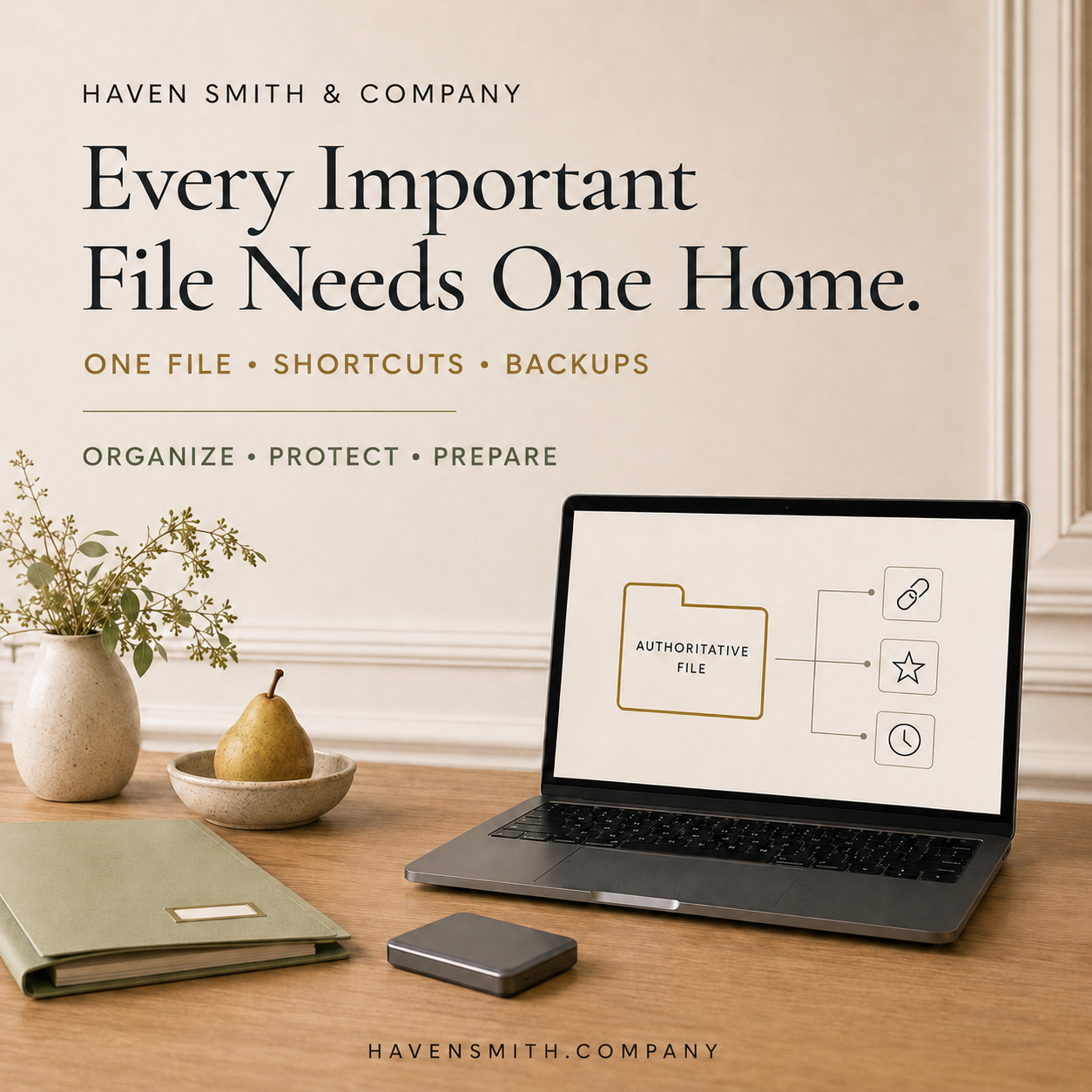
Multiple working copies create version confusion. One authoritative file, supported by intentional sharing, shortcuts and backups, creates clarity.
An important document arrives by email. You download it to your computer, place another copy in cloud storage, send one to a family member and attach it to a message.
Then someone makes a change.
Now there are several copies in several places—and no one knows which one is correct.
Keeping additional copies can feel responsible. Sometimes it is. Backups, archives and signed records all have legitimate purposes.
The problem is not the existence of more than one copy. The problem is allowing several copies to function as competing versions of the same active information.
If You Read Only One Thing
If several copies can be edited independently, you do not have convenient access. You have several competing versions of the truth.
Your Action Steps
Choose one important file that exists in several places. Then:
Find the known copies.
Identify the most complete, accurate and current version.
Choose its permanent digital home.
Rename it clearly.
Confirm who owns and controls it.
Replace unnecessary working copies with shortcuts or sharing links.
Preserve separate signed or historical versions when appropriate.
Back up the authoritative file.
Identify the Authoritative File
The authoritative file is the version your household, project or organization currently relies upon.
It should be:
Complete
Accurate
Maintained
Stored in an intentional location
Controlled by the appropriate person or organization
Accessible to the people who need it
Protected from unauthorized changes
The authoritative file does not necessarily have to be the oldest or newest copy. You may need to compare the contents, modification dates, ownership and status of several versions.
Once you identify it, rename it clearly and place it in its permanent home.
Give the File One Permanent Home
A file’s permanent home should make sense according to its purpose.
A household insurance policy might live in:
Household > Insurance > Home
A final client agreement might live in:
Clients > Client Name > Agreements
A school emergency plan might live in:
Family > Child > School > Current School Year
The important point is not the exact folder structure. It is that the file has one recognized location where it is maintained.
Other folders can provide access to that file without containing separate editable copies.
Use Shortcuts Instead of Duplicates
A shortcut points to the original file.
Google explains that Drive shortcuts reference the original file, allowing people to reach the latest information without storing independently maintained versions in multiple folders. Learn about Google Drive shortcuts.
Microsoft similarly allows users to add shortcuts to shared OneDrive folders so the same information can be reached from “My files” without creating another working copy. Learn about OneDrive shared-folder shortcuts.
This is especially useful when a document logically relates to several responsibilities.
A family emergency plan may relate to:
Household records
Healthcare
School
Travel
Caregiving
The plan does not need five editable copies. It needs one authoritative version and several intentional routes to it.
A Sharing Link Is Not a Separate File
Sending a cloud-sharing link allows another person to view or edit the original file according to the permissions you establish.
Sending an attachment creates another copy.
Attachments are sometimes necessary, but they should not automatically become the ongoing working version. If collaboration will continue, direct people back to the shared authoritative file.
Before sharing, confirm:
Whether the recipient should view or edit
Whether the link is restricted to specific people
Whether access should expire
Whether the file contains sensitive information
Whether the recipient is expected to download or preserve a separate record
A Backup Is Not a Working Copy
Backups deliberately create additional copies, but those copies have a different purpose.
A backup exists so information can be recovered after deletion, corruption, device failure, theft, ransomware or another loss. It should not be casually opened, edited and redistributed as though it were another current version.
CISA recommends the 3-2-1 backup guideline:
Three copies of important information
Two different types of storage
One copy stored off-site
Review CISA’s business-data backup guidance.
This does not contradict the “one home” principle. You can maintain one authoritative working file while protecting it through controlled backups.
Some Separate Copies Should Be Preserved
Not every duplicate is unnecessary.
You may need to preserve:
Signed or executed agreements
Submitted forms
Tax records
Legal correspondence
Historical versions
Regulatory records
Files in long-term preservation formats
Original photographs alongside edited versions
Records received from another person or institution
The difference is intentional purpose.
If a copy represents a specific transaction, status or historical point, name it accordingly. Do not leave it with the same vague name as the working version.
Ownership Matters as Much as Location
A file may appear in your folder while legally or technically belonging to someone else’s account.
That creates risk when:
An employee leaves
A contractor’s account closes
A family member changes email addresses
A volunteer stops participating
A student graduates
A subscription ends
Confirm who owns important cloud files and whether ownership can be transferred. A shortcut to a file does not guarantee continued access if the original owner deletes it or removes permission.
Start With One File
Do not begin by hunting for every duplicate across every device.
Choose one document that matters:
A family emergency plan
A financial worksheet
A client agreement
A medical summary
A school calendar
A business procedure
An estate-planning inventory
Find the copies, identify the authoritative version and give it one permanent home.
Digital organization becomes more reliable when everyone knows where the correct information lives.
Resources Outside Haven Smith & Company
Haven Smith & Company Resources
Free Digital Life Management resources:
https://www.havensmith.company/start-hereDigital Organization Course:
https://www.havensmith.company/digital-organizationDigital Life Management Course Bundle:
https://www.havensmith.company/bundleBook a free 15-minute consultation:
https://www.havensmith.company/free-consultation