
Organize With Me: Rename 25 Important Files So You Can Find Them Again
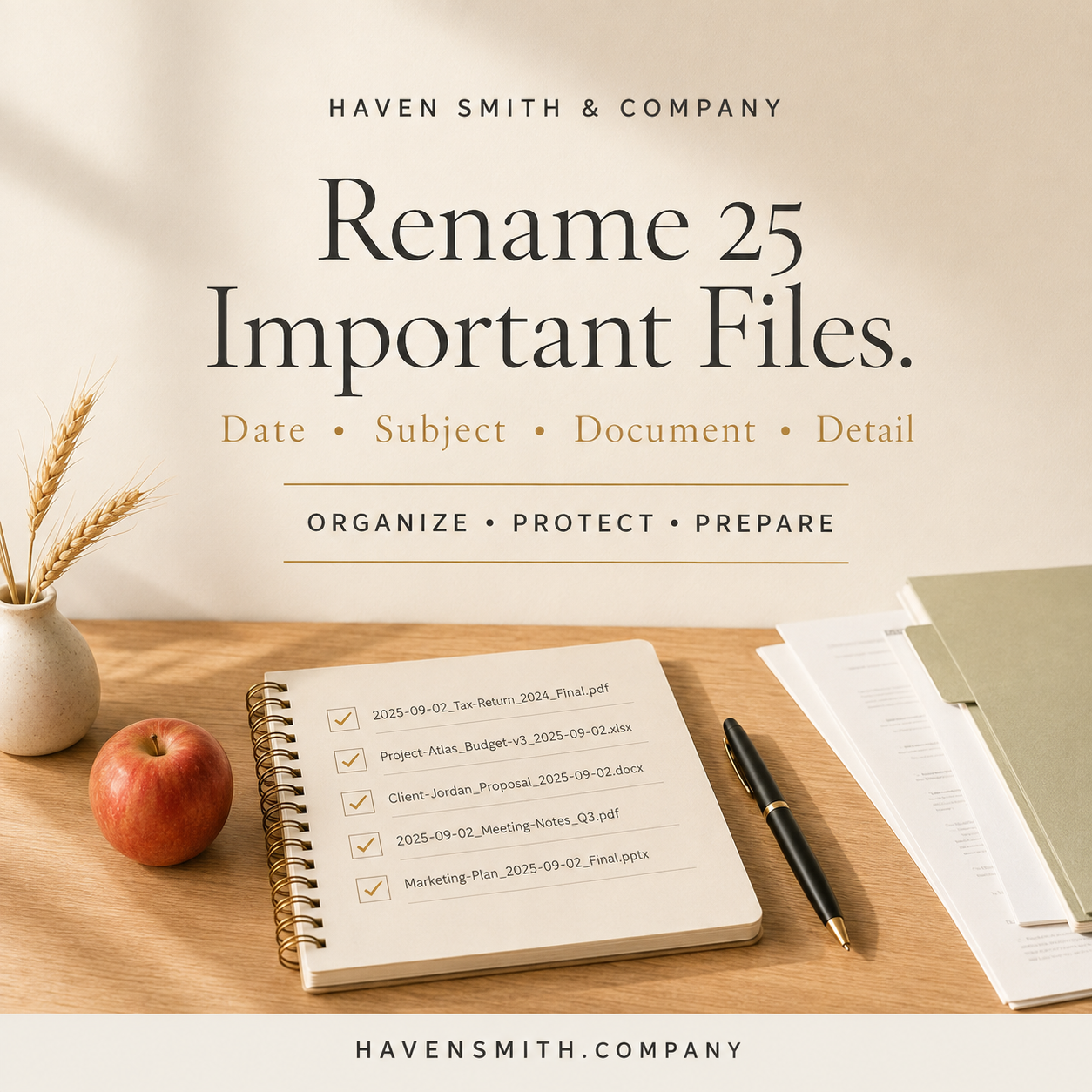
A useful file name should tell you what a document is, who or what it concerns, and when it was created—without requiring you to open it.
Most digital files begin with names we did not choose.
A scanner creates scan0047.pdf. A website provides download.pdf. An email attachment arrives as document(3).pdf. A photograph becomes IMG_6812.jpg.
Those names may be sufficient when the files first appear. Months later, they make useful information almost impossible to recognize without opening one file after another.
Today’s Organize With Me project is small and specific: rename 25 important files.
You do not need to redesign your entire filing system. You are going to make 25 files easier to identify, search for, sort and use.
If You Read Only One Thing
A file named scan0047.pdf forces you to investigate it again. A clearly named file becomes useful information.
Your Action Steps
Choose one location: Downloads, Desktop, Documents or Scans.
Set a timer for 20–30 minutes.
Select 25 files that are worth keeping.
Rename each file using one consistent formula.
Move each renamed file into its appropriate home.
Delete only the obvious temporary or superseded copies.
Stop when you reach 25.
The goal is not to finish everything. The goal is to make one meaningful area of your digital life more usable.
Use a Consistent File-Naming Formula
The National Archives recommends file names that are descriptive, consistent and meaningful. When names include components such as dates, subjects or versions, those components should remain in the same position. Review the National Archives’ file-naming guidance.
A practical personal formula is:
YYYY-MM-DD_Person-or-Account_Document-Type_Detail
Examples include:
2026-09-01_Smith-Family_Dental-Receipt.pdf
2026-08-25_Homeowners-Insurance_Renewal.pdf
2026-2027_School-Year_Emergency-Contacts.pdf
2026-09_Haven-Smith_Expense-Report.xlsx
2026-08-30_Pet-Veterinarian_Vaccination-Record.pdf
You do not need to include every possible detail. Include enough information to distinguish the file from similar files.
Google also recommends keeping file names short, simple and meaningful. Review Google Drive’s organization guidance.
Use Dates That Sort Correctly
A date written as 09-01-26 can be interpreted in several ways. It also sorts less effectively when files span multiple years.
Beginning with the year creates a predictable chronological order:
2024-09-01
2025-09-01
2026-09-01
If the exact day does not matter, use the year and month:
2026-09_Bank-Statement.pdf
If the document applies to an entire period, name the period:
2026-2027_School-Year_Calendar.pdf
Consistency matters more than choosing the perfect formula.
Name the Subject and the Document
A useful file name should answer at least two questions:
Who or what does this concern?
What kind of document is it?
Insurance.pdf is still vague.
2026_Homeowners-Insurance_Policy.pdf is much more useful.
For household records, the subject might be:
A family member
A pet
A home or property
A vehicle
A financial institution
A medical provider
A school
A business
A project
The document type might be:
Statement
Receipt
Contract
Policy
Form
Report
Invoice
Certificate
Photograph
Instructions
These terms make the file easier to identify through browsing and search.
Be Careful With “Final”
Words such as new, current, updated and final lose their meaning quickly.
A folder containing the following files does not tell you which one is authoritative:
Estate-Plan-Final.pdf
Estate-Plan-Final-2.pdf
Estate-Plan-Really-Final.pdf
Estate-Plan-Updated.pdf
Use a date, version number or status that can be understood later:
2026-09-01_Estate-Plan_Draft-v03.docx
2026-09-15_Estate-Plan_Signed.pdf
Reserve signed, approved, submitted or executed for documents that actually reached that status.
Rename Before You File
It is tempting to move a mysterious file into the correct folder and promise to identify it later.
That usually transfers the confusion instead of resolving it.
Open the document, determine what it is, rename it and then move it. Once it reaches its permanent home, its name should make sense without relying entirely on the surrounding folder.
Do Not Attempt to Rename Everything Today
A useful system is built through repeatable decisions.
If you have thousands of poorly named files, trying to correct all of them at once can turn a manageable project into an exhausting one. Begin with the files you are most likely to need:
Current insurance documents
Tax records
School forms
Medical information
Estate-planning documents
Business records
Important photographs
Active household projects
Twenty-five clearly named files are more valuable than an abandoned plan to rename 25,000.
The Goal Is Future Usability
Digital organization is not about creating perfectly attractive folders. It is about reducing the time and uncertainty involved in finding and using information.
A clear file name helps you:
Recognize information without opening it
Sort related records
Search using meaningful words
Distinguish current documents from old versions
Share the correct file
Help another authorized person understand what they found
Rename 25 files today. The next time you need one of them, you will have already done part of the work.
Haven Smith & Company Resources
Free Digital Life Management resources:
https://www.havensmith.company/start-hereDigital Organization Course:
https://www.havensmith.company/digital-organizationDigital Life Management Course Bundle:
https://www.havensmith.company/bundleBook a free 15-minute consultation:
https://www.havensmith.company/free-consultation