
A Sponsored Post Is Not a Safety Review: How to Check Social Media Ads Before You Buy
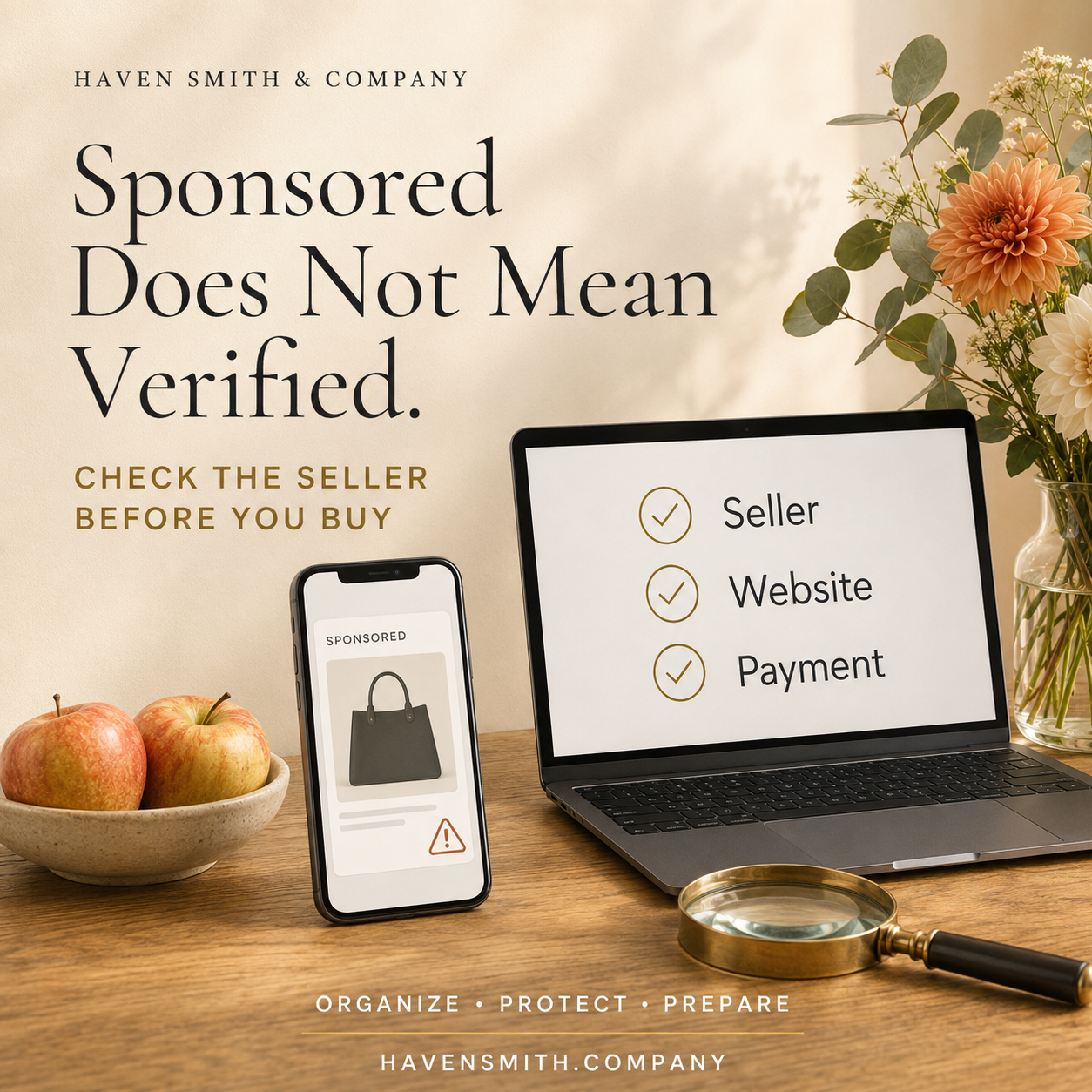
Scammers can purchase polished advertisements too. Verify the seller, destination and payment request before trusting what appears in your feed.
A social-media advertisement can look remarkably legitimate.
It may feature professional photography, a recognizable logo, enthusiastic comments and a discount that appears to expire soon. It may even promote a product you recently searched for.
The word Sponsored can create another layer of reassurance. The advertisement appears inside a familiar platform, so it is easy to assume that someone verified the company before allowing it to reach your feed.
That assumption can be expensive.
In August 2026, the Federal Trade Commission warned that social-media platforms do not always thoroughly vet the advertisements people see or the advertisers behind them. Scammers can purchase advertising space, impersonate established businesses, sell counterfeit products or direct people to fraudulent websites.
If You Read Only One Thing
“Sponsored” means someone paid to place the advertisement. It does not mean the business, product, discount or destination website was independently verified.
Your Action Steps
Before purchasing through a social-media advertisement:
Stop before using the advertisement’s link.
Search for the business independently.
Search the company name with “scam,” “complaint” and “reviews.”
Compare the promotion with the company’s official website.
Inspect the domain carefully.
Review the return policy and contact information.
Pay by credit card when possible.
Leave if the seller demands an unusual or irreversible payment method.
Why Social-Media Advertisements Feel Trustworthy
The advertisement appears inside an application you use regularly. It may be surrounded by posts from people you know, creating a false sense that the entire environment is familiar.
Targeted advertising can make the promotion feel even more relevant. The product may match your interests, browsing activity, age, location or recent searches.
That relevance does not prove the seller is legitimate. It may only demonstrate that the advertiser selected an effective audience.
Professional design does not prove legitimacy either. Logos, photographs, customer testimonials and website designs can be copied or generated quickly.
The Most Common Risks
Fraudulent social-media promotions may involve:
Counterfeit merchandise
Products that never arrive
Merchandise substantially different from the advertisement
Fake clearance or going-out-of-business sales
Brand-impersonation websites
Subscription traps
Misleading health or beauty claims
Investment schemes
Fake courses or business opportunities
Sellers collecting payment and personal information
The FTC reported that people lost more than $95 million in 2025 after ordering something through advertisements they encountered on social media. Because many scams are never reported, the actual loss may be greater. Read the FTC’s August 2026 warning.
Verify the Business Independently
Do not use the contact information provided exclusively inside the advertisement.
Instead:
Search for the business by name.
Find its independently established website.
Compare the advertised promotion with the official site.
Review the domain letter by letter.
Look for a physical address and functioning customer-service information.
Check whether the company’s established social account links to the same website.
Search for recent complaints from multiple sources.
Be cautious if the advertisement uses a recognizable brand name but sends you to a different or slightly misspelled domain.
Common substitutions may include:
Additional words or hyphens
Reversed letters
Unusual domain endings
A subdomain designed to hide the true domain
Brand names followed by “outlet,” “clearance” or “sale”
Do not assume the first search result is the official company. Scammers can also purchase search advertisements.
Treat Extreme Discounts as a Reason to Verify
A discount does not automatically indicate fraud. Legitimate companies hold sales.
However, an enormous discount combined with urgency deserves independent verification.
Be cautious of messages such as:
“Today only”
“Warehouse closing”
“Everything must go”
“Only two left”
“Your reserved price expires in five minutes”
“Luxury product at 90% off”
Urgency is designed to move you from interest to payment before you investigate.
A legitimate opportunity should survive a few minutes of verification.
Use a Safer Payment Method
Credit cards generally provide stronger dispute protections than payment methods that function like cash.
Stop if an unfamiliar seller insists that you pay through:
Gift cards
Cryptocurrency
Wire transfers
Bank transfers
Cash
A payment application sent to an individual
Any method described as necessary to “unlock” or “verify” the purchase
The FTC identifies unusual payment demands as a reliable warning sign because scammers prefer methods that are difficult to reverse. Review the FTC’s payment-method warning.
Check the Checkout Page
Before entering payment information, confirm:
The domain still belongs to the expected company.
The checkout is not redirecting you to an unrelated site.
The total price includes disclosed fees.
The return and refund terms are visible.
The seller provides a realistic delivery timeline.
You are not being enrolled in a recurring subscription without clear consent.
A padlock symbol means the connection is encrypted. It does not prove that the business itself is honest.
What If You Already Purchased?
If you believe the advertisement or seller was fraudulent:
Save screenshots of the advertisement, website, receipt and messages.
Contact the payment provider promptly.
Dispute the charge when appropriate.
Change any password you reused on the fraudulent site.
Monitor the payment card and financial account.
Report the advertisement to the social-media platform.
Report the incident at ReportFraud.ftc.gov.
If you disclosed sensitive identity information, review the FTC’s guidance at IdentityTheft.gov.
Do not continue communicating with someone who offers to recover your money for an additional fee. Recovery scams frequently target people who have already lost money.
The Rule to Remember
You do not need to avoid every advertisement or become suspicious of every unfamiliar business.
Maintain one boundary:
Treat the advertisement as an introduction—not as proof.
Verify the company independently before you provide payment or personal information.
Resources Outside Haven Smith & Company
Haven Smith & Company Resources
Free Digital Life Management resources:
https://www.havensmith.company/start-hereDigital Safety Course:
https://www.havensmith.company/digital-safetyDigital Life Management Course Bundle:
https://www.havensmith.company/bundleBook a free 15-minute consultation:
https://www.havensmith.company/free-consultation