
How to Build a Digital Life Inventory You Can Actually Maintain
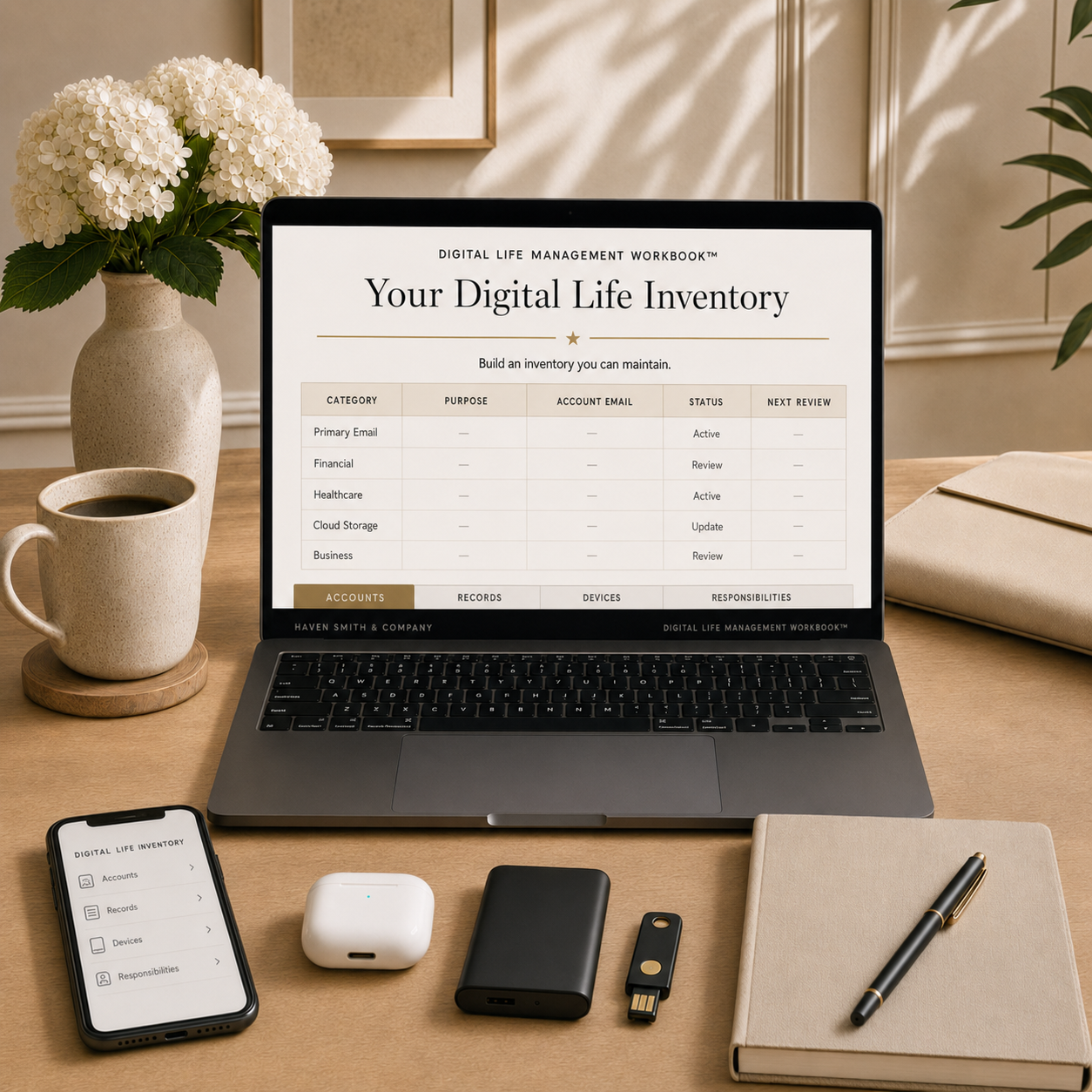
A Practical Spreadsheet for Tracking Your Accounts, Records, Devices, and Digital Responsibilities
When people decide to create a digital life inventory, they often begin by trying to record everything.
They list every account they can remember, copy information from their devices, add subscriptions, document files, and create more spreadsheet columns each time they think of another detail. Before long, the inventory becomes enormous, repetitive, and uncomfortable to store because it contains too much sensitive information.
After the initial burst of work, it is rarely updated.
The best digital life inventory is not the one that records the most information. It is the one that helps you understand what you manage and remains practical to update.
A useful inventory should help you answer four questions:
What do I manage?
Where is it located?
What requires attention?
What needs to be reviewed later?
The Digital Life Management Workbook™ is a spreadsheet designed to help you answer those questions. It gives you one structured place to track your accounts, records, devices, storage locations, and digital responsibilities as they change over time.
It is not a password list, paper planner, legal document, or one-time worksheet. It is a living operational inventory for a modern digital life.
What Is a Digital Life Inventory?
A digital life inventory is a structured record of the digital resources and responsibilities that support your personal, household, family, or business life.
It may identify:
Online accounts
Email addresses
Computers and mobile devices
Applications and subscriptions
Categories of important records
Cloud and physical storage locations
Digital property
Backup locations
Shared resources
Recurring digital responsibilities
Items that require review or action
The inventory helps you see the scope of what you manage without searching through email, browser history, old devices, financial statements, and storage folders every time you need information.
It does not replace the items it tracks.
A row identifying an insurance policy does not replace the policy document. A row identifying a cloud-storage account does not replace the information stored there. A row identifying a device does not contain everything on the device.
The inventory points you toward the information and helps you understand its role.
A Digital Life Inventory Is Not a Password List
A password list focuses on credentials. A digital life inventory focuses on visibility, location, ownership, purpose, status, and responsibility.
For example, an account inventory may record:
The name of the service
The account category
The email address associated with it
The purpose of the account
Whether it is personal, household, or business-related
The person responsible for managing it
Its relative importance
Its current status
The date it was last reviewed
An action that still needs to be completed
Where protected access information is managed
The inventory does not necessarily need the account password.
Passwords, authentication codes, private keys, recovery codes, security answers, and other sensitive credentials require appropriate protection. The Digital Life Management Workbook™ should not be treated as a replacement for a password manager or another suitable credential-storage option.
The Workbook can help you identify which accounts exist and where protected access information is managed. That distinction allows the spreadsheet to remain useful without turning it into an unrestricted collection of credentials.
Why Personal Inventories Become Difficult to Maintain
Many people begin with a blank spreadsheet and add fields as they go.
This can work for a small list, but a complete digital life includes several kinds of information. Accounts, devices, records, subscriptions, storage locations, and responsibilities do not all require the same fields.
A device may need an owner, purchase date, backup status, and disposal decision. An online account may need an associated email address, purpose, priority, and review date. A record may need a category, storage location, retention decision, and responsible person.
Trying to place all of these items on one enormous sheet creates unnecessary complexity.
Inventories also become difficult to maintain when they:
Track too much detail
Duplicate information that already exists elsewhere
Combine credentials with general account information
Attempt to list every individual file
Use overlapping categories
Include too many columns
Fail to distinguish active and archived items
Provide no place for actions or review dates
Have no clear owner
Are stored without appropriate protection
Are completed once but never reviewed
The problem is usually not that the person lacks discipline. The inventory was simply not structured for ongoing use.
What Should Be Included in a Digital Life Inventory?
The appropriate contents depend on what you manage, but most inventories should address four broad areas: accounts, records, devices, and digital responsibilities.
These categories provide enough structure to make the inventory useful without requiring every type of information to fit into the same format.
Accounts
Most adults have accumulated more online accounts than they realize.
Some accounts are used every day. Others are opened for one purchase, appointment, trip, application, or short-term need and then forgotten. Important accounts may be connected to outdated email addresses or phone numbers.
An account inventory may include:
Email
Financial services
Healthcare portals
Insurance
Government services
Utilities
Shopping
Subscriptions
Social media
Cloud storage
Travel
Education
Professional services
Business platforms
Websites and domain names
You do not need to list every website you have ever visited before the inventory becomes useful. Begin with the accounts that support your identity, finances, communications, healthcare, household, records, and business.
For each account, consider recording enough information to identify its purpose, understand its importance, locate related information, and complete future reviews.
Records
Important records may be digital, paper-based, or available through an online portal.
A digital life inventory can help you identify categories of records and document where they are stored. These may include:
Financial records
Tax documents
Insurance policies
Healthcare information
Property records
Legal documents
Education records
Household information
Employment records
Business records
Licenses
Warranties
Estate-planning documents
The inventory does not need to contain a copy of every record. It should help you understand which records exist, where current versions can be found, and what may need to be reviewed, archived, or updated.
This is especially useful when similar records are stored in several locations. You may have a paper original, a scanned copy, an email attachment, and another copy inside a service portal. The inventory can identify the primary location and reduce uncertainty about which version should be used.
Devices
Computers, phones, tablets, smartwatches, external drives, networking equipment, and other connected devices all become part of a digital life.
A device inventory may record:
The type of device
The owner or primary user
Its purpose
Whether it is personal or business-related
Its approximate age
Where it is located
Whether important information is backed up
Whether it is still active
Whether it needs review, transfer, storage, recycling, or disposal
This information becomes particularly valuable when a device is replaced.
An old phone may still contain photographs, saved messages, authentication tools, or signed-in accounts. An external drive may hold the only copy of important records. A computer stored in a closet may still be authorized to access cloud services.
The device inventory helps you see which equipment still creates an information, access, or maintenance responsibility.
Digital Responsibilities
A digital life is not made up only of things you own. It also includes responsibilities you must continue managing.
Digital responsibilities may include:
Recurring subscriptions
Account reviews
Device updates
Backups
Domain renewals
Website administration
Business-platform management
Shared household accounts
Family calendar administration
Record-retention tasks
Photograph maintenance
Software renewals
Annual digital reviews
This category distinguishes a digital life inventory from a basic asset list.
An account may be active and properly documented but still require a monthly payment. A website may be organized but still depend on an annual domain renewal. A backup may be configured but still need periodic review.
Tracking the responsibility connected to an item makes the inventory more useful for everyday management.
Organize the Inventory Around Decisions
A list becomes valuable when it supports action.
As you build the inventory, you may discover accounts, devices, records, and responsibilities that need to be:
Kept active
Updated
Moved
Archived
Documented
Protected
Shared appropriately
Reviewed later
Canceled
Closed
Removed
Including a status, next action, or review date can turn the Workbook into a practical management resource rather than a static catalog.
For example, identifying an old account is useful. Recording that the recovery email needs to be updated makes the entry actionable. Identifying a device is useful. Recording that it still needs to be backed up before disposal gives the inventory a clear purpose.
The Workbook provides visibility. The decisions you make determine what happens next.
Use Categories That Remain Useful
A maintainable inventory needs categories broad enough to accommodate change.
Overly specific categories can make the spreadsheet difficult to use. If every new account requires a new category, the structure will continue expanding. If categories overlap, the same item may appear in several places.
Depending on your personal and business responsibilities, useful categories may include:
Personal
Household
Family
Business
Financial
Healthcare
Property
Legal
Communication
Storage
Subscriptions
The best categories are the ones you can apply consistently.
Your digital life will change. You will open new accounts, receive new records, replace devices, and adopt new services. The category structure should accommodate those changes without requiring you to redesign the entire Workbook.
Record Enough Information—but Not Everything
Each field in the inventory should serve a practical purpose.
A field belongs when it helps you:
Identify an item
Locate related information
Understand its purpose
Recognize its importance
Assign responsibility
Make a decision
Complete a future review
A field may not belong when it duplicates information readily available elsewhere, creates significant maintenance, or exposes sensitive information without a clear reason.
The inventory should point you toward the information you need without becoming the only place that information can exist.
For example, the Workbook may identify where a legal document is stored without reproducing the full document. It may record which email address is connected to an account without containing the password. It may identify a backup location without attempting to catalog every file in the backup.
This approach keeps the spreadsheet useful and reduces the amount of information that must be updated repeatedly.
Decide Where the Workbook Will Live
A digital inventory should be accessible enough to serve its purpose and protected according to the information it contains.
Before entering detailed information, consider:
Which spreadsheet platform you will use
Which account will own the file
How that account is protected
Which devices can access it
Whether the file is shared
Who can view or edit it
How it will be backed up
Whether an offline copy is appropriate
How a trusted person will know that it exists
Whether legal or professional guidance affects access
There is no universal storage location that is right for everyone.
A personal inventory used only by its owner has different access requirements from a household inventory shared with a spouse. A business inventory may require role-based access and additional professional guidance. An estate-related inventory may need to coordinate with legal documents and provider requirements.
Review the protections, ownership, and sharing settings associated with the platform you choose. Avoid placing unrestricted sensitive information in a file simply because the file itself is convenient.
Build the Initial Inventory in Stages
You do not need to remember your entire digital life in one sitting.
Trying to complete everything at once can make the project feel much larger than it needs to be. A staged approach allows the inventory to become useful while you continue adding information.
Begin with the resources that matter most:
Add your primary email accounts.
Record important financial, healthcare, government, and household accounts.
Add your current computers, phones, tablets, and external storage.
Identify the major categories of records you manage.
Record your primary storage and backup locations.
Add recurring subscriptions and administrative responsibilities.
Review email, statements, devices, and application lists for items you missed.
Continue updating entries as new information is discovered.
You may also build the inventory by category. Complete one section for accounts, another for devices, and another for records.
The inventory does not need to be complete before it begins providing value. Every verified entry improves your visibility into what you manage.
[Explore the Digital Life Management Workbook™]
Use the Inventory to Organize, Protect, and Prepare
The Digital Life Management Workbook™ supports all three pillars of the Digital Life Management System™.
It does not introduce a separate method. It provides a practical place to record the information discovered while organizing, protecting, and preparing a digital life.
Organize
Use the inventory to identify what you have and where it is currently located.
As you review accounts, files, records, devices, applications, and subscriptions, the Workbook can help you document what remains active, what needs attention, and what should be moved, archived, or removed.
The inventory provides the visibility required to make informed decisions.
Protect
Use the inventory to identify high-priority accounts, important devices, recovery paths, storage locations, and information that deserves protection.
The Workbook may help you see which email addresses support important accounts, which devices require review, where backups are stored, and when account information was last checked.
It should identify what needs protection without becoming a repository for every credential.
Prepare
Use the inventory to identify accounts, records, devices, responsibilities, and digital property that may need to be understood during an emergency, incapacity, extended absence, business interruption, or future estate administration.
The Workbook can help you document what exists and where information can be found. Legal authority, account access, ownership, and estate-planning decisions should be coordinated with the appropriate professionals.
How to Maintain a Digital Life Inventory
A digital life inventory should change because your digital life changes.
Maintenance does not mean reviewing every row every week. It means updating information when something changes and completing broader reviews on a schedule appropriate to what you manage.
Update Entries When Something Changes
Update the Workbook when:
An important account is opened or closed
A connected email address changes
A device is purchased or replaced
A new storage location is adopted
A responsibility transfers to another person
A business begins using a new platform
A subscription changes
Important contact information is updated
A record category moves to a new location
Updating information when the change occurs is usually easier than reconstructing it later.
Complete Periodic Reviews
Monthly or quarterly reviews may help you identify:
Accounts that require attention
Unused subscriptions
Devices that are no longer active
Records that should be archived
Missing or incomplete entries
Backups that need review
Outdated recovery information
Actions that remain unfinished
Not every section needs the same review frequency. A high-priority account may deserve more attention than an archived device record.
Conduct a Broader Annual Review
An annual review provides an opportunity to examine the entire digital life.
This may include personal, household, family, business, emergency, and estate-planning information. It can also include reviewing who owns the Workbook, where it is stored, how it is protected, and who knows that it exists.
The appropriate schedule depends on the information you manage and how frequently it changes.
The purpose is not to preserve a perfect spreadsheet. It is to keep the inventory accurate enough to support decisions.
What Is the Digital Life Management Workbook™?
The Digital Life Management Workbook™ is a practical spreadsheet for tracking the accounts, records, devices, storage locations, and responsibilities that support your digital life.
It is designed to function as a living inventory during both the initial cleanup and ongoing maintenance.
The Workbook can help you:
See what you manage in one structured place
Track important accounts and their purpose
Identify where records are stored
Maintain a device inventory
Document storage and backup locations
Track subscriptions and recurring responsibilities
Identify areas requiring action
Record review dates
Prepare information for household, family, or business needs
Maintain your work as your digital life changes
You can use the Workbook alongside the Digital Life Management courses or as a separate organizational resource.
It is especially useful for people who understand that they need an inventory but do not want to design, format, and organize an entire spreadsheet from the beginning.
What the Workbook Will Not Do
The Workbook is a tool. It does not complete the work automatically.
It will not:
Discover every account on its own
Store or organize the actual files
Replace a password manager
Create legal authority
Replace a will, trust, power of attorney, or healthcare directive
Replace the Emergency Information Record
Decide what should be kept or removed
Update itself
Replace legal, financial, tax, technical, or cybersecurity advice
You remain responsible for entering information, reviewing it, making decisions, and maintaining the Workbook.
These boundaries are useful. They keep the Workbook focused on what it is designed to do: provide a structured place to see what you manage, what requires attention, and what should be reviewed later.
The Workbook and Digital Organization Course Serve Different Purposes
The Digital Life Management Workbook™ and Digital Organization course work well together, but they are not the same product.
The Workbook is the spreadsheet used to inventory and track information.
The Digital Organization course teaches you how to inventory what you have, make decisions about what should remain, and establish clearer places for accounts, files, devices, records, and responsibilities.
The Workbook gives you visibility. The course teaches the Organize method: Inventory, Edit, and Store & Record.
If you already understand the work and need a structured place to track it, the Workbook may be enough. If you need help deciding what to record, what to keep, what to move, and what should happen next, the course provides guided education.
[Explore the Digital Organization Course]
The Workbook and Emergency Information Record Are Not the Same
The Digital Life Management Workbook™ is a spreadsheet. The Emergency Information Record is a paper resource.
They solve different problems.
Digital Life Management Workbook™
The Workbook is:
A digital spreadsheet
A living operational inventory
A place to track accounts, records, devices, storage locations, and responsibilities
A resource used during organization, safety, preparedness, and maintenance
Updated as the digital life changes
Designed to hold detailed tracking information
Emergency Information Record
The Emergency Information Record is:
A paper record
Designed for immediate information
Focused on details someone may need quickly
Available when a device, account, power source, or internet connection is unavailable
Separate from the larger digital inventory
Neither resource replaces legal documents, secure credential storage, or advice from an appropriately qualified professional.
The Workbook helps you manage the broader digital life. The Emergency Information Record makes selected immediate information easier to locate.
Is the Workbook Right for You?
The Digital Life Management Workbook™ may be a good fit if you:
Want one place to track your digital life
Are beginning the Digital Organization course
Manage household or family information
Own a small business
Support a parent or family member
Are preparing for an emergency or estate plan
Have information spread across several accounts and devices
Prefer a spreadsheet to a paper planner
Need a structure that can be updated over time
Have tried to build an inventory before but found it difficult to maintain
You do not need advanced spreadsheet knowledge. You do need to be willing to enter, review, and update your own information.
When You May Need More Than the Workbook
The Workbook provides structure, but it does not replace education or personalized guidance.
The Digital Organization course may be the right next step if you need help deciding what to keep, move, archive, record, or remove.
The Digital Life Management Course Bundle may be appropriate if you want to complete the full Organize, Protect, and Prepare cleanup.
A Digital Life Strategy Session may be helpful if you manage complicated family or business responsibilities, are preparing for a major transition, or are unsure how the Workbook and courses fit your circumstances.
Each option provides a different level of support. The right choice depends on whether you need a tracking tool, guided education, or personalized professional guidance.
Build an Inventory You Can Maintain
Your digital life will continue to change.
You will open and close accounts, replace devices, receive new records, adopt different services, and take on new responsibilities. An inventory designed only to capture one moment will gradually become outdated.
A useful digital life inventory must be designed to change with you.
It should record enough information to help you understand what you manage without becoming another complicated document you avoid opening. It should guide you toward important accounts, records, devices, storage locations, and responsibilities without trying to contain everything.
The Digital Life Management Workbook™ gives you that structure.
It provides one practical place to see what you manage, what needs attention, and what should be reviewed later. You can begin with the most important information, add details as you discover them, and continue updating the Workbook as your digital life changes.
Start Building Your Digital Life Inventory
Track your accounts, records, devices, storage locations, and digital responsibilities in one practical spreadsheet.
[Buy the Digital Life Management Workbook™]
Need help making decisions about everything you find?
[Explore the Digital Organization Course]
Not sure where to begin with a more complicated digital life?
[View Digital Life Strategy Sessions]
Frequently Asked Questions
What is a digital life inventory?
A digital life inventory is a structured record of important accounts, records, devices, storage locations, subscriptions, property, and recurring digital responsibilities. It helps you understand what you manage and where related information can be found.
Is the Digital Life Management Workbook™ a spreadsheet?
Yes. The Workbook is a digital spreadsheet designed to be updated as accounts, devices, records, storage locations, and responsibilities change.
Is the Workbook a paper planner?
No. The Workbook is digital. The Emergency Information Record is the separate paper-based resource for immediate information someone may need during an emergency.
Should I store passwords in the Workbook?
The Workbook should not be treated as a password manager. It can identify accounts and record where protected access information is managed without storing every password, authentication code, or private key in the spreadsheet.
What should be included in a digital account inventory?
Useful information may include the service name, category, purpose, associated email address, ownership, importance, status, review date, and actions that still need to be completed.
Do I need to list every file?
No. A maintainable inventory should identify important categories and storage locations rather than cataloging every individual file.
How long does it take to build a digital life inventory?
The time required depends on how many accounts, devices, records, storage locations, and responsibilities you manage. You can build the inventory gradually, and it becomes useful before every section is complete.
How often should the Workbook be updated?
Update individual entries when something changes and review the larger inventory on a schedule appropriate to the information you manage. Some sections may need regular review, while others change infrequently.
What is the difference between the Workbook and the Digital Organization course?
The Workbook is the spreadsheet used to track information. The Digital Organization course teaches the method for inventorying, editing, storing, and recording the different parts of a digital life.
Is the Workbook a legal estate-planning document?
No. It is an organizational resource and does not replace a will, trust, power of attorney, healthcare directive, or advice from an estate-planning attorney.