
Digital Organization Isn’t About Cleaning Up Files
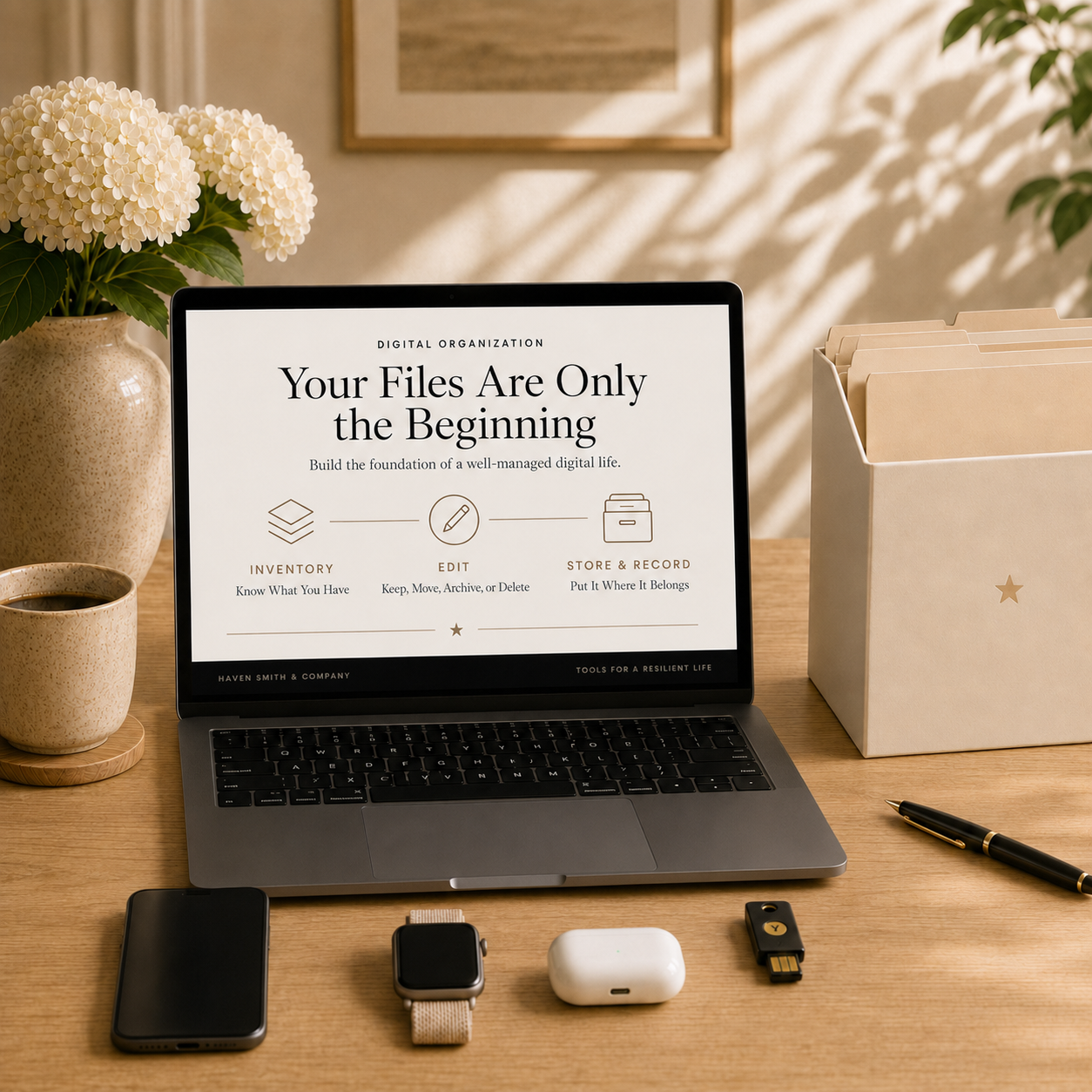
It’s About Building the Foundation of a Well-Managed Digital Life
You can spend an entire afternoon renaming files, sorting downloads, deleting email, and rearranging folders—and still have no idea where your most important information belongs.
Your desktop may look better when you finish. Your inbox count may be lower, and your folders may appear more orderly. But tax records may still be stored in three places. Personal and business documents may remain mixed together. Several cloud accounts may contain overlapping information, while old devices continue holding photographs and records you never transferred.
The files look cleaner. The digital life beneath them has not necessarily become easier to manage.
Digital Organization includes files and folders, but it does not end there. It includes the accounts, records, devices, applications, subscriptions, storage locations, and information that support your personal, family, and professional responsibilities.
A clean desktop is not the same as a well-managed digital life. Digital Organization begins with knowing what you have, deciding what deserves to remain, and creating reliable places for important information.
Why File Cleanup Feels Like Digital Organization
File cleanup provides immediate visual evidence of progress.
A folder becomes smaller. An inbox becomes quieter. Duplicate photographs disappear. The desktop no longer contains a scattered collection of downloads and screenshots. That visible improvement can be useful and satisfying. The problem is that appearance does not answer the larger questions involved in managing digital information.
Is this the right location for the document? Is another version stored somewhere else? Does the information belong to you, your household, or your business? How long should it be retained? Does someone else need to know that it exists? What will prevent the same clutter from returning?
A file can be neatly named and stored in the wrong place. An inbox can be empty while the email account remains connected to important services through outdated recovery information. A photograph library can be organized while no reliable backup exists.
Cleaning files is part of Digital Organization. It becomes valuable when it supports a larger plan rather than serving as an isolated cosmetic project.
What Digital Organization Actually Includes
Digital Organization is the practice of identifying, evaluating, and arranging the accounts, records, devices, files, applications, and information that support your life.
Depending on your responsibilities, that may include:
Email accounts
Financial accounts and records
Healthcare portals and documents
Government accounts
Personal and business devices
Cloud-storage locations
Personal files
Business and client files
Photographs and videos
Applications
Subscriptions
Household records
Important contacts
Digital property
Emergency information
Old accounts and devices
This broader definition changes the work.
What appears to be a file problem may actually be a location problem. Similar records may be stored in several places because no primary location was chosen. What appears to be an inbox problem may be an account problem because one email address is being used for banking, shopping, newsletters, family communication, and business.
What appears to be a storage problem may be a decision problem. You may have enough space but no clear answer about what should be retained, where it belongs, or who is responsible for it.
Digital Organization brings those decisions into the open.
The Difference Between Clutter and Complexity
Digital clutter is unnecessary, outdated, duplicated, or poorly placed material.
Digital complexity comes from having too many disconnected locations, accounts, rules, and responsibilities. It is what makes the digital parts of life difficult to understand and maintain.
Deleting old downloads may reduce clutter. It does not necessarily reduce complexity.
Complexity may include:
Using several email addresses without clear roles
Storing similar records in multiple cloud accounts
Mixing personal and business information
Keeping duplicate accounts because their purpose is unclear
Using one device for several unrelated responsibilities
Depending on memory to locate important records
Saving documents without recording what they are or why they matter
Accumulating subscriptions across several payment methods
Maintaining old devices because their contents are uncertain
Clutter is what you can see. Complexity is what makes the digital life difficult to manage.
Effective Digital Organization addresses both. It removes what is no longer useful while reducing the number of places, rules, and decisions you must remember.
Digital Organization Creates the Foundation
Organization is the first part of the Haven Smith & Company approach because it supports everything that follows.
You cannot decide what deserves stronger protection if you do not know what exists. You cannot prepare useful information for a trusted person if important records are scattered across unknown locations. You cannot create realistic maintenance habits around an arrangement you do not understand.
Digital Organization creates greater clarity about:
What exists
Who owns or manages it
Why it matters
Where it belongs
How long it should remain
Who may eventually need it
What should be reviewed
What can be removed
Once those questions are answered, protection becomes more focused. Preparation becomes more practical. Maintenance becomes easier to continue.
Digital Organization is not merely a cleanup project. It is the foundation of a well-managed digital life.
The Organize Method
At Haven Smith & Company, the Organize Method has three parts: Inventory, Edit, and Store and Record.
Each part answers a different question:
What do I have?
What should happen to it?
Where does it belong, and what needs to be documented?
Following the steps in order prevents the common mistake of reorganizing information before understanding what it is.
Inventory — Know What You Have
Begin by identifying the accounts, records, devices, files, applications, subscriptions, and storage locations you currently use.
You do not need to document every minor item during the first review. Start with the areas that support your identity, money, healthcare, work, household, family, and important records.
A useful starting inventory might include:
Primary and secondary email accounts
Banking and financial accounts
Healthcare portals
Personal computers and phones
Work or business devices
Primary cloud-storage accounts
Locations containing tax, legal, or healthcare records
Business platforms and client-file locations
Services with recurring charges
Devices or accounts containing important photographs
Accounts another person may eventually need to know about
The purpose of an inventory is not to create paperwork for its own sake. It is to replace vague awareness with useful information.
Ask yourself:
If this account, device, or storage location disappeared tomorrow, what would I need to know existed?
Your answer helps identify what deserves attention first.
Edit — Keep, Move, Archive, or Delete
Once you know what exists, decide what should happen to it. Use four basic decisions:
Keep
The item remains useful and is already in an appropriate location.
Move
The item remains useful but belongs somewhere else.
Archive
The item is no longer used regularly but should be retained for reference, recordkeeping, or personal value.
Delete
The item is unnecessary and can be removed responsibly.
These decisions can apply to individual files, entire categories, accounts, applications, subscriptions, photographs, or devices. Editing is where Digital Organization becomes judgment rather than housekeeping. You are deciding what deserves continued space, attention, protection, and maintenance.
This is also where unnecessary complexity begins to decrease. Closing an unused account may remove one more password, recovery path, and source of email. Consolidating records into an appropriate primary location may eliminate repeated searches across several platforms.
The goal is not to delete as much as possible. It is to retain what is useful and remove what no longer earns a place in your digital life.
Store and Record — Put It Where It Belongs
After deciding what should remain, establish reliable locations and document what should not depend on memory. This step contains two different actions.
Store
Store the actual file, record, photograph, or information in an appropriate location.
That may mean:
Moving tax records into a reliable financial-record location
Separating business documents from personal files
Consolidating photographs into a primary library
Moving important downloads out of temporary folders
Archiving records that must be retained
Selecting a dependable location for household information
Record
Record the context you or someone else may need later.
That may include:
What an account is used for
Where important records are stored
Which email address controls access
Who owns or manages the information
Whether another person may need it
When something should be reviewed
What should happen when the information is no longer needed
This distinction matters because storing information does not always preserve its meaning.
A document may be filed correctly while nobody remembers why it was retained. An account may remain active while its purpose is unclear. A folder may contain important records without another person knowing that the folder exists.
Store the information where it belongs. Record the context that makes it useful.
Start With Decisions, Not New Tools
Digital disorganization often creates the urge to find a new application.
A new tool promises cleaner folders, better notes, automatic organization, more storage, or one central place for everything. The promise is appealing because choosing software can feel easier than making hundreds of individual decisions.
But a new application can also become one more location to manage.
Before adopting another tool, decide:
What information you have
What should remain
Who is responsible for it
Where you would expect to find it
How frequently it is used
Whether another person may need it
What level of protection it requires
How it will be maintained
Then choose the simplest appropriate tool. New software can provide a place to put information. It cannot decide what belongs there.
Personal and Business Information Need Clear Boundaries
Digital Organization becomes more complicated when personal and business responsibilities overlap.
A small-business owner may use the same phone, computer, email account, and cloud storage for several areas of life. That arrangement may be convenient, particularly during the early stages of a business, but the information still needs clear boundaries.
The goal does not always have to be complete separation. It is clarity.
A business owner should be able to identify:
Which accounts belong to the business
Where business records are stored
Which devices are used for business activity
What information belongs to clients, employees, or vendors
Who currently has access
Which subscriptions are business expenses
What another person would need if the owner were unavailable
Which information is personal and should remain private
Without clear boundaries, routine events can become unnecessarily difficult. Changing a device, hiring help, preparing taxes, responding to a client request, or stepping away from work may require sorting through personal and business information at the same time.
Private guidance can be particularly useful when these responsibilities have become intertwined. A Digital Strategy Session can help identify the areas that need separation, documentation, or a clearer management plan.
Explore Private Digital Strategy Sessions
What Not to Do During Digital Cleanup
A successful cleanup is not defined by the number of files deleted or the number of hours spent working.
Avoid deleting large amounts of information without reviewing what it contains. Do not move everything into a folder called “Important,” create dozens of categories before understanding what you have, or scan and save every document simply because storage is available.
Do not place passwords in an unsecured file, move all information into a new application at once, or attempt to organize every digital area during one weekend. These approaches often replace visible clutter with a more complicated arrangement. Good Digital Organization reduces the number of decisions you must remember. Poor Digital Organization creates more of them.
A Ten-Minute Place to Begin
Choose one category:
Email accounts
Financial records
Healthcare records
Devices
Cloud storage
Personal files
Business files
Photographs
Subscriptions
Set a timer for ten minutes and answer five questions:
What do I currently have?
Where is it located?
What is the most important part?
What is creating the most confusion?
What is one decision I can make next?
Do not try to complete the category during the ten-minute review. The purpose is to establish clarity.
You may discover that the most useful next step is not deleting anything. It may be choosing a primary location, separating two categories, identifying an unfamiliar account, or documenting what another person may need to know.
That is progress. Digital Organization begins with sound decisions, not impressive cleanup totals.
Download the Digital Organization Quick Start Guide
If the ten-minute exercise revealed more than you expected, the Digital Organization Quick Start Guide will help you continue without trying to solve everything at once.
The free guide introduces:
The Digital Life Management System™
Organize, Protect, and Prepare
The Organize Method
Practical starting prompts
Simple first steps
Initial Cleanup and Maintenance
Use it to understand the larger framework, identify your starting point, and begin building a foundation you can maintain.
Download the Free Digital Organization Quick Start Guide
Ready to Complete Your Digital Organization?
The Quick Start Guide helps you understand where to begin. The Digital Organization course guides you through the work.
The course provides a structured approach to identifying what you have, evaluating what should remain, and establishing reliable places for important accounts, files, devices, and digital records.
It is designed for people who want more than a list of cleanup tips. It helps you apply the complete Organize Method to the digital responsibilities supporting your everyday life.
Explore the Digital Organization Course
Put Your Decisions on Paper
The Digital Life Management Workbook provides guided inventories, worksheets, checklists, planning pages, and reviews for Organize, Protect, and Prepare.
Use the workbook to document what you have, record important decisions, and create a foundation that can move from Initial Cleanup into long-term Maintenance.
View the Digital Life Management Workbook
Digital Organization Is the Beginning
Digital Organization is not about creating perfect folders or deleting enough files to feel caught up.
It is about understanding what you have, deciding what matters, and creating reliable places for the information that supports your life. It is also about documenting the context that makes that information useful to you and, when appropriate, to the people you trust.
When that foundation is in place, digital safety becomes more focused. Preparation becomes more practical. Maintenance becomes easier to continue.
Cleaning up files may be one part of the work. Building a well-managed digital life is the larger purpose.