
The Complete Digital Spring Cleaning Checklist
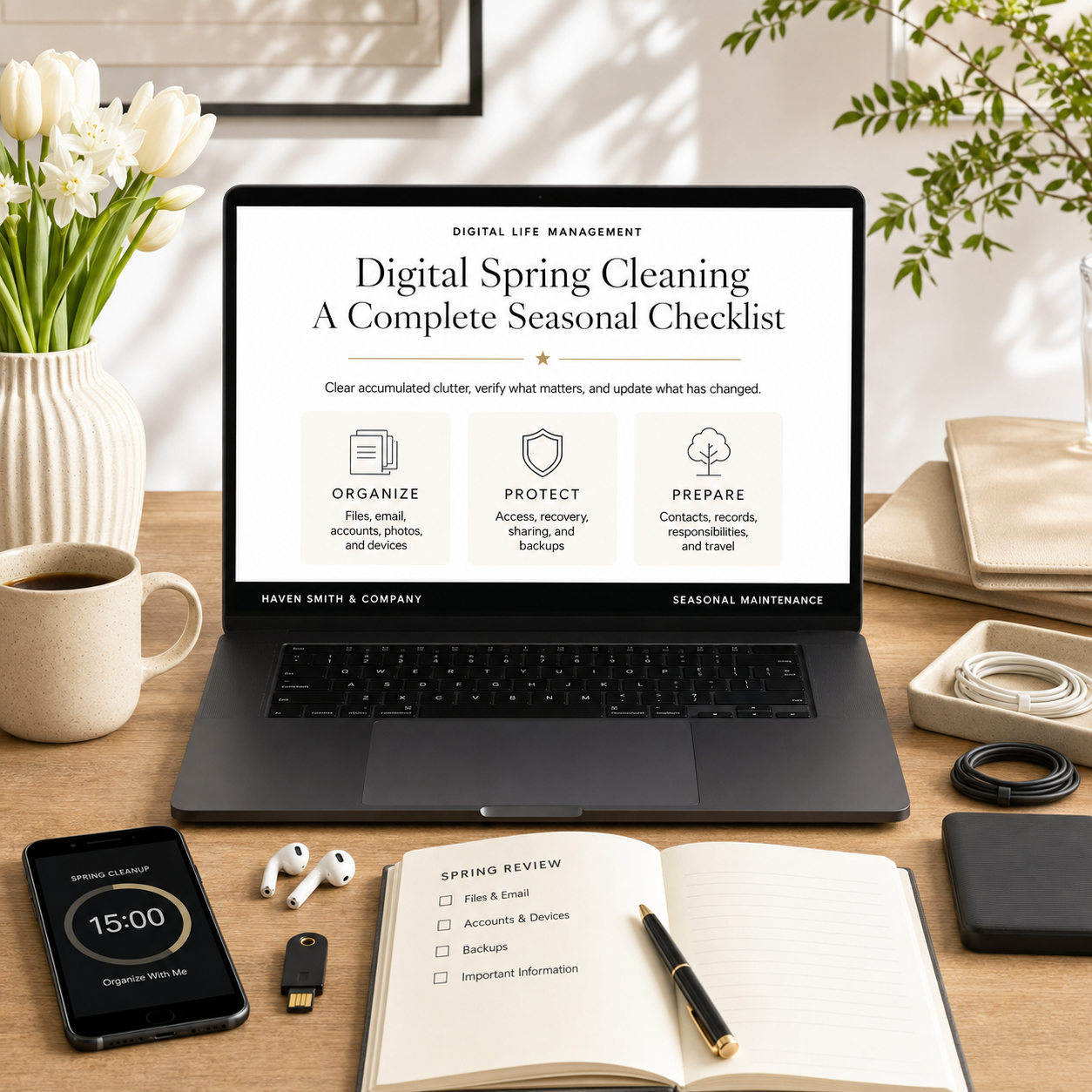
A Practical Seasonal Review for Your Accounts, Files, Devices, Records, Digital Safety, and Important Information
Spring cleaning works because it gives accumulated decisions a scheduled place on the calendar. We open closets, sort through drawers, remove what we no longer need, and prepare our homes for the months ahead.
Our digital lives accumulate clutter in much the same way.
Downloads from tax season remain on the Desktop. Holiday shopping creates new accounts and subscriptions. Photos, screenshots, documents, and email continue arriving. Applications keep information from abandoned projects. Contact records become outdated, and old devices remain connected to important accounts.
Digital spring cleaning gives you an opportunity to review what has accumulated, remove unnecessary clutter, verify that important information is protected, and update anything that changed during the first part of the year.
This is not a challenge to delete as much as possible. It is a practical seasonal review based on three priorities:
Organize what you have
Protect what matters
Prepare for what comes next
If you have already completed the Initial Cleanup phase of the Digital Life Management System™, this checklist can support your quarterly or seasonal maintenance. If you have never completed an Initial Cleanup, the review may reveal larger projects that require more time.
Either result is useful. The goal is to understand what needs attention and make steady progress.
Before You Start Deleting, Protect What You Are Cleaning
Deleting unnecessary material can make devices and storage locations easier to use. Moving too quickly, however, can result in the loss of important files, records, or photos.
Before making large changes:
Confirm that important files and photos are backed up
Verify that expected cloud synchronization is working
Identify your primary storage locations
Avoid deleting the same collection from several connected devices at once
Create a temporary review folder for uncertain items
Record where important files, backups, and archives are stored
Choose one category at a time
Synchronization and backup do not always serve the same purpose. Synchronization keeps information consistent across connected devices, which may also synchronize a deletion. A separate backup gives you another way to recover information when the working copy is lost, damaged, or changed.
Clean first when the decision is obvious. Archive temporarily when it is not.
Part One: Organize What You Have
Digital organization begins with knowing what you have, deciding what still deserves a place in your life, and giving retained information a reliable home.
The Organize method includes three steps:
Inventory
Edit
Store & Record
You do not need to complete a full inventory before beginning your spring review. Record what you discover as you work, make the decisions that are clear, and add larger projects to a list for later.
Spring-Clean Your Desktop, Documents, and Downloads
The Desktop and Downloads folder often become holding areas for unfinished work and forgotten files. They are useful temporary workspaces, but they are not good permanent storage locations.
Review these areas for:
Old downloads
Duplicate documents
Software installers
ZIP files
Temporary files
Screenshots and PDFs you no longer need
Empty folders
Files already stored elsewhere
Documents that were never properly filed
Unfinished work that no longer matters
Delete what is clearly unnecessary. Move important files into permanent folders organized by purpose, such as Financial, Healthcare, Legal, Home, Family, Personal, or Business.
Use descriptive file names that will make sense months or years from now. Names such as “Document,” “Scan,” or “New File” create more work later because they do not tell you what the file contains.
Keep your folder structure simple. If you regularly have to stop and wonder where a document belongs, you may have created too many categories.
Spring-Clean Your Email
The goal of email cleanup is not to reach inbox zero. It is to make useful decisions and keep important communication visible.
Review your inboxes and:
Delete obvious promotional clutter
Unsubscribe from messages you no longer want
Report and block spam
Save important attachments somewhere more appropriate
Complete or schedule messages that require action
Archive useful correspondence
Review folders and labels
Remove filters or rules that no longer help
Check email storage usage
Update signatures and contact information
Your inbox is where information arrives—not where every document, decision, and responsibility should remain forever.
If you have thousands of old messages, do not spend your entire spring searching for a perfect inbox. Begin with recent email, high-volume senders, large attachments, and messages that still require a decision.
Review Applications and Subscriptions
Applications can become long-term storage locations for projects, documents, conversations, and personal information. Before deleting an application or closing an account, confirm whether it contains anything you need to preserve.
Review applications on your computer, phone, and tablet. Look for:
Applications you no longer use
Abandoned projects
Duplicate applications serving the same purpose
Old shared workspaces
Unnecessary downloads and attachments
Sensitive information you no longer need
Applications connected to an old employer, business, or organization
Services that continue charging automatically
For each application, decide whether to keep, remove, replace, or close it. Export important projects or records when appropriate, and cancel subscriptions before deleting an application if the billing will otherwise continue.
Review annual renewals, free trials that became paid plans, duplicate services, and memberships you no longer use. Confirm that the applications you retain still support the work you need to do.
Review Cloud Storage and External Drives
Cloud storage and external drives often contain duplicate folders, outdated backups, old projects, temporary downloads, and several versions of the same files.
Review each location and determine its primary job:
Active files
Synchronization
Backup
Archive
Shared information
Then:
Remove duplicate folders
Delete outdated backups when they are no longer needed
Archive completed projects
Organize retained files by purpose
Confirm your primary storage locations
Verify synchronization
Test the recovery of an important file
Record backup and archive locations
Every important file should have one clear home. Additional copies may serve as backups, but they should not leave you wondering which version is current.
If you use several cloud services, decide whether each one still serves a useful purpose. Consolidation can help, but move carefully and verify files before closing an account or deleting the original collection.
Review Your Digital Photos
Photos can become one of the largest collections in your digital life. They may be spread across phones, computers, cloud libraries, social media, shared albums, and external drives.
Before reorganizing a large photo collection, verify that you have at least one reliable backup.
Begin with obvious clutter:
Screenshots
Receipts and paperwork
Blurry or accidental photos
Temporary reference images
Unnecessary bursts
Nearly identical pictures
Duplicate edits
Photos that no longer have personal or practical value
After removing unnecessary material, organize retained photos into useful categories such as Favorites, Family, Trips, Occasions, Holidays, and Important Records.
Confirm which photo library is your primary collection. Verify cloud and external backups, and record the locations of shared libraries and archives.
You do not need to create an album for every event before considering your spring review complete. Reducing obvious clutter and confirming reliable storage will make future organization easier.
Review Your Contacts
Contacts often contain duplicate records, outdated phone numbers, old mailing addresses, incomplete names, and people you no longer recognize.
Use your spring review to:
Merge duplicate contacts
Delete records you no longer need
Update names, mailing addresses, email addresses, and mobile numbers
Review emergency and healthcare contacts
Update school and caregiver information
Confirm business and professional contacts
Create useful groups or labels
Identify your primary contact list
Export or back up important contacts
A reliable contact list supports family communication, emergency planning, professional relationships, holiday mailing, and future marketing campaigns.
Review Your Devices and Accessories
Identify the computers, phones, tablets, watches, drives, printers, routers, and other connected devices that still support your life.
For active devices:
Install legitimate updates
Review available storage
Remove unused applications
Check screen locks
Review connected accounts
Confirm backup settings
Clean screens and cases according to manufacturer guidance
Match chargers and accessories to the devices you still use
For inactive devices:
Confirm that important information has been transferred or backed up
Sign out of accounts when appropriate
Remove the device from trusted-device lists
Erase personal information correctly
Prepare the device for transfer, sale, donation, recycling, or secure disposal
Do not erase or discard an old device merely because you have not used it recently. It may still contain records, photos, saved credentials, or information that was never transferred.
Review Your Accounts
Spring is a useful time to revisit accounts created during holiday shopping, tax preparation, travel planning, school registration, or New Year projects.
Review:
Financial accounts
Healthcare portals
Government services
Shopping accounts
Subscription services
Travel programs
Cloud accounts
Social media
Work platforms
Business services
Websites and domains
Close accounts you no longer need when doing so is appropriate. Before closure, use remaining balances or benefits, download necessary records, update connected services, and remove stored payment information where possible.
Update outdated names, mailing addresses, email addresses, and mobile numbers. Pay particular attention to important accounts connected to an old email address or phone number you may eventually lose.
The Digital Life Management Workbook™ can help you record important accounts, devices, storage locations, subscriptions, and remaining projects in a maintainable spreadsheet.
Part Two: Protect What Matters
Digital spring cleaning should include more than removing clutter. It is also an opportunity to verify that your most important accounts, information, devices, recovery paths, and backups remain protected.
Begin with the accounts that control access to other parts of your digital life.
Review Your Most Important Accounts
Prioritize:
Your primary or root email account
Your password manager
Your Apple, Google, or Microsoft account
Banking and investment accounts
Your mobile carrier
Primary cloud storage
Important work or business accounts
Domain and website accounts
For each account, review:
Whether the password is unique
Available multifactor authentication
Recovery email addresses
Recovery mobile numbers
Trusted devices
Active sessions
Security alerts
Connected applications
Account permissions
You do not need to change every password simply because it is spring. Prioritize passwords that are weak, reused, exposed, or connected to high-responsibility accounts.
Remove recovery information you no longer control. Check whether old devices, former work addresses, outdated mobile numbers, or previous employees still have access.
Verify Your Backups
A backup should be understandable and recoverable, not merely present.
During your review:
Identify what is currently backed up
Confirm that backups are completing
Check available storage
Review cloud and external-drive backups
Test whether you can recover an important file
Confirm that important information does not exist in only one location
Record primary and backup locations
Decide who is responsible for maintaining each backup
If you discover that an important collection exists in only one place, address that before continuing with large-scale deletion or reorganization.
Review Financial Activity and Alerts
Spring is also a good time to review financial activity and recurring payments.
Check:
Recent bank and credit-card statements
Unfamiliar transactions
Recurring charges
Annual renewals
Stored payment methods
Transaction alerts
Account login alerts
Credit reports or credit freezes when appropriate
Contact information used for alerts
Cancel services you no longer use and investigate charges you do not recognize. Update alert destinations if they are connected to an old email address or mobile number.
Review Sharing and Access
Information shared for a project, event, job, or family need may remain accessible long after the original purpose has ended.
Review:
Shared cloud folders
Shared photo albums
Family accounts
Collaborative workspaces
Calendar sharing
Document permissions
Connected applications
Former employees, contractors, or vendors
Old household or organizational access
Remove access that is no longer needed without disrupting legitimate family, household, or business responsibilities.
Part Three: Prepare for What Comes Next
Spring often precedes summer travel, school transitions, moves, changing family schedules, and new household or business projects.
Use your spring review to confirm that important information is current and that the appropriate people would know where to begin if you were unavailable.
Update Important Information
Review:
Emergency contacts
Healthcare providers
Insurance information
Household services
Schools and caregivers
Employers and business contacts
Attorneys, accountants, and advisers
Locations of legal and estate documents
Device and storage information
Important household and business responsibilities
Record where important information can be found without placing every password, financial detail, or sensitive record in an unsecured document.
Review Your Trusted-Person Plan
Ask yourself:
Who would know where to begin if I were unavailable?
Does that person know where important information is stored?
Have my trusted contacts changed?
Do my instructions reflect my current household or business responsibilities?
Are important family records accessible?
Do any decisions require professional legal or financial guidance?
Sharing information does not automatically grant legal authority, and possessing a password does not necessarily create the right to use an account. Consult qualified legal, financial, estate-planning, or cybersecurity professionals when your circumstances require their expertise.
Prepare for Summer
A spring review can make upcoming travel and summer schedule changes easier.
Review:
Travel accounts and reward programs
Mobile carrier settings
Device backups
Family calendars
Emergency contacts
Healthcare and insurance information
Pet, home, or caregiving responsibilities
Information a trusted person may need while you are away
Completing these tasks in spring gives you time to correct outdated information before a trip, school transition, move, or family change.
Choose a Spring-Cleaning Schedule You Can Maintain
You do not need to complete the entire checklist in one day.
One option is to focus on one area each week:
Week 1: Files and email
Week 2: Applications, subscriptions, and accounts
Week 3: Photos, contacts, and storage
Week 4: Safety, backups, and important information
You could also use three weekend sessions:
Weekend 1: Organize
Weekend 2: Protect
Weekend 3: Prepare
If shorter sessions work better, use 5-, 10-, 15-, or 25-minute Organize With Me sessions to clear Downloads, remove screenshots, unsubscribe from email, review applications, merge contacts, check shared folders, or update your Workbook.
Choose a schedule that supports the work. Progress matters more than completing the entire checklist by an arbitrary date.
What Not to Do During Digital Spring Cleaning
Avoid turning a seasonal review into a rushed deletion project.
Do not:
Delete large collections before verifying backups
Close an email address before updating connected accounts
Erase a device before preserving important information
Install unknown cleanup applications
Create an overly complicated folder structure
Store passwords in an unsecured spreadsheet
Assume synchronization is the same as backup
Consolidate storage without confirming that files transferred correctly
Give another person access without considering privacy and authorization
Treat every undecided item as something that must be deleted
Continue working until exhaustion simply to finish the checklist
When a decision is unclear, record it and return later. A careful decision is more valuable than an empty folder.
How to Know When Your Spring Cleaning Is Complete
Your seasonal review is complete when you have:
Removed the most obvious accumulated clutter
Moved important files into appropriate locations
Reviewed email, applications, subscriptions, photos, and contacts
Confirmed your primary storage locations
Verified important backups
Reviewed high-responsibility accounts
Updated recovery information
Removed outdated sharing and access
Updated important contacts and responsibilities
Created a list of larger projects that require more time
You do not need to finish every lower-priority project before completing your seasonal review. Record unfinished work and schedule the next useful step.
When Spring Cleaning Reveals a Larger Project
A seasonal checklist works best when you already have a useful foundation to maintain.
You may need a complete Initial Cleanup if your spring review reveals:
Years of accumulated accounts and files
No reliable digital inventory
Several unclear storage locations
Important accounts connected to outdated recovery information
Backups you cannot verify
Significant family or business responsibilities that are undocumented
No clear preparation for emergencies or future access
More unresolved decisions than a seasonal review can reasonably address
A seasonal checklist can help you maintain a reliable foundation. If that foundation has never been built, the next step is a guided Initial Cleanup.
Get Help With Your Digital Spring Cleaning
Start With the Digital Organization Course
If you need more than a checklist, the Digital Organization Course guides you through identifying what you have, making informed decisions, and creating storage and recordkeeping practices you can maintain.
The course helps you move beyond random decluttering and build a useful foundation for your accounts, files, devices, records, and digital responsibilities.
Explore the Digital Organization Course
Track What You Discover
The Digital Life Management Workbook™ is a practical spreadsheet for tracking accounts, devices, records, storage locations, subscriptions, digital property, responsibilities, and unfinished projects.
Use it during your spring review so the information you discover does not have to remain in your memory.
Explore the Digital Life Management Workbook
Complete the Full Initial Cleanup
If your spring cleaning uncovered needs involving organization, digital safety, and future preparation, the Digital Life Management Course Bundle provides a complete guided path through the Initial Cleanup.
The bundle takes you through:
Month One: Digital Organization
Month Two: Digital Safety
Month Three: Digital Legacy & Estate Planning
You can follow the recommended three-month sequence or adapt the schedule to your circumstances.
Start the Complete Initial Cleanup
Get Personalized Guidance
If you are unsure where to begin or are managing a complicated household, family, caregiving, or business situation, a Digital Life Strategy Session can help you identify your priorities and determine the appropriate next steps.
Book a Digital Life Strategy Session
Frequently Asked Questions
What is digital spring cleaning?
Digital spring cleaning is a seasonal review of your accounts, files, email, devices, applications, photos, subscriptions, storage, backups, security settings, and important information. It helps you remove accumulated clutter and update areas that changed during the first part of the year.
Where should I begin digital spring cleaning?
Begin with the areas creating the most clutter, expense, access problems, or daily frustration. Confirm that important information is backed up before deleting or moving large collections.
How long does digital spring cleaning take?
A focused seasonal review may take several short sessions or a few weekends. If you have years of accumulated work, you may need a complete Initial Cleanup rather than a seasonal review.
Should I change all my passwords during spring cleaning?
Not necessarily. Prioritize reused, weak, exposed, or compromised passwords and review the protections surrounding your most important accounts first.
Is cloud synchronization the same as backup?
Not always. Synchronization keeps files consistent across connected devices, while a backup provides another recovery copy. Review what each service protects and test whether important information can be recovered.
What should I delete from my computer?
Begin with old downloads, duplicate documents, software installers, temporary files, unnecessary screenshots, empty folders, and files already stored elsewhere. Confirm backups before making large deletions.
Can Haven Smith & Company help with digital spring cleaning?
Yes. You can begin with the free Digital Organization Quick Start Guide, enroll in the Digital Organization Course, use the Digital Life Management Workbook™, complete the full Course Bundle, or book a Digital Life Strategy Session.
Begin With One Category
Digital spring cleaning is not about making every folder perfect or deleting everything you have not opened recently. It is an opportunity to remove unnecessary clutter, verify that important information is protected, and update the records and responsibilities that support your life.
Begin with one category. Make the decisions that are clear. Record what needs more attention, and schedule the work that cannot be completed today.
A few focused sessions each spring can prevent small digital problems from becoming larger ones. If your review reveals that you need more than seasonal maintenance, the Digital Organization Course and the complete Digital Life Management Course Bundle can guide you through the work in a practical sequence.