
Disaster Relief Scams: 7 Checks Before You Donate Online
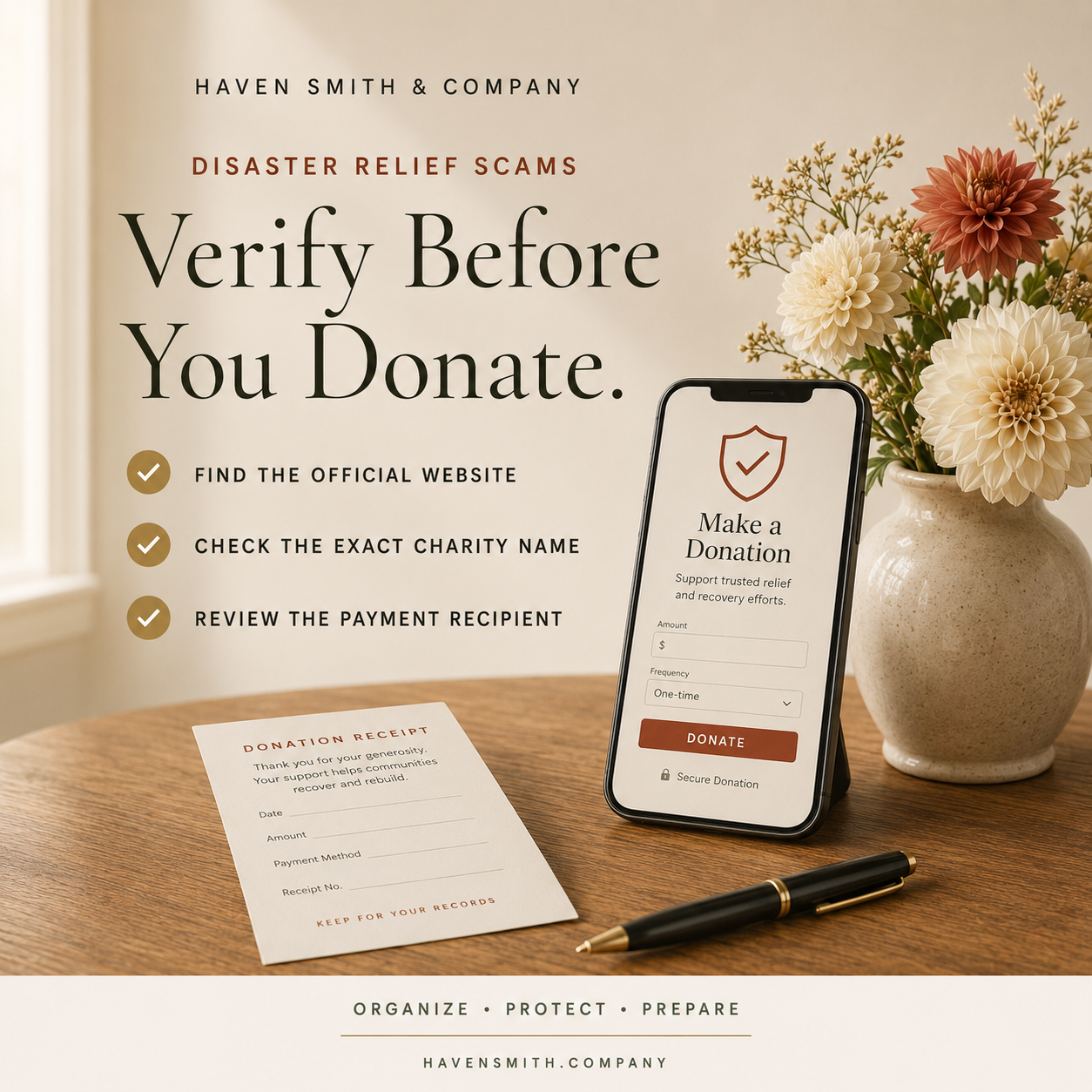
A real crisis creates legitimate need—and an opportunity for scammers to impersonate charities, redirect donations and exploit urgency.
When a disaster appears in the news, many people want to help immediately.
Scammers understand that impulse. They may create fake charities, impersonate legitimate organizations, circulate fraudulent crowdfunding campaigns, or send urgent messages directing people to payment accounts they control.
The disaster may be real. The photographs may be real. The need may be real.
None of that proves the donation request is legitimate.
On August 27, 2026, the Federal Trade Commission warned that scammers were creating fake charities that appeared to support people affected by weather emergencies, floods, earthquakes, and other disasters. Read the FTC’s current warning.
You can still give generously. Give through a process that verifies where the money is going.
If You Read Only One Thing
The existence of a real disaster does not prove that the person requesting your donation represents a real relief organization.
Your Action Steps
Before donating online:
Stop and identify exactly who is asking.
Do not donate through the message or advertisement that first reached you.
Locate the organization’s official website independently.
Verify the organization’s exact legal name.
Review who controls any crowdfunding campaign.
Avoid unusual or irreversible payment demands.
Confirm the recipient and amount before submitting payment.
Seven Checks Before You Donate
1. Do Not Donate Directly Through an Unexpected Message
A fraudulent request may arrive through:
Email
Text message
Social-media post
Direct message
Online advertisement
Telephone call
Search advertisement
QR code
Crowdfunding link
Do not assume that a message is legitimate because it contains accurate information about a disaster or uses photographs from the affected location.
Leave the message and locate the charity independently.
2. Verify the Exact Organization Name
Scammers may use a name that resembles a real charity. A minor change in spelling, punctuation, or wording can be easy to miss.
Write down the organization’s exact name. Search for the official website independently and compare:
The name
Web address
Contact information
Stated mission
Donation page
The FTC recommends researching the exact name because dishonest fundraisers may use names that sound like established charities. FTC guidance on evaluating charities.
3. Check the Web Address
A polished website is not proof of legitimacy.
Look carefully for:
Misspelled organization names
Unusual domain endings
Extra words or characters
Recently created imitation pages
Donation buttons that redirect to unrelated domains
Payment recipients that do not match the organization
If you already know and trust the charity, type its established address directly into the browser or use a bookmark you created previously.
4. Research an Unfamiliar Charity
The IRS Tax Exempt Organization Search can provide information about an organization’s tax-exempt status and filings. Search tax-exempt organizations through the IRS.
Tax-exempt status does not tell you whether the organization is effective or whether a particular message is authentic, but it can help confirm whether a claimed organization exists under the name provided.
You can also search the organization’s name with words such as:
Complaint
Scam
Review
Fraud
Do not rely solely on testimonials displayed by the organization itself.
5. Investigate Crowdfunding Campaigns
A crowdfunding platform may host legitimate campaigns, but the platform’s familiar branding does not guarantee every claim made by every organizer.
Before contributing, determine:
Who created the campaign
How that person knows the beneficiary
Who will receive the money
Whether the beneficiary has confirmed the campaign
What the money is intended to cover
What protections the platform provides
If a campaign claims to support a specific family or person, look for independent confirmation from the beneficiary or a trusted person directly connected to them.
6. Be Suspicious of Unusual Payment Instructions
The FTC warns against donation demands involving cash, gift cards, or wire transfers. Credit cards and checks generally provide a clearer payment record. FTC donation-safety guidance.
Be especially cautious if someone insists that you:
Buy gift cards
Wire money
Send cryptocurrency
Use a payment application to pay an individual
Provide banking credentials
Act before you have time to investigate
A legitimate need can be urgent without requiring an unsafe payment method.
7. Review the Final Payment Screen
Before submitting payment, confirm:
The organization name
The payment recipient
The amount
Whether the donation is one-time or recurring
Any added processing fee
The web address
The confirmation and receipt process
Some donation pages automatically select recurring contributions. Make sure the frequency reflects what you intended.
After donating, save the receipt and review the account statement.
Information a Charity Should Not Need
A charitable contribution generally should not require:
Your account password
Your banking login
A verification code sent to your phone
Remote access to your device
Your Social Security number
Payment to “unlock” the donation
Installation of unfamiliar software
Stop if a fundraiser turns the conversation into an account-security process.
If You Donated Through a Fraudulent Page
Act promptly:
Contact the bank, credit-card issuer, or payment service.
Explain that the transaction resulted from fraud.
Ask whether the payment can be stopped or disputed.
Change any password entered on the fraudulent site.
Review the account for additional charges.
Report the incident at ReportFraud.ftc.gov.
Preserve messages, receipts, URLs, and screenshots.
Do not pay a second person who promises to recover the donation for an advance fee. Recovery scams frequently target people who have already experienced fraud.
Generosity With Verification
The goal is not to become suspicious of every charitable organization.
The goal is to separate the emotional decision to help from the technical decision about where to send money.
Choose the cause with your heart. Verify the payment destination with care.
Resources Outside Haven Smith & Company
Haven Smith & Company Resources
Digital Safety Course:
https://www.havensmith.company/digital-safetyDigital Life Management Course Bundle:
https://www.havensmith.company/bundleFree Digital Life Management resources:
https://www.havensmith.company/start-hereBook a free 15-minute consultation:
https://www.havensmith.company/free-consultation