
How to Clean Up Your Phone Without Losing Important Information
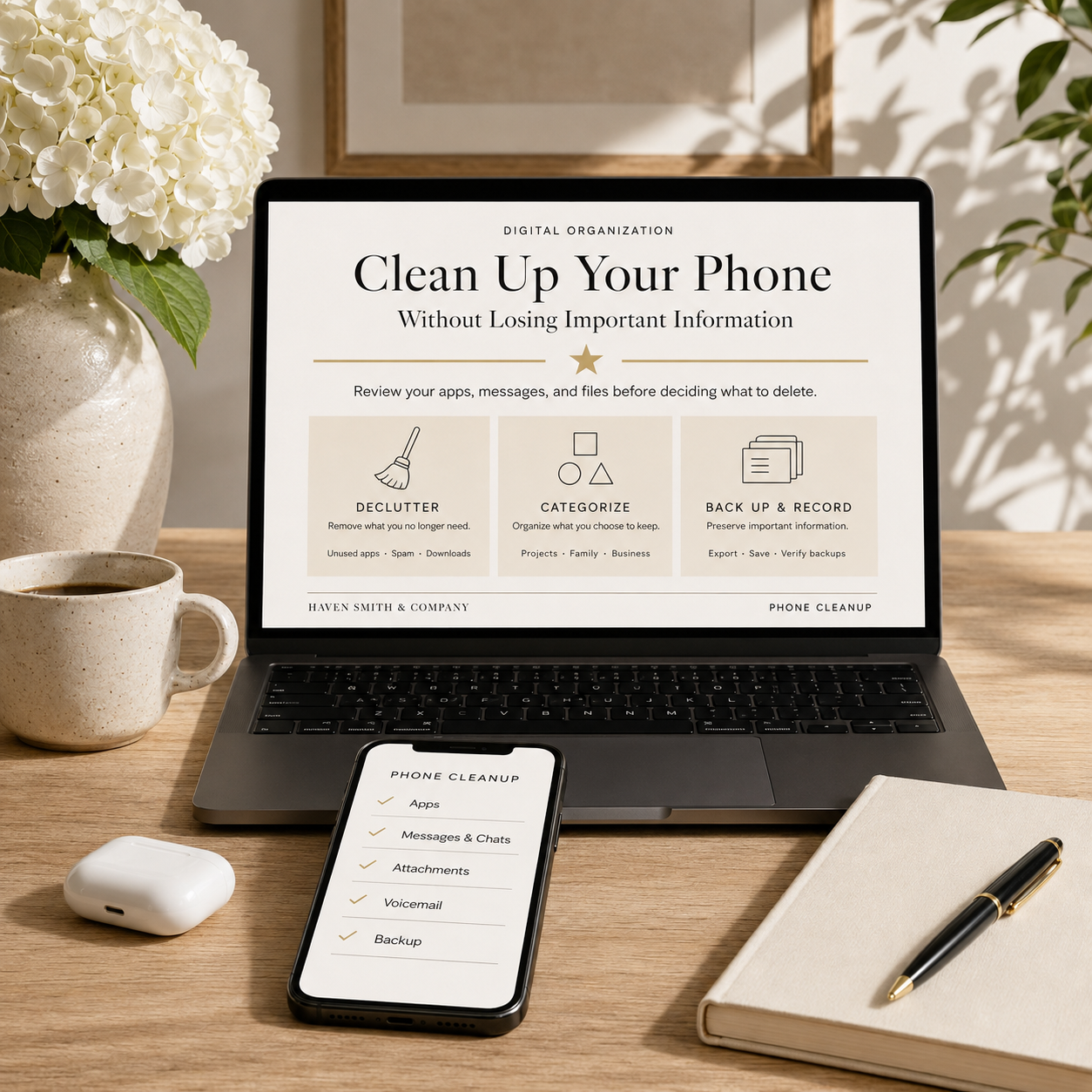
A Practical Method for Reviewing Apps, Organizing Information, Cleaning Up Messages, and Preserving What You Need
Your phone may be one of the smallest devices you own, but it holds an enormous part of your digital life.
It contains apps connected to your finances, healthcare, work, family, home, travel, photographs, accounts, and important records. It may also contain years of text messages, chat histories, voicemail, downloads, attachments, unfinished projects, and information stored nowhere else.
That is why cleaning up a phone requires more than deleting a few apps or rearranging the home screen.
An app you no longer use may still contain an important project. A message thread may hold a document you never saved anywhere else. A voicemail may contain information you meant to record. A healthcare, school, or financial app may be the only place where you can currently access an important record.
A good phone cleanup reduces unnecessary clutter without separating you from the information you still need. The goal is to understand what is stored on your phone, remove what no longer matters, organize what you choose to keep, and make sure important information is backed up and recorded.
The Haven Smith & Company method uses three practical steps:
Declutter
Categorize
Back Up & Record
In this article, we will apply those three steps to two areas that frequently become overlooked storage locations: your apps and the information inside them, followed by your texts, chats, attachments, and voicemail.
Start by inventorying what is on your phone
Before deleting anything, review what your phone currently contains.
Your inventory may include:
Installed apps
Apps stored in your library but not displayed on the main screen
Messaging and communication platforms
Notes, scanning, design, and productivity apps
Financial and healthcare apps
Cloud-storage apps
Authentication and account-recovery tools
Downloads and offline content
Shared projects and workspaces
Text messages and chat histories
Attachments and voicemail
Device and application backups
You do not need to document every minor application before beginning. Start by identifying the apps and communication platforms that hold important information, connect to important accounts, or support responsibilities you manage.
Review the phone’s storage settings to see which apps use the most space. A large app may contain downloaded videos, podcasts, maps, documents, messages, or other material that can be reviewed without deleting the app itself.
Remember that deleting an app, deleting the information stored inside it, and closing the associated account may be three separate actions. Removing an app from your phone does not always cancel a subscription or delete the account. In other cases, deleting an app or its local data could remove information that has not been synchronized elsewhere.
Before removing an app, determine whether it contains information you still need and whether that information exists anywhere else.
Part One: Clean Up Your Apps
Many apps gradually become long-term storage locations for important information. Note-taking apps accumulate reference material. Design and productivity apps hold unfinished projects. Scanning apps retain documents. Communication platforms contain attachments. Cloud services become mixtures of active work, archived material, and duplicate files.
The first part of your phone cleanup is to review both the applications and the information stored inside them.
Step One: Declutter your apps
Begin by removing applications and app-based information that no longer serve a purpose.
Delete unused apps
Review apps you no longer use, but consider their purpose before deleting them.
Some apps are used infrequently because they support occasional but important needs. An insurance, government, travel, emergency, authentication, or healthcare app may not have been opened recently but may still belong on the phone.
Before deleting an app, ask:
Does this app contain information I need?
Does it control an active subscription?
Is it connected to an important account?
Does it provide authentication or account recovery?
Is its information synchronized with another device or service?
Do I need to export anything first?
Can I reinstall it and regain access if needed?
If the application is unnecessary and contains nothing you need to preserve, remove it. If it controls a paid subscription, verify whether the subscription must be canceled separately.
Remove abandoned projects
Writing, design, video, scanning, audio, note-taking, and productivity apps may contain old drafts and unfinished projects.
Review the projects stored inside the apps you use. Delete abandoned work that no longer has personal, professional, or historical value. If a project needs to be preserved, export it before removing it from the application.
For important work, consider retaining both an editable project file and a standard version that can be opened without the original app. Depending on the material, that standard version might be a PDF, image, video, document, spreadsheet, or audio file.
Delete duplicate files
A document can appear in several places on the same phone. You may have one copy in a message thread, another in Downloads, another inside a scanning app, and another in cloud storage.
Identify the copy that should be retained and move it to the appropriate permanent location. Compare file dates, completeness, image quality, and edits before deciding that two files are duplicates.
Once you have confirmed that the correct version is safely stored, remove the unnecessary copies.
Delete sensitive information you no longer need
Apps may contain photographs of identification documents, financial records, medical information, signed forms, payment details, account information, or other private material.
If the information no longer serves a legitimate purpose, delete it. If it must be retained, move or export it to an appropriately protected location.
Do not leave sensitive information inside an everyday app merely because it was convenient to upload, scan, or share it there.
Remove old shared files and workspaces
Former employers, clients, volunteer groups, schools, family projects, and community organizations may have added you to shared folders, project spaces, or communication channels.
Review shared material that no longer relates to your current responsibilities. Remove unnecessary shared files, leave inactive workspaces when appropriate, and ask an administrator to remove old access when you cannot do it yourself.
For professional material, retain only what you are authorized to keep. Do not move employer, client, or organizational information into personal storage simply because you once had access to it.
Clear unnecessary downloads and attachments
Many apps store downloaded information directly on the phone. This may include:
Podcast episodes
Music and videos
Offline maps
Travel documents
PDF files
Presentation materials
Message attachments
Scanned documents
Audio recordings
Temporary reference files
Delete downloads that have served their purpose. If an attachment is an important record, move it into the permanent location where it belongs instead of leaving it buried inside an app.
Step Two: Categorize the information inside your apps
Deleting unused apps is helpful, but it does not address the information inside the apps you continue to use.
Review the applications that contain projects, documents, notes, recordings, designs, or reference material. Organize the information using categories that reflect its purpose.
Your categories may include:
Projects
Clients
Personal
Family
Home
Business
Reference
Archive
Not every app needs every category. Use only the ones that make sense for the material stored there.
A project-management app might include Projects, Clients, and Archive. A note-taking app might include Personal, Family, Home, Business, and Reference. A design app might separate current projects from completed work. A scanning app may serve as a temporary collection point before records are moved into their permanent financial, healthcare, legal, home, or business folders.
Use clear names and avoid creating more categories than you can maintain. If you regularly hesitate because an item could fit into several places, simplify the structure.
Most importantly, remember that apps are tools—not permanent filing cabinets. Keep the projects and information you still need, organize what remains, and make sure important work exists somewhere outside the app whenever possible.
Step Three: Back up and record your important apps
Once your apps are decluttered and organized, protect the information that matters.
Export important projects
If valuable work exists only inside one application, find out whether it can be exported.
Applications change. Features are removed. Subscriptions become more expensive. Companies close. Accounts can become inaccessible. A project stored only in a proprietary format may be difficult to recover without the original application.
Export important projects in a commonly used format when possible. Confirm that the exported files open correctly before treating them as reliable copies.
Verify cloud synchronization
Do not assume that an app is synchronized simply because it displays a cloud symbol or appears on more than one device.
Confirm:
Which account controls synchronization
Whether synchronization has completed
Which devices can access the information
Whether deletions are copied across devices
Whether previous versions are retained
Whether the information can be downloaded or exported
Synchronization helps keep information consistent across devices, but it may not provide an independent backup. If deleting something from one device also deletes it everywhere else, you may need a separate copy of your most important work.
Download important records when appropriate
Healthcare portals, school apps, financial platforms, travel services, and other applications may provide access to information you need to retain.
Download important records when appropriate and move them into permanent record storage. A record should not remain available only through an application or account that could change its access rules, retention period, or features.
Record the apps that matter
Your Digital Life Management Workbook™ should identify the primary apps you use for important parts of your life.
These may include apps for:
Financial information
Healthcare
School and family communication
Business and client work
File storage
Authentication
Travel
Home management
Important projects
Record the app, its purpose, the associated account, and the location of exported or backed-up information. Keep passwords and recovery codes in an appropriately protected password manager rather than entering them in an ordinary inventory.
Part Two: Clean Up Texts, Chats, and Voicemail
Text messages, chat apps, and voicemail are designed for communication, but they often become long-term storage for information that belongs somewhere else.
A message history may contain photographs, documents, addresses, healthcare instructions, financial information, school notices, family decisions, confirmation numbers, and business records. People often leave this material inside old conversations because they assume they will be able to search for it later.
That becomes less reliable as messages accumulate, devices change, accounts are closed, attachments stop loading, or platforms apply their own retention rules.
Messages are conversations—not filing cabinets. Save important documents, photographs, and information where they belong instead of depending on old threads to find them later.
Step One: Declutter your communications
Begin by removing messages and voicemail that no longer have practical, personal, or recordkeeping value.
Delete spam texts and scam messages
Report suspicious messages through the appropriate platform or carrier when possible, then delete them. Do not click unfamiliar links, open unexpected attachments, call numbers provided in suspicious messages, or reply to unknown senders.
Block repeat senders when helpful, although criminals may use spoofed or frequently changing numbers.
Delete expired verification codes
Routine sign-in messages and one-time verification codes generally have no value after they have been used.
Delete expired codes and review whether your device offers an automatic cleanup setting. Understand what the setting removes before enabling it, particularly if your messages contain other automated notices you want to retain temporarily.
Remove temporary conversations
Delivery coordination, appointment scheduling, travel arrangements, marketplace exchanges, event details, and one-time introductions often lose their value once the activity is complete.
Delete conversations that no longer contain useful information. If the thread contains a record, photograph, address, or other item you need, save that item first.
Review old attachments
Message attachments may use considerable storage and can be difficult to locate later.
Review documents, audio files, photographs, videos, and other attachments. Save important items to their appropriate permanent locations. Delete material that is duplicated, outdated, or no longer needed.
Before removing an attachment, confirm that the saved copy opens correctly and contains the complete information.
Remove duplicate photos and videos
A photograph sent through several individual and group conversations may already exist in your primary photo library.
Confirm that you have retained the original or best-quality version before deleting message attachments. Messaging apps may compress images, reduce video quality, or remove metadata, so the copy in the conversation may not be the version you want to preserve.
Review voicemail
Delete spam, accidental calls, routine reminders, and voicemail that no longer requires action.
If a voicemail contains important personal, healthcare, financial, business, or family information, determine whether it should be saved, transcribed, or documented somewhere more appropriate.
Do not assume voicemail will remain available indefinitely. Changing carriers, devices, accounts, or service plans may affect access to older messages.
Remove empty or inactive chats
Group conversations and chat platforms can accumulate empty channels, outdated groups, and inactive threads.
Leave or archive groups that no longer serve a purpose. Before leaving, save any information or attachments you are authorized to retain.
Step Two: Categorize communication by purpose
Organize retained communication according to the role it plays in your life.
Useful categories include:
Family
Friends
Healthcare
Financial
Business
Home
Schools
Important Records
This does not mean that every messaging app needs eight folders. Many platforms offer limited organizational features.
Depending on the app, you may be able to use:
Pinned conversations
Favorites
Folders or labels
Named groups
Archived threads
Muted low-priority groups
Clear contact names
Searchable conversation titles
These categories primarily help you recognize what kind of information a conversation contains and where anything important should ultimately be stored.
A healthcare instruction may need to be documented with healthcare information. A financial document should move to financial records. A school form belongs with school information. A home-repair receipt may belong with home records. A business decision may need to be recorded in a client or project location.
The conversation can remain in the messaging app while it is useful, but the important information should not depend entirely on that thread.
Step Three: Back up and record important communications
After reviewing your messages, confirm that necessary communication can be recovered or accessed when needed.
Verify message backups
Determine whether your text messages are included in the phone’s device or cloud backup. Review the backup settings for any additional communication apps you use.
Different platforms handle message histories differently. Some synchronize automatically. Some require a separate backup setting. Some prioritize temporary, disappearing, or device-specific communication.
Confirm which account controls the backup and whether you could restore the information after replacing or losing the phone.
Save important attachments
Move important documents, photographs, recordings, and other attachments to their appropriate permanent locations.
Give files clear names when necessary. Confirm that the saved versions open correctly, and include them in the appropriate backup plan.
Export conversations when necessary
Most conversations do not require permanent preservation. Some may contain important family history, healthcare instructions, business decisions, transaction information, or documentation related to a significant event.
When a conversation needs to be preserved, use the platform’s available download or export features. A complete export may retain more information than a series of screenshots.
How a conversation should be preserved or used in a formal legal, financial, employment, or regulatory matter depends on the circumstances. Seek qualified professional advice when those requirements apply.
Record important communication apps
Your Digital Life Management Workbook™ should identify the communication platforms used for:
Family
Schools
Healthcare
Business teams
Clients
Community groups
Financial notifications
Emergency communication
Record each app, its purpose, the associated account, and any relevant backup or export location.
This documentation makes it easier to understand how important communication moves through your digital life and helps the appropriate people know where to look if you cannot manage it yourself.
Review phone settings after the cleanup
Once you have reviewed the information inside your apps and communications, examine the settings that affect how new information accumulates.
Review:
Available device storage
App permissions
Automatic downloads
Message-retention settings
Notification settings
Background activity
Cloud synchronization
Device backup status
Apps with access to photos, contacts, location, microphone, or camera
Whether important apps are receiving updates
Do not disable permissions simply because an app has them. A permission may support a feature you actively use. The goal is to understand which apps have access and remove permissions that are unnecessary for how you use them.
Notification settings also deserve attention. Keep alerts that support security, communication, appointments, and important responsibilities. Reduce promotional and low-value notifications that repeatedly interrupt you without requiring action.
Organize the home screen last
A tidy home screen can make a phone easier to use, but moving icons should be one of the final steps—not the entire cleanup.
After reviewing the information behind the apps, you can:
Keep frequently used apps on the first screen
Group related apps when folders are helpful
Remove unnecessary widgets
Move infrequently used apps away from the primary screen
Keep security and communication tools easy to find
Reduce visual distractions
Make important functions accessible without excessive searching
A phone can look organized while still containing years of unreviewed information. The deeper cleanup should come first.
Create a practical maintenance schedule
You do not need to repeat the entire phone cleanup every month. Small, regular reviews can keep clutter from rebuilding.
Weekly
Delete expired verification codes, spam, temporary screenshots, obvious message clutter, and downloads that have served their purpose.
Monthly
Review unused apps, voicemail, large attachments, abandoned projects, offline content, and available storage.
Quarterly
Verify the phone backup, review app permissions, export important records, leave inactive workspaces, and confirm that important apps are still connected to the correct accounts.
Annually
Review your primary apps, communication platforms, subscriptions, cloud accounts, backup settings, and the information recorded in your Digital Life Management Workbook™.
What a well-managed phone should give you
The success of a phone cleanup is not measured by the number of apps you delete or how few icons remain on the home screen.
A well-managed phone should help you:
Know which apps support important responsibilities
Understand where important information is stored
Remove unused apps without losing valuable work
Keep sensitive information in appropriate locations
Find important conversations and records
Save necessary attachments outside message threads
Verify that your phone and app information are backed up
Reduce unnecessary downloads, messages, and notifications
Record the apps and accounts your digital life depends on
Maintain the phone without repeatedly starting over
The goal is not an empty phone. It is a phone that is easier to use, understand, protect, and maintain.
Build phone cleanup into your digital organization
Your phone connects nearly every part of your digital life. It provides access to accounts, communication, records, photographs, cloud storage, authentication tools, financial services, healthcare, family responsibilities, and business information.
That is why phone cleanup belongs within the Organize pillar of the Digital Life Management System™.
The Digital Organization Course provides step-by-step guidance for inventorying and editing the accounts, files, devices, apps, messages, records, and storage locations that support your everyday life. You will learn how to remove unnecessary clutter, organize what you keep, back up important information, and record the details needed for long-term maintenance.
If you are ready to clean up more than your home screen, begin with the Digital Organization Course.
If your phone contains information spread across many apps, accounts, family responsibilities, or business tools, a Digital Life Strategy Session can help you determine what belongs on the phone, what should be moved, and what needs stronger backup and documentation.
You can also download the free Digital Organization Quick Start Guide to begin inventorying your digital life and identify the areas that need attention first.
Your phone should help you manage your life. It should not be the only place where important information lives—or a collection of apps and conversations you are afraid to touch because you do not know what might disappear.
Take the Next Step Toward a Well-Managed Digital Life
Cleaning up your phone is a valuable place to begin, but your phone does not stand alone. Its apps connect to your accounts, files, photographs, records, cloud storage, security tools, family responsibilities, and business information.
Haven Smith & Company offers several ways to help you continue, depending on the level of support you need.
Learn the Complete Digital Organization Method
The Digital Organization Course walks you through the first month of the Digital Life Management System™.
You will learn how to inventory and edit your accounts, files, devices, apps, messages, photographs, digital records, and storage locations. The course takes you beyond surface-level cleanup and helps you build a practical foundation you can maintain.
Choose this option if you want structured, step-by-step guidance that you can complete on your own schedule.
Explore the Digital Organization Course
Create a Record of Your Digital Life
The Digital Life Management Workbook™ is a practical spreadsheet for recording the accounts, apps, devices, records, storage locations, subscriptions, responsibilities, and other information that support your digital life.
Use the Workbook to document the primary apps you rely on, where important information is stored, which accounts control your backups, and where someone should look if you are unable to manage these responsibilities yourself.
Choose this option if you need one central place to inventory and maintain the important parts of your digital life.
Explore the Digital Life Management Workbook™
Get Personalized Help
A Digital Life Strategy Session provides one-on-one guidance based on the accounts, devices, information, and responsibilities you currently manage.
Your session can help you determine which apps matter, what information should be moved, where important records belong, what needs to be backed up, and which areas of your digital life deserve attention first.
Choose this option if your digital life is complex, you are unsure where to begin, or you want help applying the Digital Life Management System™ to your specific circumstances.
Book a Digital Life Strategy Session
Organize, Protect, and Prepare Every Part of Your Digital Life
If you are ready to go beyond phone cleanup, the Digital Life Management Course Bundle guides you through the complete three-month process:
Month One: Organize your accounts, files, devices, records, and digital information.
Month Two: Protect the accounts, access points, recovery paths, and backups that matter most.
Month Three: Prepare important information for emergencies, incapacity, family responsibilities, and the future.
Choose the bundle if you want one guided path for building a more organized, protected, and prepared digital life.
Explore the Digital Life Management Course Bundle
Your phone should help you manage your life. It should not be the only place where important information lives—or a collection of apps and conversations you are afraid to touch because you do not know what might disappear.
Choose the level of support that fits where you are today, and begin building a digital life you can manage with confidence.