
How to Organize Computer Files and Folders So You Can Find What You Need
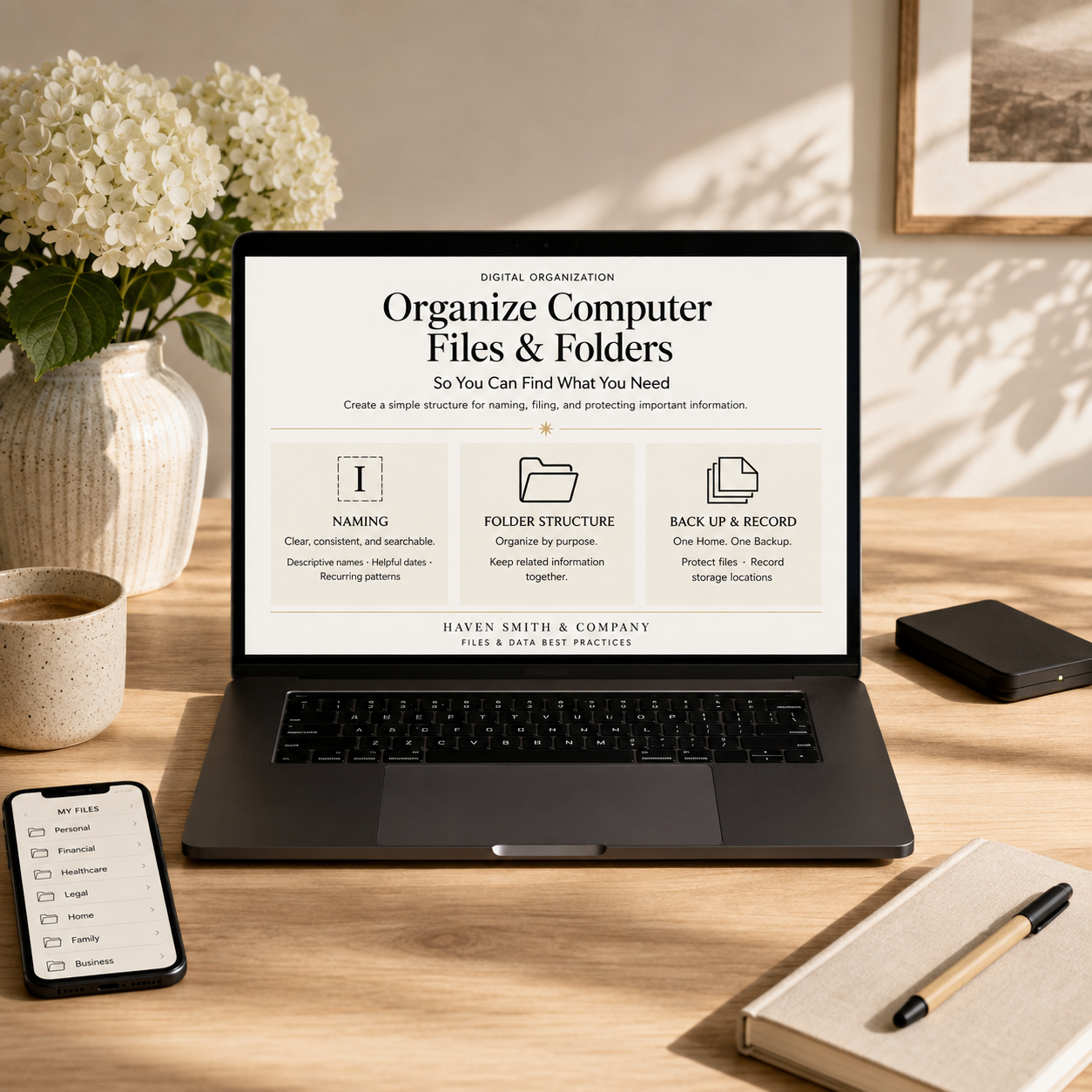
A Practical Method for Naming Files, Building a Simple Folder Structure, and Creating One Clear Home for Important Information
You know the file exists. You remember downloading it, scanning it, or creating it. You may even remember part of its name.
But you cannot remember whether it is on the Desktop, inside Documents, in a cloud folder, or buried within a folder transferred from your previous computer. Search results return several similar files, and none of the names make it clear which version you need.
This problem is not always caused by having too many files. It is often caused by inconsistent filenames, overlapping folders, and several possible places where the same information could belong.
A useful file structure should make decisions easier. You should not have to reconsider the entire organization of your digital life every time you save a document. The filename should help you identify the file, the folder should reflect the responsibility it supports, and the storage location should have a clear purpose.
The goal is not to build the most detailed folder hierarchy possible. It is to create a simple structure you can understand, search, maintain, and explain to someone else.
File Organization Should Reduce Decisions
A complicated structure can look impressive when it is first created. It may include dozens of categories, several levels of subfolders, color labels, tags, abbreviations, and a detailed naming formula for every possible file.
The problem appears when you try to use it.
If you constantly wonder which folder to choose, what abbreviation to use, or whether a file belongs in two different places, the structure is creating work instead of reducing it. That hesitation leads to files being left on the Desktop, stored indefinitely in Downloads, or placed in vague folders for later review.
A useful organization structure should answer three basic questions:
What is this file?
Which part of my life does it support?
Where is its permanent home?
When the answers are clear, filing becomes a small decision rather than a new project.
Clean Up Temporary Locations Before Building the Permanent Structure
Before reorganizing your full file collection, review the places where loose and unfinished files accumulate.
Your Desktop should be used primarily for active work. Downloads should serve as an incoming area for files that still need to be reviewed. Documents—or another deliberately selected storage location—should contain files you have chosen to retain.
If those locations are crowded with old downloads, temporary screenshots, duplicate documents, installation files, and unfinished work, begin with How to Clean Up Your Desktop, Documents, and Downloads Without Creating a Bigger Mess.
That cleanup creates the space needed to build a permanent folder structure. This article focuses on what happens next: naming retained files, deciding where they belong, and creating practices that remain useful over time.
Organize Files by Purpose, Not File Type
One of the most important decisions in file organization is how the top-level folders are defined.
Many people begin with folders based on file type:
PDFs
Spreadsheets
Images
Word Documents
Scans
This separates files according to their format rather than the reason they are being kept.
A mortgage statement, insurance policy, property-tax bill, repair estimate, and photograph of a home improvement may all use different file formats. They are easier to understand when stored together because they support the same Home responsibility.
Instead of organizing primarily by file type, create folders that reflect the parts of your life.
Possible top-level categories include:
Personal
Financial
Healthcare
Legal
Home
Family
Business
Your categories should match your actual responsibilities. You may also need folders for Education, Property, Caregiving, Volunteer Work, or another area you manage regularly.
You do not need to use every possible category. A folder should exist because it gives recurring information an obvious home, not because it appeared on someone else’s organization checklist.
Build a Folder Structure That Reflects How You Use Information
Begin with broad, recognizable categories. Add subfolders only when they make a recurring group of information easier to locate.
A Financial folder might include:
Banking
Credit
Insurance
Investments
Taxes
A Healthcare folder might include:
Insurance
Providers
Claims
Test Results
Prescriptions
A Home folder might include:
Insurance
Maintenance
Mortgage or Lease
Property Taxes
Utilities
Warranties
A Business folder might include:
Administration
Clients
Contracts
Finance
Marketing
Operations
Taxes
These are examples, not requirements. The appropriate folders depend on what you manage and how you expect to retrieve the information.
Keep related information together. If all records for one property are regularly used as a group, it may be more helpful to organize them under that property than to separate every insurance document, tax bill, and repair invoice into unrelated locations.
The structure should support retrieval. Ask yourself where you would look first if you needed the file six months from now. That answer usually reveals the most useful category.
Avoid Unnecessary Duplicate Folders
Duplicate folder structures often develop gradually.
You may have:
A Financial folder inside Documents
Another Financial folder in cloud storage
A third Financial folder transferred from an old computer
A Tax folder inside each of them
Several copies of the same statements distributed among those locations
This makes it difficult to know which folder is current and which files are complete.
Before creating a new folder, search for an existing location that already serves the same purpose. If two folders contain related information, decide whether they should be consolidated, archived, or assigned different roles.
The word “duplicate” does not automatically mean one folder should be deleted. An older folder may contain files missing from the newer one. Compare the contents before deciding which location should remain primary.
The objective is one clear home for each important file, supported by an appropriate backup—not several unexplained working copies.
Keep the Structure Simple Enough for Someone Else to Navigate
A clear folder structure should make sense to more than the person who created it.
This matters when:
A family member helps during an emergency
A business colleague needs an important record
A caregiver assists with healthcare or financial responsibilities
A computer is replaced
Files are transferred to a new storage location
Someone manages information during incapacity
Records must eventually be handled as part of an estate
Another person should not need to understand a private collection of abbreviations, color codes, or overlapping categories to locate a basic insurance policy, financial record, or business agreement.
This does not mean every file should be available to everyone. Appropriate access and privacy still matter. It means the structure itself should be clear enough that an authorized person can understand it.
Name Files Clearly and Consistently
Folders provide context, but filenames should still explain what individual files contain.
Avoid vague names such as:
Document1.pdf
Scan.pdf
New Document.docx
Statement Final.pdf
Updated File New.pdf
These names may make sense when a file is first created, but they become difficult to identify after the context is forgotten.
A useful filename may include:
Date
Subject
Organization or person
Document type
Account or property reference
Version, when necessary
For example:
2026-07_Bank_Statement.pdf
2026-07-31_Home_Insurance_Policy.pdf
2026_Healthcare_Claim_Record.pdf
Smith_Property_Repair_Estimate_2026-08.pdf
Client_Name_Service_Agreement_Signed.pdf
The filename does not need to contain every possible detail. It needs enough information to distinguish the file from other records and make it easier to identify in search results.
Include Dates When They Help
Dates are especially useful for recurring statements, annual records, contracts, meeting notes, reports, and documents that may have several versions.
Use a consistent date format. The format YYYY-MM-DD places the year first, followed by the month and day:
2026-08-01
This format is helpful because files beginning with dates generally sort chronologically when sorted by filename.
Not every file requires a complete date. A monthly statement may need only the year and month:
2026-07_Credit_Card_Statement.pdf
An annual record may need only the year:
2026_Home_Insurance_Policy.pdf
Choose the amount of date information that helps you distinguish the file, and use the same pattern for similar records.
Use Consistent Names for Recurring Documents
Recurring documents are easier to find when the same naming pattern is used each time.
For monthly bank statements, choose one pattern:
YYYY-MM_Bank_Account_Statement.pdf
Then follow that pattern consistently:
2026-05_Bank_Checking_Statement.pdf
2026-06_Bank_Checking_Statement.pdf
2026-07_Bank_Checking_Statement.pdf
Avoid changing between several patterns such as:
May Bank.pdf
Checking Statement June 2026.pdf
Statement_07_FINAL.pdf
Consistency allows files to sort predictably and makes missing periods easier to notice.
The same principle can be applied to invoices, meeting notes, healthcare claims, reports, contracts, and other recurring information.
Use Descriptive Names and Tags Appropriately
Descriptive filenames should do most of the identification work. Tags can provide another way to group or find files, depending on the applications and devices you use.
A tag might help identify:
Active projects
Records awaiting action
Tax-related documents
Files requiring another person’s review
Materials scheduled for archival
Tags should supplement a clear structure rather than compensate for unclear filenames and folders. If access to the tags depends on one application or device, consider whether the file would still be understandable without them.
Use only a small number of tags with defined purposes. Too many labels create the same uncertainty as too many folders.
Avoid Unnecessary Versions
Version names often become difficult to interpret:
Final
Final2
Final New
Final Revised
Really Final
When a document requires several working versions, use a consistent version number or date:
Business_Plan_v01.docx
Business_Plan_v02.docx
2026-08-01_Business_Plan.docx
When the final file is approved or signed, identify that status clearly:
Client_Service_Agreement_Signed_2026-08-01.pdf
Home_Insurance_Policy_Active_2026.pdf
Delete or archive obsolete drafts only after confirming which version should be retained. Some drafts may need to remain for business, legal, historical, or collaborative reasons.
Create One Clear Home for Important Files
Every important file should have one clear primary home.
That location might be:
A permanent folder on a computer
A synchronized cloud folder
A business document platform
Another storage location chosen for a specific responsibility
The appropriate location depends on how the file is used, who requires access, and how it is backed up.
The primary home should be the location where the current file is maintained. Other copies should have defined roles, such as backup, archive, or authorized sharing.
This is the principle of:
One Home, One Backup.
“One Home” identifies the primary location. “One Backup” means the file has an appropriate separate recovery copy. It does not mean that one backup arrangement will be sufficient for every person, business, or type of record. It means the primary file and its protection should be understood rather than scattered among unexplained copies.
Understand the Difference Between Primary Storage, Backup, and Archive
These three roles should not be treated as interchangeable.
Primary Storage
This is where the current working file lives. It is the location you use when you need to review, edit, replace, or share the file.
Backup
A backup provides a recovery copy if the primary file is lost, damaged, or removed. A backup should be stored and managed in a way that supports recovery.
Archive
An archive contains information retained for long-term reference but not used regularly. Archived files should still have clear names, known locations, and appropriate protection.
A folder copied to an external drive is not automatically a dependable backup if you do not know when it was created, what it contains, or whether the files can be recovered. A cloud folder is not automatically an archive simply because no one has reviewed it recently.
Define the role of each location and record it.
Cloud storage and external drives require their own review because they often contain a mixture of active files, outdated backups, and long-term archives. That process is covered separately in How to Organize Cloud Storage and External Drives Without Creating More Confusion.
Archive Instead of Deleting When You Are Unsure
Not every file can be confidently deleted during the first review.
If you are uncertain whether a file may be needed, place it in a clearly labeled archive instead of making a rushed decision. The archive name should describe what it contains and, when appropriate, when it should be reviewed.
Examples include:
Archived_Tax_Records_2018-2022
Previous_Computer_Files_Review_By_2026-12
Completed_Client_Projects_2024
Former_Home_Records_Sold_2025
Avoid allowing the archive to become an invisible catch-all folder. Record its location, protect it appropriately, and review it according to the responsibilities connected to the files.
Archiving is a valid organization decision. It separates inactive information from current files without treating uncertainty as a reason to delete.
Record Important Storage Locations
A clear folder structure helps you find information, but the larger storage arrangement should also be documented.
Use the Digital Life Management Workbook™ to record:
The primary location for important files
The cloud service used for active storage
Backup locations
Archive locations
External drives
Business storage platforms
Shared folders
The person responsible for maintaining each location
Information another authorized person may someday need to find
Do not record passwords in an ordinary spreadsheet. Passwords and authentication secrets should be managed through appropriate security tools.
The Workbook provides a map of your digital life. It can help you remember where important information is stored and reduce the number of locations that depend entirely on memory.
Clean Up Weekly and Back Up Monthly
A maintainable file structure still requires regular attention.
Clean Up Weekly
A weekly review can include:
Filing retained downloads
Moving completed work from the Desktop
Renaming important new files
Removing temporary material
Checking for unnecessary duplicate copies
Returning files to their correct permanent folders
Reviewing files awaiting a decision
This prevents new information from accumulating outside the permanent structure.
Back Up Monthly
A monthly review can include:
Confirming that important files are backed up
Checking the primary storage locations
Testing access to an appropriate backed-up file
Reviewing archive locations
Updating the Workbook
Recording changes to cloud services or external drives
The exact schedule may vary depending on how frequently files change and the responsibilities they support. A business with daily document activity may require more frequent backup than a personal archive that changes only occasionally.
The principle remains the same: clean up regularly, verify backup, and record meaningful changes.
Review Files Before They Become Overwhelming
A large file cleanup often begins because hundreds or thousands of small decisions were postponed.
The easiest way to prevent that accumulation is to make a few decisions when a file first arrives:
Does this need to be kept?
What does it support?
What should it be called?
Where is its permanent home?
Does it need to be backed up?
Does its location need to be recorded?
You do not need to answer every question for every temporary file. You do need to make timely decisions about important documents and recurring information.
A brief weekly review is usually easier than another large reorganization project.
Common File and Folder Organization Mistakes
Organizing Primarily by File Type
Separating PDFs, spreadsheets, images, and documents can divide information that belongs to the same responsibility. Organize by purpose so related files remain together.
Creating Too Many Folder Levels
Deep folder hierarchies can make files difficult to navigate and create uncertainty about where information belongs. Add a level only when it separates a recurring and useful category.
Recreating the Same Folders in Several Locations
Duplicate structures make it difficult to identify the current file. Define the primary location and give other storage locations explicit backup, archive, or sharing roles.
Using Vague Filenames
Names such as Scan.pdf and Document1 do not explain what the file contains. Rename important documents with clear, descriptive information.
Saving Every File in More Than One Working Folder
Unexplained copies create version confusion. Use one primary home and an appropriate backup rather than several editable copies.
Deleting Files Because Their Purpose Is Unclear
When a file may still matter, archive it and schedule a later review. Uncertainty is not proof that the file has no value.
Building a Structure No One Else Can Understand
Avoid private abbreviations and unnecessarily complex categories. An authorized person should be able to navigate the structure if circumstances require it.
Failing to Record Storage Locations
A well-named folder is still difficult to find if no one remembers which computer, account, drive, or cloud service contains it. Record the important locations in the Workbook.
Build a File Structure You Can Maintain
The Digital Organization Course is Month One of the Digital Life Management System™. It guides you through inventorying and editing your accounts, files, devices, and records; organizing retained information; moving it into appropriate storage; and recording where it belongs.
You will learn how to create clear categories, make better decisions about what to keep, move, archive, or delete, and build an organization foundation that supports ongoing maintenance.
Explore the Digital Organization Course
The Digital Life Management Workbook™ provides a practical spreadsheet for recording important files, accounts, devices, storage locations, backup arrangements, and digital responsibilities.
Explore the Digital Life Management Workbook™
If your files are spread across several computers, cloud services, external drives, and old folder structures, a Digital Life Strategy Session can help you understand the larger organization problem and determine the appropriate starting point.
Book a Digital Life Strategy Session
You can also download the free Digital Organization Quick Start Guide for a practical introduction to organizing your accounts, files, devices, and digital records.
Frequently Asked Questions
What is the best way to organize computer files and folders?
Begin with broad folders based on purpose, such as Personal, Financial, Healthcare, Legal, Home, Family, and Business. Add subfolders only when they make recurring information easier to find.
Should I organize files by type or purpose?
Organize primarily by purpose. Files with different formats may support the same responsibility and are usually more useful when stored together.
How many folders should I create?
Create only the folders needed to give recurring information an obvious home. If you regularly hesitate between several categories, simplify the structure.
What is the best way to name files?
Use clear and consistent names that may include the date, subject, organization, document type, or status. Avoid vague names such as Document1, Scan.pdf, and Final New.
What date format should I use in filenames?
The YYYY-MM-DD format is useful when a complete date is needed because it generally allows files to sort chronologically by filename. Use YYYY-MM or YYYY when that amount of detail is sufficient.
Should I delete duplicate files?
Compare the contents, date, resolution, status, and completeness of possible duplicates before deleting one. Confirm that the retained copy is current, opens correctly, and is stored in the appropriate location.
What should I do with files I may need later?
Place them in a clearly labeled archive rather than deleting them. Record the archive location and review it according to the responsibilities connected to the files.
How often should I organize my files?
Complete a brief cleanup weekly and verify backup monthly, adjusting the schedule to reflect how frequently your important information changes.
What does “One Home, One Backup” mean?
Each important file should have one clear primary location and an appropriate separate backup. Other copies should have defined roles, such as archive or authorized sharing, rather than existing as unexplained duplicates.
Make Every File Easier to Find
A useful file structure does not require dozens of folders or a complicated naming formula. It requires clear filenames, recognizable categories, dependable storage locations, and regular maintenance.
Organize files according to the responsibilities they support. Give every important file one clear home, protect it with an appropriate backup, and record the storage locations that matter.
When the structure reduces decisions instead of creating them, finding and filing information becomes easier—not only today, but years from now.