
How to Organize Cloud Storage and External Drives Without Creating More Confusion
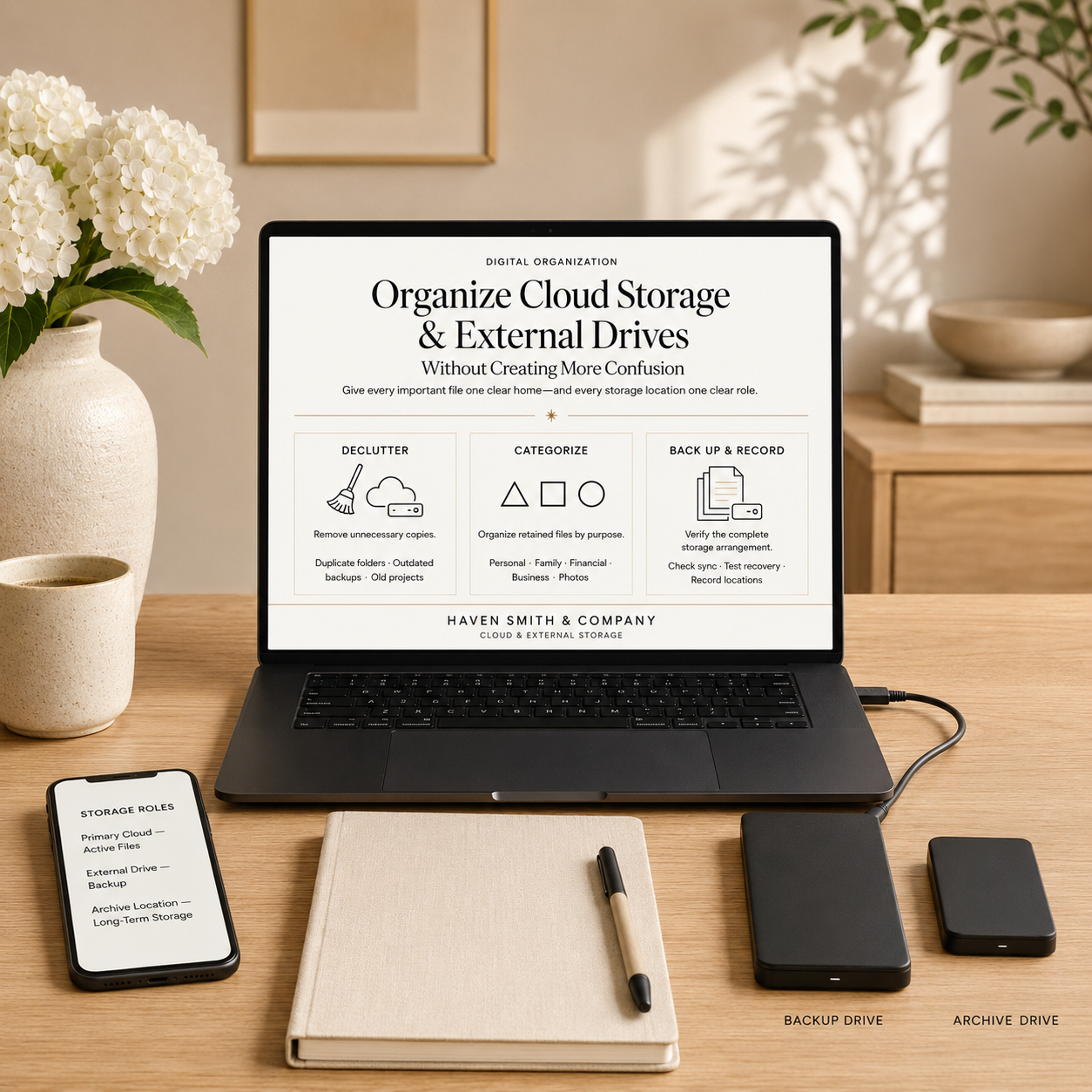
A Practical Method for Decluttering Old Files, Defining Each Storage Location, and Verifying Your Backups
Cloud storage services and external drives are supposed to make digital information easier to store and protect. Over time, however, they often become scattered collections of old files, duplicate folders, outdated backups, transferred computer files, and archives no one remembers creating.
You may have active documents in one cloud account, photographs in another, business files on an external drive, and several folders named after previous computers. Important files may exist in more than one place, but it is not clear which copy is current, which location is backed up, or which files can be safely removed.
Several copies can feel reassuring. They can also create confusion when none of the locations has a defined role.
A useful storage cleanup requires more than deleting enough files to lower a storage bill or create space on a drive. You need to inventory each location, remove what no longer serves a purpose, organize the files you choose to keep, and decide which locations support active work, backup, and long-term archives.
Every important file should have one clear home. Every supporting storage location should have a clear purpose.
Why Cloud Storage and External Drives Become Disorganized
Storage locations usually accumulate gradually.
You may begin using one cloud service because it came with an email account and another because it was included with a computer or phone. A business application may create its own folders. Shared documents may appear in locations controlled by other people. An external drive may begin as a backup and later become a place for files removed from a full computer.
Eventually, the same storage location may contain:
Active working files
Old computer transfers
Duplicate folders
Backups from several dates
Archived projects
Temporary downloads
Photographs and videos
Software installers
ZIP files
Files copied from other drives
Information you no longer recognize
The problem is not always the amount of storage being used. The larger problem is that the roles of the storage locations have become unclear.
A cloud folder may be treated as active storage, backup, and archive at the same time. An external drive may contain a mixture of primary files and backup copies. When those roles are not defined, it becomes difficult to know what is protected and what can be removed.
Understand Three Different Storage Roles
Before reorganizing files, distinguish among primary storage, backup, and archive.
Primary Storage
Primary storage is the clear home for the current file. It is the location you use when you need to open, edit, replace, or share that information.
A primary file might live on a computer, in a synchronized cloud folder, within a business document platform, or in another location selected for a particular responsibility.
The important point is that you know which copy is current.
Backup
A backup provides a separate recovery copy if the primary file is lost, damaged, removed, or made inaccessible.
A folder should not be considered a dependable backup simply because it appears on an external drive or in the cloud. You should know what is included, when the backup was created or updated, and how to recover an appropriate file.
Archive
An archive contains information retained for long-term reference but not used regularly. Archived records may include completed projects, former property documents, prior-year business information, family history, or records retained for legal, financial, administrative, or personal reasons.
Archives still need clear names, known locations, and appropriate protection. “Old Files” is not a sufficient description if no one knows what the folder contains or why it remains.
Defining these roles is the foundation of cloud and external-storage organization.
Begin With a Storage Inventory
Before moving or deleting files, identify every cloud and external-storage location you use or may still need.
Your inventory may include:
Personal cloud storage accounts
Business cloud storage accounts
Shared cloud folders
External hard drives
Portable solid-state drives
USB drives
Memory cards
Old computer backups
Device backup locations
Drives stored elsewhere
Storage controlled by a family member or business colleague
Archived files connected to a former account or device
For each location, record:
The service, drive, or device
The account or person controlling access
What the location appears to contain
Whether it is actively used
Whether files synchronize
Whether it serves as primary storage, backup, or archive
The approximate date of the most recent files
Whether another person has access
Whether the location should be retained, consolidated, reviewed, or retired
Do not record passwords or authentication secrets in an ordinary spreadsheet. Use appropriate security tools for those details. The inventory should document the location, purpose, and responsibility rather than expose account access.
The Digital Life Management Workbook™ can provide a practical place to record your primary cloud storage, backup locations, archive locations, devices, and related responsibilities.
Understand What Cloud Synchronization Is Doing
Before cleaning cloud storage, confirm how files move between the cloud and your devices.
A synchronized folder may make the same files available on several devices. When a synchronized file is changed, moved, or deleted, that action may also be reflected elsewhere.
This means that removing a file from one computer does not necessarily remove only a local copy. It may change the primary cloud collection and every connected device.
Review:
Which folders synchronize
Which devices are connected
Whether files are stored locally, online, or both
How deleted items are handled
Whether previous versions are available
Which account controls the storage
Whether shared folders remain under another person’s control
If you do not understand how a particular service handles synchronization, storage, deletion, or recovery, review the provider’s current instructions before making significant changes.
Synchronization may support access and consistency. It should not automatically be treated as a separate backup.
Review External Drives Before Changing Them
External drives often contain information collected across several years and devices. A label such as “Backup,” “Computer Files,” or “Photos” may not accurately describe what is on the drive today.
Before deleting or reorganizing anything, determine:
Which device or computer created the files
The approximate date of the most recent update
Whether the drive contains primary files
Whether the files exist anywhere else
Whether the drive was used for automated backup
Whether the backup process is still active
Whether the drive contains an archive
Whether the files can be opened
Whether another person depends on the contents
Do not erase or repurpose a drive merely because it appears old. It may contain the only copy of transferred computer files, family photographs, completed business projects, or records that still need to be retained.
Open a representative sample of files and confirm that they are accessible. If the drive has technical problems, makes unusual sounds, repeatedly disconnects, or cannot be read reliably, stop the cleanup and seek qualified technical assistance.
Declutter High-Confidence Items
Once you understand the storage locations, begin with files and folders that are easier to evaluate.
Your cloud and external-storage cleanup should review the following categories.
Duplicate Folders
Duplicate folders may have identical names while containing different files or versions. Compare the contents before deleting or merging anything.
Determine:
Which folder contains the current files
Whether either folder contains unique information
Whether one is a backup or archive
Whether the folders should be consolidated
Which location should remain primary
Do not assume that the newer folder is complete or that the larger folder contains every file.
Outdated Backups
An outdated backup may still contain useful historical information, but it may no longer serve as the current recovery copy.
Before removing it, confirm:
A newer backup exists.
The newer backup includes the required information.
The files can be recovered.
The older backup is not the only source for a former device or date range.
No legal, financial, business, or family responsibility requires retention.
If the outdated backup still provides historical value, move it into a clearly labeled archive rather than leaving it among active backups.
Old Project Files
Completed projects may contain drafts, exports, temporary files, duplicate assets, and final materials.
Decide which information should be:
Retained as the final project record
Archived for future reference
Preserved because of a business or legal responsibility
Removed because it was temporary
Consolidated with related records
A completed project should not remain mixed with active work if it no longer requires regular access.
Temporary Downloads
Cloud folders and external drives can collect installers, attachments, exported reports, and files temporarily transferred between devices.
Review whether those files:
Still serve a purpose
Have already been filed
Exist in a better permanent location
Contain important records
Can be downloaded again if needed
Remove temporary files only after confirming that valuable information has a clear home.
Software Installers
Software installers may have been copied to cloud storage or external drives for convenience. Confirm that the file is only an installer and can be obtained again before removing it.
Keep an installer when there is a specific reason to preserve that version, but do not retain every installer automatically.
ZIP Files You No Longer Need
ZIP files may remain after their contents have been extracted. Confirm that the extracted files are complete and accessible before deleting the compressed archive.
Some ZIP files should remain in the form received, particularly when they contain project records, delivered materials, or an archive whose original structure matters.
Files Already Archived Elsewhere
If a file or folder has already been placed in its permanent archive, confirm that the archived copy is complete, accessible, and appropriately protected. Then remove unnecessary working copies when it is safe to do so.
The goal is not to eliminate every copy. It is to distinguish the primary file, backup, archive, and any authorized shared copy.
Empty Folders
Remove empty folders that no longer support the storage structure. Before deleting one, confirm that it does not contain hidden, filtered, or online-only files you have not reviewed.
Empty folders copied from an old structure can create unnecessary navigation and make a drive appear more complex than it is.
Archive Instead of Deleting When You Are Unsure
Some folders will not be easy to evaluate during the first review. They may contain records from an old computer, files created by another family member, former business materials, or information with an unclear retention requirement.
When you are uncertain, archive rather than delete.
Use a clear archive name that identifies:
What the folder contains
The source
The relevant date range
When it should be reviewed again
Examples include:
Archived_Previous_Computer_2022
Completed_Business_Projects_2023-2025
Former_Home_Records_Sold_2024
External_Drive_Review_By_2026-12
Store the archive in a known location, include it in the appropriate protection arrangement, and record where it is kept. Do not allow “Archive” to become another unexplained location containing everything no one wanted to decide.
Categorize Retained Files by Purpose
After removing high-confidence clutter, organize retained files according to the responsibilities they support.
Your course categories include:
Personal
Family
Financial
Legal
Healthcare
Business
Photos and Videos
Home
Use only the categories that reflect your life and work. Additional categories may be appropriate when they support recurring responsibilities.
Organizing by purpose keeps related information together even when the files use different formats. A Home folder might include insurance policies, repair invoices, property photographs, warranty information, and maintenance records. A Business folder might include contracts, spreadsheets, presentations, and marketing assets.
Avoid creating a separate top-level structure for every file format. PDFs, images, spreadsheets, and documents are usually more useful when grouped with the responsibility they support.
Use the same broad categories across appropriate storage locations when possible. Consistency makes it easier to understand what is active, what is backed up, and what has been archived.
Decide Which Files Are Active
Active files are the documents and materials you currently use, update, or reference regularly.
They might include:
Current financial records
Active household documents
Current business projects
Healthcare information
Family and school records
Current legal documents
Recent photographs and videos
Files connected to ongoing responsibilities
Choose one clear primary location for these files. This might be a synchronized cloud folder, a computer folder, a business document platform, or another arrangement appropriate to how the information is used.
Do not maintain several editable copies unless there is a defined reason. Multiple working versions increase the chance that updates will be made to the wrong file.
Decide Which Locations Serve as Backups
A backup location should have a clear recovery purpose.
For each backup, record:
What information is included
Which primary location it protects
How the backup is created
How often it is updated
Whether the process is completing
How a file can be recovered
Who is responsible for checking it
An external drive may provide backup for selected computer folders. A cloud service may provide another form of protection, depending on how it is configured and how recovery works. The correct arrangement will vary according to the information, devices, and responsibilities involved.
Do not call a location a backup simply because it contains old copies. Verify what it protects and whether recovery works.
Decide Which Files Belong in Long-Term Archives
Archives separate inactive information from the files used regularly.
An archive may contain:
Completed projects
Previous-year records
Former property documents
Retired business materials
Historical family information
Old photographs and videos
Records retained for reference or legal requirements
A long-term archive should remain organized and documented. Use clear names, record the date range, and avoid mixing active working files into the same location.
If an archive is stored on an external drive, record the drive and where it is physically kept. If it is stored in the cloud, record the account and folder location.
Give Every Important File One Clear Home
The central principle of this cleanup is simple:
Every important file should have one clear home.
That home is the primary location where the current file is maintained.
Other copies should have defined roles:
Backup
Archive
Authorized sharing
Temporary transfer
If two cloud folders and three external drives all appear to contain the same information, determine which location is primary and what the other copies represent.
Do not delete the other copies until you have compared the contents, confirmed the backup arrangement, and addressed unique or historical files.
One clear home reduces version confusion. Defined supporting locations provide protection without creating another collection of unexplained duplicates.
Back Up and Record the Final Arrangement
Once retained files have been organized, complete the Back Up & Record stage from your course.
Verify Cloud Synchronization
Confirm that the expected folders and files are appearing on the appropriate devices. Review whether recent changes are synchronizing and whether any errors require attention.
Remember that successful synchronization does not necessarily create an independent backup.
Verify External-Drive Backups
Confirm that the expected files are present and that the backup reflects the appropriate primary storage location. Check when the drive or backup was last updated.
Do not rely solely on a folder name or the presence of files. Verify that the backup arrangement is still active and appropriate.
Confirm Primary Storage Locations
Record the clear home for important categories such as:
Personal records
Family information
Financial documents
Legal records
Healthcare information
Business files
Photos and videos
Home records
This creates a map of where current files belong.
Test Backup Recovery
Select an appropriate non-sensitive file and confirm that it can be located and recovered through the backup process.
A recovery test provides more useful evidence than simply seeing a drive, cloud icon, or backup folder. Follow the current instructions for the tools you use, and seek qualified technical help when the backup arrangement is complex.
Record Primary Cloud Storage
Document the cloud services used for active files, the accounts controlling them, and the categories stored there.
Record Backup Locations
Document the drives, services, or other locations used for recovery copies. Include enough detail to identify the storage location later.
Record Archive Locations
Document where long-term archives are stored, what they contain, and the date ranges they cover.
Update the Digital Life Management Workbook™ whenever an important storage location or responsibility changes.
Create a Storage Maintenance Schedule
Cloud services and external drives will continue accumulating information unless their roles are reviewed regularly.
Weekly
File recent downloads.
Move active documents into their primary locations.
Remove temporary transfers.
Check for obvious duplicate working files.
Keep active folders separate from archives.
Monthly
Verify that important files are backed up.
Confirm that expected cloud folders are synchronizing.
Connect and review external drives used for regular backup.
Test access to an appropriate backed-up file.
Update the Workbook when locations change.
Quarterly
Review available cloud and external-drive storage.
Examine duplicate folders.
Review old projects and temporary exports.
Confirm that each location still has a clear role.
Check shared access and storage controlled by other people.
Annually
Update the full storage inventory.
Review long-term archives.
Consolidate or retire unnecessary storage locations.
Review old computer backups.
Confirm that another authorized person can identify important locations when appropriate.
Reassess whether the current arrangement still supports your responsibilities.
The appropriate schedule may vary, but regular review prevents active storage, backup, and archive from becoming mixed together again.
Common Cloud and External-Storage Mistakes
Treating Synchronization as Backup
Synchronization can make files available across devices, but it may also apply deletions and other changes across those devices. Confirm how separate recovery works.
Calling Every Copy a Backup
An unidentified folder on an external drive is not automatically a dependable backup. Record what it protects, when it was updated, and how recovery works.
Using Cloud Storage as Both Working Space and Archive
Without a clear distinction, active files and inactive records become mixed together. Decide which folders support current work and which contain long-term archives.
Keeping Several Primary Copies
Several editable versions create uncertainty about which file is current. Choose one clear home and assign backup, archive, or sharing roles to other copies.
Deleting Old Backups Without Reviewing Them
An old backup may contain unique files from a previous computer or date range. Compare it with the current collection before removing it.
Leaving External Drives Unlabeled
A drive should have a recognizable name or physical label, a recorded purpose, and a known relationship to the files it protects or archives.
Failing to Test Recovery
A backup has limited value if you do not know whether the files can be restored. Test an appropriate file and follow the current recovery instructions for the tools you use.
Forgetting Who Controls Shared Storage
A shared folder may remain under another person’s account. Record ownership and avoid treating access to someone else’s folder as permanent storage you control.
How This Fits With the Rest of Your File Organization
Cloud and external-storage cleanup is one part of a larger file organization process.
First, clean the temporary and catch-all locations using How to Clean Up Your Desktop, Documents, and Downloads Without Creating a Bigger Mess.
Next, build the permanent structure using How to Organize Computer Files and Folders So You Can Find What You Need.
Then review cloud services and external drives to define:
The primary home for active files
The backup locations
The long-term archives
The storage responsibilities that should be recorded
Together, these three methods address the full path from incoming files to permanent organization, backup, and documentation.
Organize the Storage Behind Your Digital Life
The Digital Organization Course is Month One of the Digital Life Management System™. It guides you through inventorying and editing your accounts, files, devices, and records; organizing retained information; placing it into appropriate storage; and recording where it belongs.
You will learn how to review cloud services and external drives, make better decisions about what to keep, move, archive, or delete, and create an organization foundation you can maintain.
Explore the Digital Organization Course
The Digital Life Management Workbook™ provides a practical spreadsheet for recording your primary cloud storage, external drives, backup locations, archives, accounts, devices, and digital responsibilities.
Explore the Digital Life Management Workbook™
If your files are distributed across several cloud accounts, external drives, previous computers, and forgotten backups, a Digital Life Strategy Session can help you understand the current arrangement and determine where to begin.
Book a Digital Life Strategy Session
You can also download the free Digital Organization Quick Start Guide for a practical introduction to organizing your accounts, files, devices, and digital records.
Frequently Asked Questions
What is the best way to organize cloud storage?
Begin by inventorying each cloud service and identifying what it contains. Choose a clear primary location for active files, organize retained files by purpose, and record which locations provide backup or long-term archives.
How should I organize an external hard drive?
Determine whether the drive supports active storage, backup, or archive. Remove unnecessary files carefully, organize retained information by purpose, use clear folder names, and record what the drive contains and where it is kept.
Is cloud synchronization the same as backup?
Not necessarily. Synchronization keeps files and changes consistent across connected devices, while backup should provide an appropriate recovery copy. Review how your particular service handles deletion, version history, and recovery.
Can I delete old computer backups?
Review the contents before deleting them. An old backup may contain unique files from a previous computer or date range. Confirm that important information exists in the current primary location and can be recovered before removing the older copy.
How do I know which duplicate folder to keep?
Compare the contents, date ranges, file versions, and storage roles of both folders. Determine which location should remain primary and confirm that unique files have been addressed before removing another copy.
What is the difference between primary storage, backup, and archive?
Primary storage contains the current file you actively maintain. Backup provides a separate recovery copy. Archive contains information retained for long-term reference but not used regularly.
How often should I back up external drives?
The appropriate schedule depends on how frequently the primary files change and the responsibilities they support. Your course method recommends backing up monthly and cleaning up weekly, with more frequent backup when important files change more often.
Should I keep files in both cloud storage and on an external drive?
That can be appropriate when each location has a defined role. One may serve as the primary working location while another supports backup or archive. Avoid keeping unexplained copies without knowing which version is current.
What should I record in the Digital Life Management Workbook™?
Record your primary cloud storage, external drives, backup locations, archive locations, the categories stored in each place, and the person responsible for maintaining or accessing them.
Define the Purpose of Every Storage Location
A successful storage cleanup is not measured only by how much space you free. It is measured by whether you know where current files live, how important information is backed up, and where long-term archives are stored.
Cloud services and external drives should not become collections of unexplained copies. Give every important file one clear home, assign each additional location a defined role, verify that recovery works, and record the arrangement you created.