
How to Organize Your Contacts Before Sending Holiday Cards
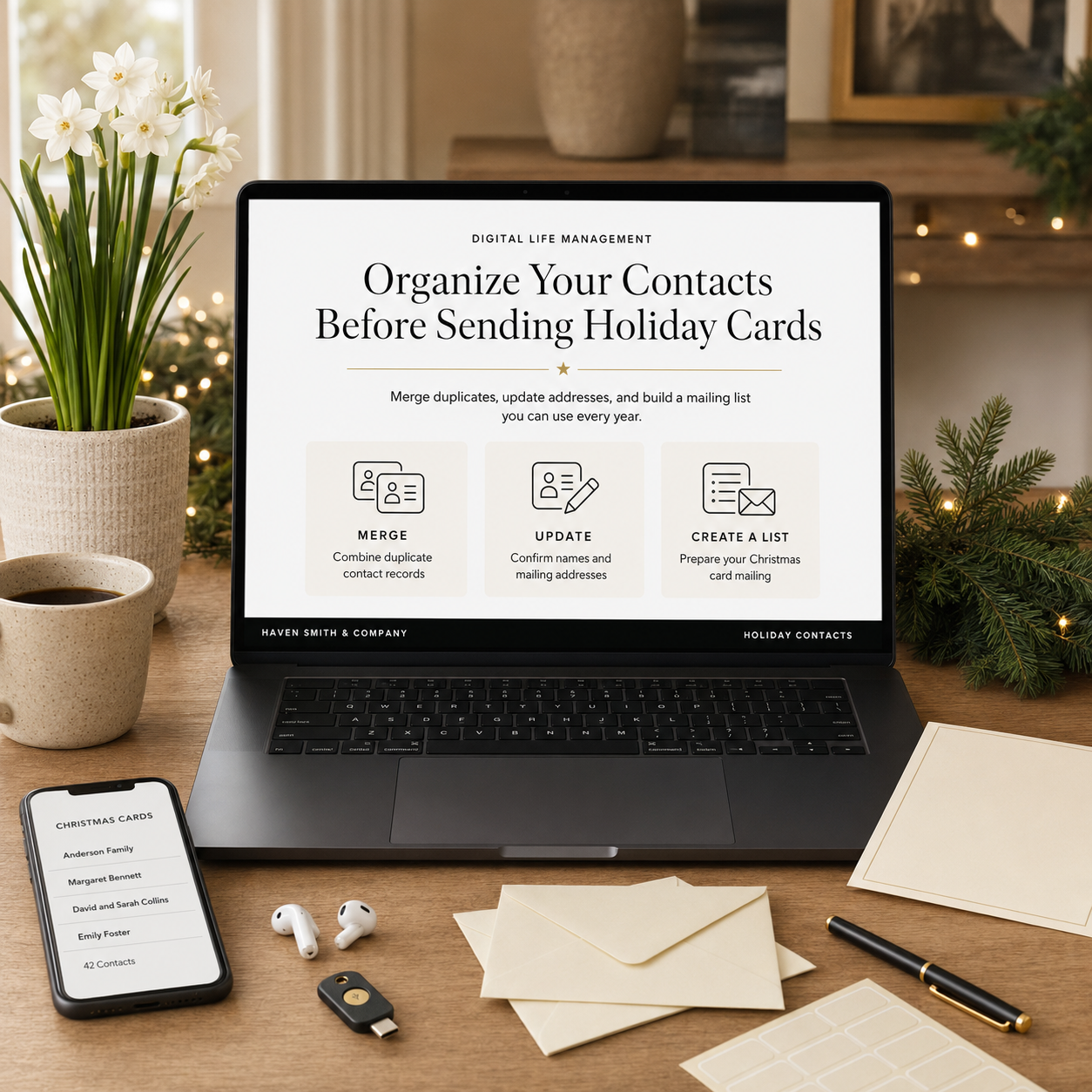
A Practical Method for Merging Duplicates, Updating Addresses, Creating a Christmas Card List, and Preparing Mailing Labels
Sending Christmas cards should begin with choosing a photograph or design. Instead, many families discover that the real work is finding current addresses.
One address is stored in Apple Contacts. Another is connected to Gmail. A cousin’s new address is buried in a text message. A former neighbor appears three times, while a close friend’s contact card still contains an address from six years ago.
Before ordering cards or printing labels, take time to organize the contact information behind them.
The result will be more than an accurate Christmas card list. You will have a cleaner and more useful family address book that can support invitations, travel, emergencies, family communication, and future holiday seasons.
Your Contact Library and Christmas Card List Are Not the Same Thing
Begin by separating three related but different resources.
Your master contact library
This is the permanent collection maintained in Apple Contacts, Google Contacts, Outlook, or another contact application. It contains the people and organizations you may need to call, email, text, visit, or mail throughout the year.
Your Christmas card list
This is a list, label, or group containing the people who may receive a card. It should draw its information from the master contact library rather than becoming a competing address book.
Your seasonal mailing tracker
This is a temporary list or spreadsheet that records whether a card has been addressed, mailed, returned, or corrected. It can also contain the exact household name you want printed on the envelope.
Keeping these three resources separate prevents one of the most common contact-management problems: maintaining several versions of the same address and no longer knowing which one is current.
Your permanent contact information should remain in the master contact library. Your Christmas card list determines who may receive a card, while the seasonal tracker records this year’s progress.
Step 1: Identify Where Your Contacts Are Stored
Many people assume that every contact visible on an iPhone or Mac belongs to Apple. In reality, Apple Contacts may display records from iCloud, Google, Microsoft, Yahoo, and other accounts in one application.
That is why the same person sometimes appears several times. One card may belong to iCloud, another may belong to Google, and a third may have been imported from an old mailing list.
Begin with a simple inventory.
Contact inventory checklist
Open Apple Contacts and display the account sidebar.
Identify contacts stored in iCloud.
Identify contacts stored in Google.
Identify contacts stored in Microsoft or other accounts.
Open Google Contacts in a browser.
Locate spreadsheets from previous Christmas mailings.
Review address books stored by card-printing companies.
Identify addresses that exist only in email or text messages.
Identify old phones or computers that may contain contact information.
Note which locations contain permanent records and which contain temporary copies.
Do not immediately import every contact from one account into another. That can create another round of duplicates before the existing collection has been reviewed.
Step 2: Decide Where Permanent Contact Information Belongs
A single contact does not necessarily need to exist independently in both iCloud and Google.
You might decide that:
iCloud Contacts will serve as your primary family address book.
Google Contacts will serve as your primary contact location.
Personal and business contacts will remain in separate accounts.
Apple Contacts will display records from several accounts without moving them.
One account will hold family contacts while another holds professional contacts.
The right choice depends on the devices and accounts you use. The important point is knowing which account owns the permanent record.
When the same person appears in more than one account, Apple can link the contact cards so they display as one combined contact while the underlying records remain in their original accounts. This can be useful when you want one view without moving or duplicating the data.
If your contacts are only one part of a larger collection of scattered accounts, files, devices, and records, the Digital Organization Course can help you inventory what you have, make informed decisions, and build a foundation you can maintain.
Explore the Digital Organization Course
Step 3: Back Up Your Contacts Before Changing Them
Create a backup before merging, linking, deleting, importing, or moving contact records.
A backup is especially important if you plan to:
Merge large numbers of duplicates
Delete old contacts
Import a previous Christmas card list
Move contacts between accounts
Link records from different providers
Allow a third-party application to access your address book
Back up Apple Contacts
On a Mac:
Open Contacts.
Choose File → Export → Contacts Archive.
Select a protected storage location.
Include the date in the filename.
A Contacts Archive gives you a restorable copy of the complete Apple contact collection.
Back up Google Contacts
In Google Contacts:
Select your contacts.
Choose Export.
Select Google CSV.
Save the file somewhere protected.
Include the date in the filename.
Do not treat a contact synchronization feature as your only backup. Synchronization can copy changes and deletions across connected devices, which is useful during ordinary use but may also spread an unwanted change.
Step 4: Merge Duplicate Contacts
Contact applications can identify many duplicates automatically, but no automated match should replace a careful review.
Two people may have the same household telephone number. A parent and adult child may share a name. Spouses may share an address and email account while still requiring separate contact cards.
Compare the complete records before merging.
Information to compare
Full name
Preferred name
Mailing address
Email addresses
Telephone numbers
Organization
Family relationship
Notes
Photograph
Account where the contact is stored
Merge duplicates in Apple Contacts
On a Mac:
Open Contacts.
Choose Card → Look for Duplicates.
Review the number of duplicate cards found.
Click Merge.
Repeat the process until no additional duplicates are found.
If two cards belong to the same person but are stored in different accounts, consider linking them instead. Select the cards and choose Card → Link Selected Cards. Apple may also provide Merge and Link Selected Cards when a duplicate exists across accounts.
Merge duplicates in Google Contacts
In Google Contacts:
Open Merge & fix.
Review the duplicate suggestions.
Merge individual matches that clearly belong to the same person.
Use Merge all only after reviewing the proposed changes.
Search manually for duplicates that remain.
Google cannot merge contacts stored in separate Google accounts, so review each account individually.
Review remaining duplicates manually
Automatic tools may miss contacts with:
A maiden and married name
Different spellings
Different email addresses
An old and new telephone number
A household name and an individual name
A nickname and formal name
A business and personal record
Search for close family members, frequent correspondents, neighbors, and longtime friends manually. These are often the people whose records have accumulated the most information over time.
Step 5: Delete Contacts You No Longer Need
Not everyone in your address book needs a Christmas card, but that does not mean every unselected person should be deleted.
A useful business, family, medical, school, or professional contact may remain in your address book without joining the Christmas card list. Deletion should be based on whether the permanent record still serves a purpose.
Possible deletion categories include:
Empty contact cards
Obvious spam
Businesses that have permanently closed
Former service providers you no longer use
Obsolete school or activity contacts
Duplicate business listings
Records containing no recognizable information
Contacts imported accidentally
Temporary contacts that are no longer useful
Outdated records already preserved correctly elsewhere
When you are uncertain, do not rush to delete the record. Review what information it contains, decide whether another contact should retain part of that information, and return to it later if necessary.
Step 6: Standardize Names and Household Information
Names that work well for telephone calls do not always produce good mailing labels.
A contact card might identify one person as “Mary,” while the Christmas card should be addressed to “John and Mary Smith” or “The Smith Family.” Another household may include partners with different last names, adult children, professional titles, or several generations at one address.
Review:
First name
Middle name
Last name
Preferred name
Spouse or partner
Children’s names
Household name
Professional title
Organization
Formal or informal greeting
Exact envelope name
Possible envelope formats include:
John and Mary Smith
The Smith Family
Dr. John Smith and Mary Jones
Ashley Karr and Margot Karr
Haven Smith & Company
Keep each person’s useful name in the permanent contact record. If the envelope requires a household name, record that separately in the seasonal mailing tracker instead of replacing an individual’s name with “The Smith Family.”
Use the names people currently use rather than copying last year’s label without review. Families change through marriage, divorce, death, birth, adoption, relocation, and children becoming adults.
Step 7: Update and Standardize Mailing Addresses
Every Christmas card address should be reviewed for completeness.
Mailing address checklist
Full street number and street name
Apartment, suite, or unit
City
State
ZIP Code
Country when required
Current household members
Recent move
Seasonal or alternate address
International address format
Missing information
Watch for common problems:
Apartment number placed on the wrong line
Missing directional information
Incomplete ZIP Code
Old city or state
Outdated military or international address
Business address stored as a home address
Two current-looking addresses with no indication of which is preferred
Corrections left inside a text message but never added to the contact card
When someone sends a new address, update the master contact immediately. Do not correct only the Christmas card spreadsheet or the address book maintained by the printing company.
Otherwise, the same correction will have to be found and entered again next year.
Step 8: Create a Reusable Christmas Card List
Once the master contact library is cleaner, create a dedicated list or label for potential Christmas card recipients.
Name it simply:
Christmas Cards
Avoid including the year in the permanent list name. The same list can be reviewed and reused each holiday season.
Create a list in Apple Contacts
Create a regular list named Christmas Cards and add the appropriate contact cards. Removing someone from the list will not delete the permanent contact.
Depending on your setup, Apple Contacts can also be used to print contact lists, mailing labels, and envelopes.
Create a label in Google Contacts
Create a Google Contacts label named Christmas Cards and apply it to the appropriate contacts. That label can then be reviewed or exported separately from the rest of your address book.
Review the relationships represented
Consider:
Immediate family
Extended family
Close friends
Neighbors
Church community
School relationships
Professional relationships
Long-distance relationships
People who sent you a card last year
People added to your life during the current year
This should remain a practical list rather than an obligation. You can remove someone from the Christmas card list without deleting the contact or diminishing the relationship.
Step 9: Create a Seasonal Mailing Tracker
Your contact list identifies the recipients. A temporary tracker helps you manage the actual mailing.
Suggested columns include:
ColumnPurposeSend This YearDetermines who is includedEnvelope NameRecords the exact household nameStreet AddressPrimary mailing addressApartment or UnitSecondary address informationCityMailing cityStateMailing stateZIP CodePostal codeCountryCountryPersonal NoteIdentifies cards needing a handwritten noteAddressedTracks progressMailedTracks completionReturnedIdentifies an address problemUpdated in ContactsConfirms the permanent record was corrected
The tracker should not become another permanent address book. If information changes, correct the Apple or Google contact first and use the tracker only to record the seasonal task.
Step 10: Collect Missing Addresses
When information is missing, ask for it directly.
A simple message works well:
We are updating our Christmas card list and would love to send you one this year. Would you please send me the best current mailing address for your household?
When requesting several addresses:
Ask people individually when practical.
Do not expose everyone’s email address in a group message.
Do not place home addresses in a publicly accessible document.
Explain why you are requesting the information.
Update the permanent contact when the response arrives.
Delete temporary messages or files when they are no longer needed.
Some online address-book and card services allow you to create a private link that people can use to submit their addresses. This can be convenient for a large list, but review the provider’s privacy policy, account protections, and data-retention practices before asking friends and family to submit their home addresses.
Step 11: Export Only the Contacts You Need
When your list is ready, you may need to export it for a card company, label application, mail merge, or spreadsheet.
Do not upload your complete address book when only a smaller group of mailing records is required.
Export from Google Contacts
Open the Christmas Cards label.
Select the contacts in that group.
Choose Export.
Select the format required by the card company.
Open the exported file before uploading it.
Remove columns the recipient does not need.
Export from Apple Contacts
Apple Contacts can export selected contacts as vCards. If you need a CSV or Excel file, you can select the contacts, drag them into an Apple Numbers spreadsheet, and export that sheet in the required format.
Review the Numbers file carefully. Contact exports may contain more information than the card company needs, including email addresses, telephone numbers, notes, photographs, relationships, or organization details.
Remove unnecessary fields
Telephone numbers
Email addresses
Birthdays
Private notes
Family relationships
Healthcare information
Internal business information
Photographs
Unnecessary organization details
Contacts not receiving cards
Retain only what is required to produce the mailing:
Envelope name
Street address
Apartment or unit
City
State
ZIP Code
Country
Save the mailing file as a separate copy. Do not strip useful information from the master contact library merely because the card vendor does not need it.
Contact files can contain far more personal information than a card company requires. The Digital Safety Course teaches a broader approach to protecting personal information, accounts, devices, recovery paths, and access.
Explore the Digital Safety Course
Step 12: Prepare Labels or Pre-Addressed Envelopes
Once the mailing file is ready, choose how the envelopes will be addressed.
Use the card company
Many card companies allow customers to upload addresses and print them directly on the envelopes. Some can also stamp and mail the cards.
Before submitting the file:
Review the first several address previews.
Check couples and families with different last names.
Check apartment and unit information.
Check international addresses.
Confirm the return address.
Review font size and line wrapping.
Confirm that no unintended contacts were included.
Print labels at home
You can create labels using Apple Contacts, Microsoft Word mail merge, dedicated label software, or another application that accepts your contact file.
Print a test page on ordinary paper before using label sheets. Hold the test page against the label sheet to confirm that the alignment is correct.
Address the cards by hand
Some families prefer handwritten envelopes. In that case, print or display the Christmas card list and mark each household as it is completed.
Whichever method you choose, use the same reviewed mailing information. Changing addresses independently during the envelope process creates another version that may never return to the master contact.
Step 13: Protect the Holiday Mailing File
A Christmas card file contains private home addresses. It should not remain scattered across email attachments, desktops, Downloads folders, and vendor accounts.
Mailing-file privacy checklist
Store the permanent contact backup somewhere protected.
Create a separate mailing-only export.
Remove unnecessary fields.
Avoid emailing the complete list without a clear reason.
Delete duplicate exports.
Remove the file from Downloads after use.
Review whether the card vendor retains uploaded addresses.
Close obsolete address-book accounts.
Remove unnecessary third-party access to contacts.
Keep only the final files that continue to serve a purpose.
If the vendor maintains an online address book, decide whether that convenience is worth retaining another copy of your family and friends’ addresses. If you keep it, protect the account and review the address book before using it again next year.
Step 14: Record Mailed, Returned, and Corrected Cards
The process does not end when the cards enter the mail.
Record:
Date mailed
Returned cards
Incorrect addresses
Forwarding information
Household-name corrections
Recipients added late
Cards received from someone not currently on the list
People who should be reviewed next year
When a card is returned, update the permanent contact as soon as new information becomes available. Do not place the returned envelope in a drawer and leave the correction for next Christmas.
At the end of the season, save the final Christmas card design and family photograph in the appropriate family archive. Delete draft designs and temporary exports that no longer serve a purpose.
Keep Personal Contacts Separate From Marketing Permission
This distinction is especially important for small-business owners.
A person appearing in your Apple Contacts, Google Contacts, or Christmas card list has not necessarily agreed to receive:
Email newsletters
Promotional text messages
Automated sales messages
Business campaigns
Maintain separate business categories:
Confirmed email subscriber
Confirmed SMS subscriber
Appropriate to invite
Do not contact
Personal only
Do not upload your Christmas card list into Squarespace Email Campaigns or a text-marketing platform unless each person has separately provided the required marketing permission.
A personal relationship and marketing permission serve different purposes. Manage them separately, even when the same individual appears in both your personal and professional life.
Maintain Contacts Throughout the Year
The easiest way to prevent another large holiday cleanup is to update contacts when information changes.
Ongoing contact habits
Update an address when someone moves.
Merge duplicates when they appear.
Record name and household changes.
Remove obsolete temporary contacts.
Correct returned mail promptly.
Back up contacts periodically.
Review connected contact accounts.
Keep the Christmas card list current.
Protect exported contact files.
Perform a larger review every fall.
A five-, ten-, or fifteen-minute Organize With Me session can provide a practical time block for reviewing one category of contacts. You might review extended family one week, friends the next, and professional contacts later.
Small updates throughout the year are easier than reconstructing an entire address book every November.
A 60-Minute Holiday Contact Cleanup
If you need to send cards soon, begin with one focused hour.
First 10 Minutes: Back Up and Inventory
Identify where contacts are stored and create Apple and Google backups. Decide which account appears to hold the most complete permanent records.
Next 15 Minutes: Merge Duplicates
Use Apple and Google duplicate suggestions, then manually review obvious remaining duplicates among family members, friends, and frequent contacts.
Next 15 Minutes: Update Card Recipients
Confirm household names, addresses, apartment information, ZIP Codes, and recent moves. Request missing information from the people most likely to receive cards.
Next 10 Minutes: Create the Christmas Card List
Create the Apple list or Google label and add the appropriate recipients. Remove anyone who no longer belongs on this year’s mailing without deleting useful permanent contacts.
Final 10 Minutes: Export and Review
Create the mailing-only file, remove unnecessary fields, and examine every address before uploading or printing.
You may not complete a large contact library in one hour, but you can prepare an accurate card list and identify what still needs attention.
Frequently Asked Questions
When should I organize my Christmas card address list?
Begin four to six weeks before Christmas. This provides time to request missing addresses, order cards, correct formatting problems, and mail everything without concentrating the entire process into one weekend.
Should I keep my Christmas card list in a spreadsheet?
Use Apple Contacts, Google Contacts, or another contact application as the permanent address book. A spreadsheet works well as a temporary tracker for envelope names, mailing progress, returned cards, and corrections.
How do I merge duplicate contacts?
Apple Contacts offers Card → Look for Duplicates, while Google Contacts provides Merge & fix. Back up your contacts first and review proposed matches before accepting them.
How do I create a Christmas card group in Apple Contacts?
Create a regular list named Christmas Cards and add the appropriate contact cards. Removing someone from the list will not delete the underlying contact.
How do I create a Christmas card list in Google Contacts?
Create a label named Christmas Cards, select the appropriate contacts, and apply the label. You can then review or export that group separately.
How can I collect addresses privately?
Ask people individually or use a private address-collection link from a provider whose privacy and retention practices you have reviewed. Update your permanent contact record when each address arrives.
Can I upload Christmas card contacts to my email newsletter?
Only if those people have separately agreed to receive marketing emails. A personal mailing address or Christmas card relationship is not the same as permission for business campaigns.
What should I remove before uploading contacts to a card company?
Remove telephone numbers, email addresses, birthdays, photographs, private notes, family relationships, and other information the card company does not need. Upload only the fields required to print or mail the envelopes.
When the Christmas Card List Reveals a Larger Digital Organization Problem
You may begin this process expecting to update a few addresses and discover that your contacts are divided among iCloud, Google, old spreadsheets, former card websites, several devices, and years of text messages.
That discovery is useful. It shows you what needs a permanent home, what should be merged or deleted, and what deserves continued maintenance.
Haven Smith & Company offers several ways to continue.
Digital Organization Course
Learn how to inventory your accounts, files, devices, and records; make informed decisions; and build a digital foundation you can maintain.
Explore the Digital Organization Course
Digital Safety Course
Learn how to strengthen the accounts, devices, information, recovery paths, and access points that support your everyday digital life.
Explore the Digital Safety Course
Digital Life Management Course Bundle
Work through the complete Initial Cleanup across Digital Organization, Digital Safety, and Digital Legacy and Estate Planning.
Explore the Complete Course Bundle
Digital Life Strategy Session
Receive personalized guidance if your contacts and other digital responsibilities are distributed across several accounts, platforms, devices, and family members.
Book a Digital Life Strategy Session
Organize the Information Behind the Tradition
Organizing contacts may begin as a Christmas card task, but its value extends far beyond the envelopes you mail this year.
A reliable contact library helps your family stay connected, coordinate plans, prepare for travel, respond to emergencies, preserve important relationships, and communicate more easily throughout the year.
Send the cards, record the corrections, and keep the information current. The work you complete this Christmas can continue supporting your family long after the holiday mail has arrived.