
Three Digital Junk Drawers You Can Clean Up Today
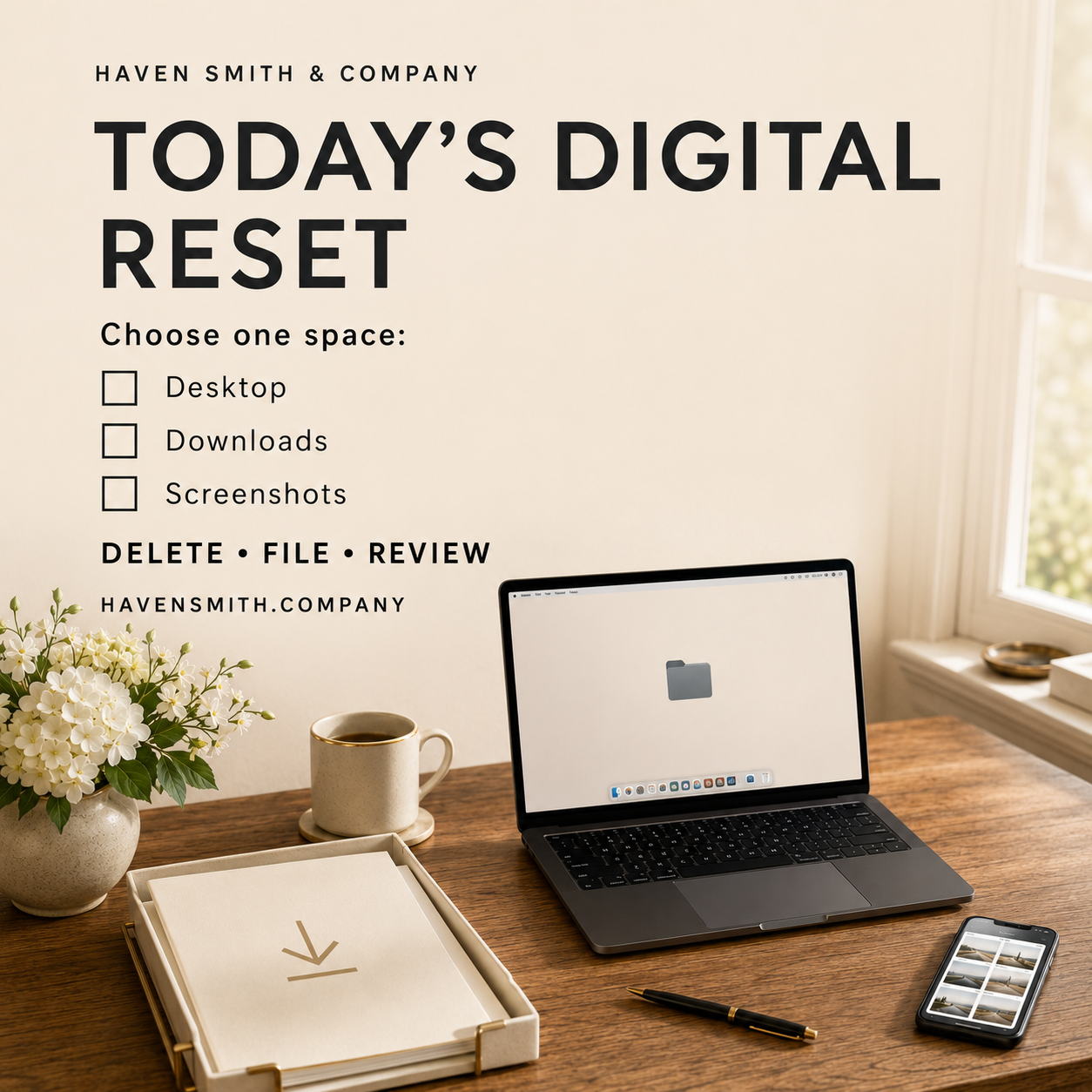
Reset your Desktop, Downloads, and Screenshots with a manageable organizing session.
Digital clutter often collects in the same three places: your Desktop, Downloads folder, and Screenshots collection. You do not need to reorganize your entire digital life today. Start with one of these clutter-prone spaces and make it easier to use.
If You Read Only One Thing
Treat your Desktop, Downloads, and Screenshots as temporary workspaces: delete what you do not need, move important items into permanent storage, and leave only active items behind.
Your Action Steps
Choose one digital junk drawer. Start with your Desktop, Downloads, or Screenshots—not all three unless you have time.
Delete the obvious clutter. Remove duplicates, obsolete installers, accidental screenshots, expired documents, and files you know you no longer need.
Move important items into permanent storage. File anything you need to keep in the folder, photo album, cloud location, or record system where it belongs.
Create a temporary “Review” folder. Move uncertain items there so they do not stop your progress.
Set a maintenance rule. Decide when you will return to this space—weekly, monthly, or after completing a major project.
Why These Three Spaces Become Digital Junk Drawers
Your Desktop, Downloads, and Screenshots are designed for convenience. They give you somewhere immediate to place a file, save an attachment, or capture information you might need later.
The problem is not using them. The problem is allowing temporary information to become permanent clutter.
An organized digital life does not require an empty Desktop or Downloads folder. It requires knowing what is there, why it is there, and what should happen to it next.
Digital Junk Drawer #1: Your Desktop
Think of your Desktop as an active worktable. It can hold files connected to current projects, but it should not become the permanent home for years of unrelated documents.
Start by grouping what you see:
Delete: Duplicates, outdated versions, accidental files, and items you no longer need
File: Completed documents and records that belong in permanent storage
Keep active: Files you are currently using
Review later: Anything requiring a decision you cannot make quickly
If your Desktop is still visually overwhelming, create one temporary folder named Desktop Review. Move the uncertain items into it and schedule another short session to review them. This is not the final organizational system; it is a way to keep uncertainty from stopping today’s cleanup.
Digital Junk Drawer #2: Your Downloads Folder
Your Downloads folder is an incoming basket. Every attachment, form, photograph, installer, PDF, and ZIP file you download may land there—even after you have finished using it.
Sort Downloads by date or file type, then look for easy deletions:
Old software installers
ZIP files you have already opened
Duplicate PDFs
Forms you have already completed
Attachments stored somewhere else
Temporary images and documents
Move anything important into an appropriate permanent location. A tax document might belong with financial records, while a medical form might belong in a healthcare folder.
Be careful with unfamiliar files. If you do not recognize something, investigate it before opening or deleting it.
Digital Junk Drawer #3: Your Screenshots
Screenshots are useful because they capture information immediately. They are also easy to forget.
Review your Screenshots collection and ask:
Is this still useful?
Does this information exist somewhere more reliable?
Should I save the information rather than the screenshot?
Does this contain personal or sensitive information?
Would I know why I saved this six months from now?
Delete accidental and outdated screenshots. Move meaningful photographs into an appropriate album. Save important information in a more durable format when necessary.
If you use Apple Photos, the Utilities and Screenshots collections can help you locate screenshots, documents, receipts, duplicates, and other items that are ready for review.
Define “Finished” Before You Begin
You do not need to make these spaces perfect. Choose a finish line that fits the time and energy you have available.
You might decide to:
Work for ten minutes
Review the 25 newest downloads
Clear one section of your Desktop
Delete screenshots from the previous month
Reduce one folder enough that you can find what you need
A completed ten-minute cleanup is more useful than an ambitious digital-organizing project you continually postpone.
Outside Resources
Apple: Find receipts, documents, screenshots, recently edited photos, and other Utilities collections
https://support.apple.com/guide/iphone/find-receipts-qr-codes-edited-photos-iph995007f21/iosApple: Merge duplicate photos and videos on iPhone
https://support.apple.com/guide/iphone/merge-duplicate-photos-and-videos-iph1978d9c23/iosApple: Choose where screenshots are saved on a Mac
https://support.apple.com/en-us/102646
Haven Smith & Company Resources
Use the free Focus Timer for a five-, ten-, fifteen-, or thirty-minute cleanup:
https://www.havensmith.company/free-focus-timerWork alongside our free Organize With Me videos:
https://www.havensmith.company/free-organize-with-me-videosDownload the free Digital Organization Guide:
https://www.havensmith.company/free-digital-organization-guideExplore the Digital Organization course:
https://www.havensmith.company/digital-organizationOrganize important information with the Digital Life Management Workbook™:
https://www.havensmith.company/digital-life-management-workbookBook a free 15-minute consultation if you are unsure where to begin:
https://www.havensmith.company/free-consultation
Start with one digital junk drawer, set a realistic timer, and make the space easier to use. You can return for the next small reset when you are ready.