
Your Digital Systems Need to Work When Life Does Not Go as Planned
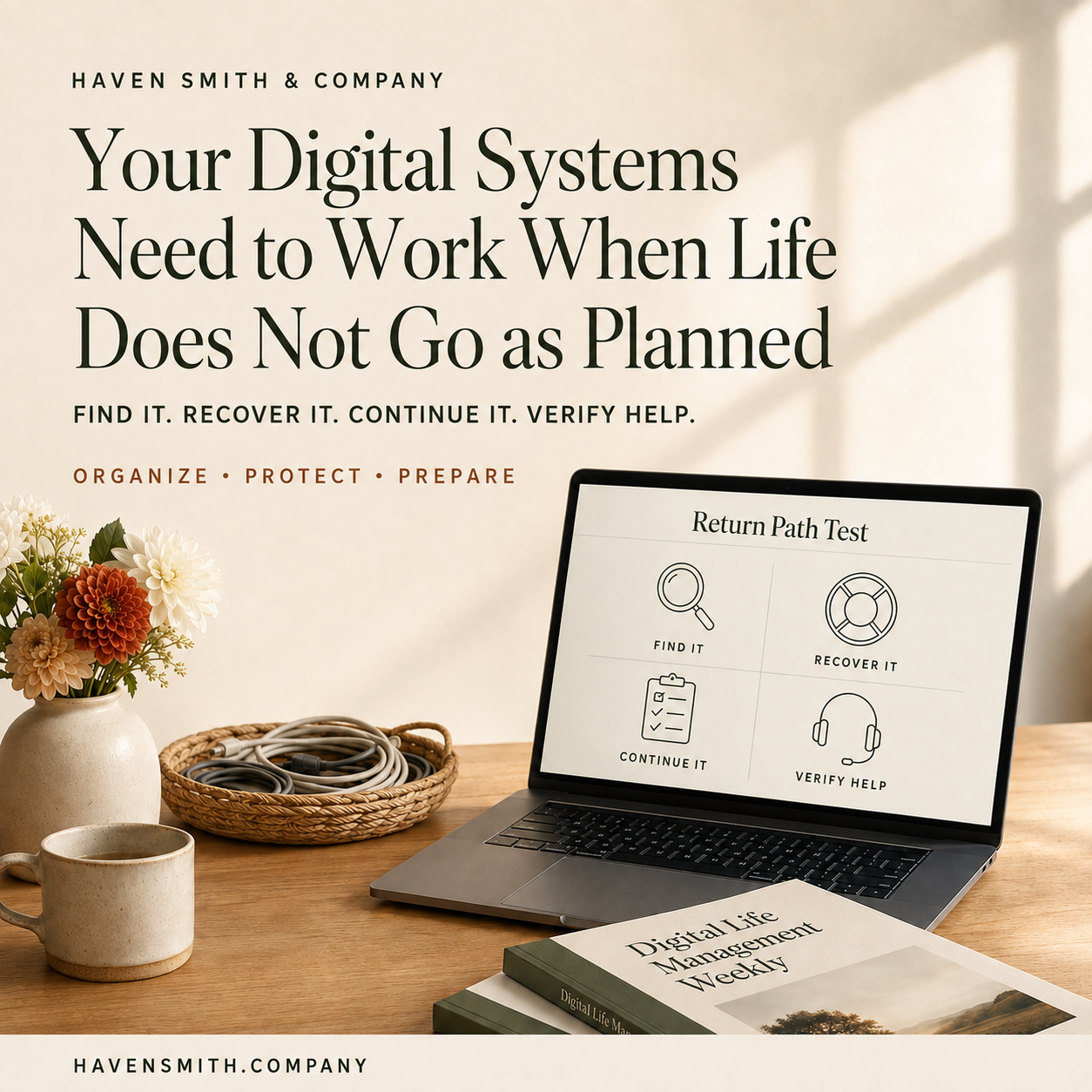
Download Issue 06 of Digital Life Management Weekly, published October 11, 2026. This complimentary edition brings together practical lessons to help you organize what you have, protect what matters and prepare for what comes next for your digital life—all in one beautifully designed publication you can save, print, share or return to whenever you need it.
Make sure you can find the information, recover the account, continue the responsibility and verify trusted help after something changes.
Your digital systems may work well while everything remains normal.
You remember the deadline. Your phone receives the code. The document is still in your recent files. You know which bill must be paid. The family member who usually helps is available.
Then something changes.
A device is lost. A phone number is replaced. An illness interrupts the routine. An employee leaves. A document is moved. A convincing stranger offers assistance.
A resilient digital life needs more than a correct path for ordinary days. It needs a reliable return path.
If You Read Only One Thing
For every important digital responsibility, ask four questions: Can I find it? Can I regain access? Can an authorized person continue it? Can I verify that help is legitimate?
Your Action Steps
Choose one important household, personal or business responsibility.
Identify where the relevant information is stored.
Confirm how you would recover the account or information if your normal device were unavailable.
Record who is authorized to continue the responsibility if you cannot.
Establish how you would verify any person offering help.
Correct the first missing return path you discover.
Repeat the test with one responsibility each week.
Finding It Is Not the Same as Recovering It
You may know that a document exists without being able to retrieve it efficiently.
You may know which account holds the information without being able to regain access after losing a phone.
You may have given someone instructions without confirming that they have legal authority to act.
You may have a trusted helper without a safe method for verifying that a message actually came from that person.
Each of these is a return-path problem.
The Return Path Test
Apply these four questions to any important responsibility.
Can I Find It?
Can you locate the document, account, notice or instruction without relying on memory?
A useful system includes:
A recognizable location
A meaningful filename
A current link or institution name
A clear owner
Enough context to understand what the information represents
Can I Regain Access?
If your normal phone or computer were unavailable, could you recover the account?
Review:
Recovery email addresses
Recovery phone numbers
Trusted devices
Backup codes
Recovery contacts
Provider instructions
Strong security without a prepared recovery process can leave the rightful owner outside the account.
Can an Authorized Person Continue It?
If you were unavailable, could the appropriate person lawfully and practically continue the responsibility?
They may need:
Legal authority
A map of institutions and responsibilities
Document locations
Professional contacts
Clear activation instructions
A process for obtaining appropriate access
Sharing a password is not a substitute for authority or a continuity plan.
Can I Verify That Help Is Legitimate?
If a person contacted you about a problem, how would you confirm who they are?
Use:
A known phone number
An existing family conversation
The provider’s official application
A website you navigate to independently
A previously established professional relationship
Do not trust unexpected links, telephone numbers or requests for verification codes simply because the message looks convincing.
Apply the Test to Real Responsibilities
You can use the Return Path Test with:
Your primary email account
Health insurance
Household bills
Tax records
Family photographs
Business bookkeeping
Website ownership
Cloud storage
Estate-planning documents
A parent’s technology-support plan
An important professional license
A recurring subscription
You do not need to test everything at once. Choose the responsibility whose failure would create the greatest disruption.
A Return Path Is What Makes a System Resilient
Organization helps you find what you need during ordinary life.
Protection reduces the likelihood of unauthorized access, loss and fraud.
Preparation helps the right person act when circumstances change.
The return path connects all three.
It turns a folder into a retrievable record, security settings into a recoverable account, instructions into a continuity plan and family assistance into a trustworthy support process.
Do Not Wait for Failure to Reveal the Gaps
Most return-path problems remain invisible until the original path stops working.
You may not notice an outdated recovery number until you lose access. You may not notice that a family member lacks authority until a bill needs immediate attention. You may not realize a document is unsearchable until someone urgently needs it.
A controlled review lets you solve the problem before the problem chooses the timing.
Outside Resources
Haven Smith & Company Resources
Build the complete system with the Digital Life Management System™ Course Bundle.
Map accounts, files, devices, important information and continuity responsibilities with the Digital Life Management Workbook™.
Work through one priority with personalized guidance in a Digital Life Strategy Session.
Receive practical guidance each week through the free Digital Life Management Weekly Briefing.
Not sure where to begin? Take the free two-minute quiz and get the one thing to do next.
Choose one critical responsibility and apply all four questions today. Find it. Recover it. Prepare for its continuation. Establish how trusted help will be verified.
That is how you build an organized, protected and prepared digital life with a reliable way back in.
Free · Two minutes
Where does your digital life stand?
Nine questions on organizing, protecting and preparing. You get your level and the one thing worth sorting out first.
Take the free quizFree · Nine questions · No account needed