

For public servants and small agencies · focused guide
What is already published about you, and how to take it down.
Nobody leaked it. It was assembled, out of records that are public by law, bought in bulk and stitched together. This is how to find it, how to get it removed, and which of the removals hold. By the end you have a list of what is out there and a date in the calendar to check it again.
This guide is one of the titles in The Digital Life Management Library. The Library is $299 and includes everything we publish.
- What is already published about you — the people-search sites, doing it yourself rather than paying, and California’s single deletion request
- The four exposures that are not brokers — the fitness app, the interior photographs of your house, the obituary, and the photographs
- Suppression at the source — address confidentiality programs, voter rolls and property records, and what an agency should be doing for its people
- Your phone and the public records law — three states, three answers, and a clean separation done once
- Free help, and what stopped being free — what the funding change in October 2025 did, and what is still free
- An ebook — PDF, instant download, no login
It downloads the moment you pay. There is no account to make and nothing to log back into, and you have seven days to change your mind.
What it is for
The week somebody looks you up because of your job.
It is for the afternoon you find out how much of your address history is sitting on a site you have never heard of.
It is for the agency with no security staff and a training requirement nobody has read.
It is for the twenty minutes twice a year that keeps all of it from coming back.
What is in it
Seven parts, split between what is yours and what is the agency’s.
The first half is personal exposure and what you can do about it in an afternoon. The second half is the agency: the public records law, what is really required of you, and what free help still exists after the funding changed. Each part says plainly which side of the line it sits on.
What is already published about you
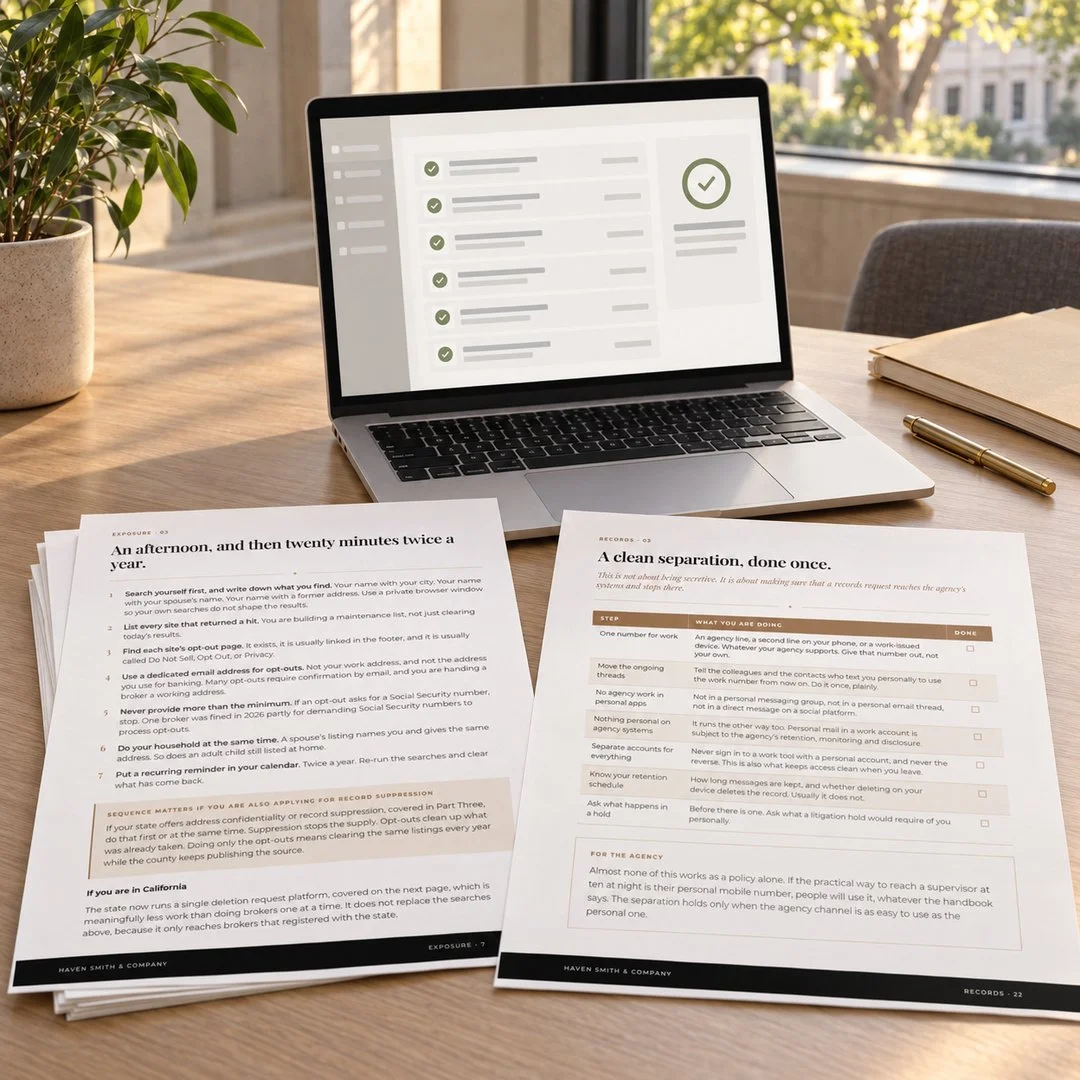
People-search sites are built from property deeds, voter registration, court filings, business filings, marriage and divorce records and professional licenses. Doing the removals yourself works better than paying a service. An afternoon, then twenty minutes twice a year. Including what California’s single deletion request does and where it stops.
The four exposures that are not brokers
The fitness app, which is the best documented of all of them. The interior photographs of your house, still online from the last time it sold. The obituary, which is a targeting document. And the photographs, with a claim we decline to repeat.
Suppression at the source
Address confidentiality programs, and the fact that voter rolls and property records are separate applications with separate rules. The laws that let you demand removal and where they currently stand. And a short list of what an agency should be doing for its people rather than leaving to them.
Your phone, and the public records law
Three states, three different answers about whether a personal device comes into scope. The part nobody warns you about is the search rather than the disclosure. And how to make a clean separation once, so the question stops arising.
What is hitting agencies
What the incident counts show, and what they cannot show. Two things changed in 2026, and both move where the effort is worth spending.
What is really required
Who the criminal justice information rules cover and who they do not. What changed, and what training is genuinely required. And the mandate that covers city hall rather than only the police department.
Free help, and what stopped being free
Federal funding for the multi-state information sharing center ended on 1 October 2025. What is still free, what to expect from it, and why your own state may be running the best program available to you.
Why this guide exists
Eleven websites, written on a piece of paper.
In June 2025 the man charged in the attacks on two Minnesota legislators and their spouses was found with a handwritten list in his vehicle. It named eleven people-search websites, with notes on which ones were free and what each one required. His notebooks listed more than forty-five state and federal officials, with addresses.
None of those addresses were leaked. They were assembled from records that are public by law, and the eleven sites on that list are the same ones anybody can use this afternoon.
Separately, the free tier of the multi-state information sharing and analysis center ended on 1 October 2025 after more than twenty years. Membership went from 18,574 organizations to 5,618, a decline of roughly seventy percent. A small agency that relied on it has to decide what replaces it, and the guide is specific about what is still free.
Honestly
Who this is for, and who it is not.
This is for you if
- You work in public service and your name, role or address is published somewhere because of it.
- You run or support a small agency with no dedicated security staff.
- You have been told there is a training requirement and nobody can say which one applies to you.
- Your personal phone has agency email on it and nobody has told you what that means for a records request.
- Your free security support changed in October 2025 and you have not replaced it.
This is not for you if
- You are looking for a compliance framework or an audit deliverable. This will not satisfy an auditor.
If you want more than this
The personal half, and the rest.
Half of this guide is about your own exposure rather than your agency’s. If that is the half you care about, the personal guides go further.
The Digital Life Management System $179
Three months, two hours a week. Organize, protect, prepare, with the Workbook and the Record.
Protecting Yourself from AI Fraud and Scams $19
One verification habit that holds up against a cloned voice, and takes ten seconds.
The Digital Life Management System for Your Team $99
For the people you work with, covering their personal digital lives. From $99 a person.
Before you buy
The questions people ask.
Is this a compliance guide?
No. It will not satisfy an auditor or map to a framework. It covers what is genuinely required of you and then what is worth doing, which is a different job.
Does it name the people-search sites?
Yes, and it covers doing the removals yourself rather than paying a service, because doing it yourself works better and the subscription services keep charging after the records come back.
I am not in law enforcement. Is this still for me?
Yes. The guide is explicit about who the criminal justice information rules cover and who they do not, and about the mandate that covers city hall rather than only the police department.
Does it cover whether my personal phone is subject to a records request?
It covers three states with three different answers, and the practical point that the burden is the search rather than the disclosure. It is not legal advice about your own state.
What changed about the free security support?
Federal funding for the multi-state information sharing and analysis center ended on 1 October 2025 and there is no free membership tier. The guide covers what is still free and what your state may be running instead.
Is this legal advice?
No. It is education about exposure and organization. Where something matters, take it to counsel.
Can I get a refund?
Yes. Write to us within seven days and we will refund you.
Find it, get it removed, and keep it down.
The brokers, the four exposures that are not brokers, the records law, and what is still free. By the end you know what is published, and how to keep it down. One payment of $29.
Instant download · No login · Seven-day guarantee