
The Complete Digital Travel Preparation Checklist
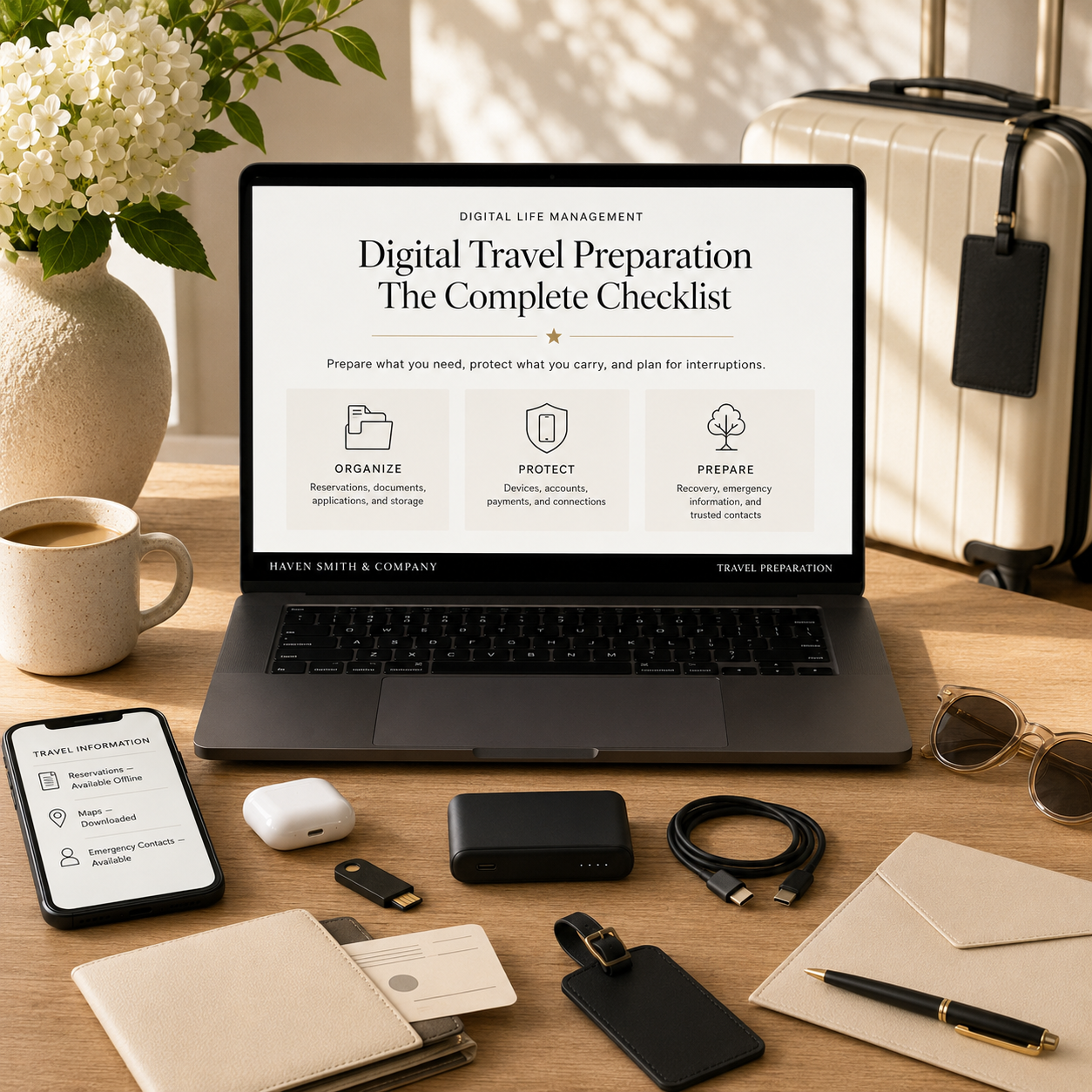
How to Prepare Your Devices, Accounts, Payments, Records, and Important Information Before You Travel
The device in your hand may hold your boarding pass, hotel reservation, directions, payment access, family communication, photos, identity information, and the recovery path for several important accounts.
That makes digital preparation an important part of travel planning.
Travel temporarily changes how you use your digital life. You may access accounts from unfamiliar locations, depend more heavily on your phone, connect through unfamiliar networks, make purchases from new merchants, and receive unexpected messages about reservations or itinerary changes.
At the same time, household, family, caregiving, and business responsibilities may continue while you are away.
Digital travel preparation does not require carrying every record you own or expecting something to go wrong. It means making sure you can access what you need, protect what you carry, recover from common disruptions, and give the appropriate people a clear place to begin while you are away.
Use this checklist to:
Organize what you will need
Protect what you will carry
Prepare for interruptions and responsibilities
Complete the tasks that apply to your trip and circumstances. A short domestic trip may require less preparation than an extended international trip, a family vacation, or business travel involving sensitive information.
Part One: Organize What You Will Need
Travel information can become scattered across email, text messages, calendars, airline applications, hotel accounts, screenshots, and printed documents. Begin by bringing essential details together in a way that remains protected and accessible.
The goal is to reduce searching without creating one unsecured file containing every piece of personal information you own.
Review Your Reservations and Confirmations
Gather the information you expect to use during the trip, including:
Flight, train, or transportation confirmations
Hotel and lodging information
Rental-car reservations
Event tickets
Dining reservations
Tour and activity confirmations
Travel insurance details
Loyalty-program information
Parking reservations
Ground transportation
Pet, childcare, caregiving, or home-service arrangements
Create one practical travel folder or itinerary for non-sensitive information. Depending on your preferences, this might be a protected note, calendar, email folder, travel application, or document available offline.
Include addresses, confirmation numbers, dates, times, and verified contact information. Avoid copying unnecessary financial, identity, or account-access information into the same document.
Organize Your Travel Documents
The documents you need will depend on your destination, transportation, activities, health, and family circumstances.
Your list may include:
Government-issued identification
Passport
Visa information
Travel insurance
Healthcare information
Prescription information
Emergency contacts
Accessibility information
Vehicle registration and insurance
Consent or custody documentation
Information required for children or dependent adults
Protected digital copies may be useful when appropriate, but do not store sensitive identity documents in an unsecured email, publicly shared folder, or ordinary photo album.
A limited paper backup of essential information can also be helpful if a device or connection is unavailable. Protect paper documents containing personal information and carry only what the trip requires.
For international travel, verify current entry, identification, health, and emergency requirements through official government, transportation, and destination sources. Requirements can change, so confirm them for your specific trip rather than relying on an old checklist.
Review Your Travel Applications
Travel frequently requires new applications for airlines, hotels, rental cars, transit, maps, translation, weather, communication, and mobile service.
Before leaving:
Download applications from legitimate stores
Confirm that you can sign in
Review application permissions
Update recovery information
Download tickets or reservations
Check whether important features work offline
Remove stored payment information you do not need
Delete abandoned travel applications from previous trips
Do not wait until you are standing in an airport, rental facility, or hotel lobby to discover that you cannot access an account or receive a verification code.
Save Essential Information for Offline Access
Internet access can be slow, expensive, restricted, or temporarily unavailable. Save appropriate offline copies of the information you would still need without a connection.
This may include:
Boarding passes
Transportation confirmations
Hotel names and addresses
Essential telephone numbers
Maps and directions
Basic itinerary information
Insurance contacts
Reservation numbers
Emergency information
Use care when saving screenshots. A screenshot can be convenient, but an ordinary photo gallery should not become an unsecured collection of passports, payment cards, medical records, and other sensitive documents.
Review Device Storage
Travel can generate photos, videos, tickets, downloads, maps, and application data. Check that your devices have enough available storage before departure.
You may want to:
Remove unnecessary downloads
Delete obvious screenshot clutter
Move large files you do not need during the trip
Remove unused applications
Confirm photo-backup settings
Download media for offline use
Leave enough space for new photos and videos
Do not begin a major photo-library migration or complete device reorganization the night before leaving. Make simple, low-risk improvements and schedule larger projects for another time.
Part Two: Protect What You Will Carry
Travel places greater responsibility on the devices, accounts, payment methods, and recovery paths you use every day.
Focus first on the accounts and devices that protect access to everything else.
Update and Back Up Your Devices
Complete legitimate updates early enough to resolve unexpected problems before departure.
For each phone, tablet, or computer you plan to carry:
Install legitimate updates
Confirm that applications are current
Complete a backup
Verify that the backup finished
Review screen-lock settings
Check device-location features
Record necessary device and carrier information
Remove sensitive files you do not need
Confirm available storage
Pack appropriate chargers and adapters
A backup is most useful when you know it can be recovered. If possible, test the recovery of an important file before the trip.
Review Your Most Important Accounts
Travelers often depend heavily on email, cloud storage, banking, mobile service, and primary platform accounts.
Prioritize:
Your root or primary email
Password manager
Apple, Google, or Microsoft account
Mobile carrier
Banking and payment accounts
Primary cloud storage
Important work or business accounts
Domain and website accounts
For each important account, review:
Whether the password is unique
Available multifactor authentication
Recovery email address
Recovery mobile number
Backup codes
Trusted devices
Recent account activity
Security alerts
Remove outdated recovery information and devices you no longer use. Pay particular attention to accounts connected to an old email address, mobile number, employer, or device.
Prepare for Multifactor Authentication and Recovery
Multifactor authentication often depends on the phone being carried. Before departure, consider how you would access important accounts if that phone were lost, damaged, or unable to connect.
Confirm that:
Authentication applications work
Recovery email addresses are accessible
Recovery mobile numbers are current
Backup codes have been saved securely
Trusted devices are accurate
Your password manager is accessible
Critical accounts have an appropriate recovery path
Do not keep your only recovery code in the same unsecured bag, phone, or wallet as the device it is meant to recover. The right arrangement will depend on the account, trip, and people involved, but the goal is to reduce dependence on one item.
Review Your Mobile Service
Check your current mobile plan before relying on it in another region or country.
Review:
Domestic or international coverage
Roaming settings
Data limits
Available hotspot service
International plans
eSIM options
Carrier account access
Carrier security protections
The current process for reporting a lost phone
Whether account verification depends on the traveling phone number
If you plan to use a new eSIM or international service, set it up early enough to understand how it works. Record your primary carrier information and make sure you can reach the carrier if the phone becomes unavailable.
Plan for Internet Access
Unfamiliar networks require additional care, but you do not need to avoid every connection outside your home.
When practical:
Prefer cellular data or a personal hotspot for sensitive activity
Verify a network’s correct name before connecting
Turn off automatic connection to unfamiliar networks
Avoid accessing important accounts on shared computers
Keep devices locked and updated
Sign out of accounts you use on another device
Bring your own charger
Use a standard electrical outlet when available
A virtual private network may protect some network traffic, but it does not make a fraudulent website, malicious download, or unsafe decision harmless. Continue verifying websites, messages, and requests even when using one.
Prepare Your Payment Methods
Travelers should have more than one legitimate way to pay without carrying every financial card they own.
Before leaving:
Confirm that payment cards are active
Check expiration dates
Review current issuer travel policies
Turn on useful transaction alerts
Verify the contact information used for alerts
Record appropriate issuer contact information
Bring a backup payment method
Store backup cards separately
Review mobile-wallet access
Understand foreign-transaction fees when applicable
Remove outdated cards from travel applications
Financial institutions have different travel-notification policies. Verify current guidance directly with each issuer rather than assuming that a travel notice is always required.
Reduce Unnecessary Exposure
You do not need to carry every file, account, card, or record associated with your digital life.
Consider removing or securely storing:
Unnecessary work files
Sensitive client information
Old downloads
Personal records not needed during the trip
Saved cards in unused applications
Accounts that remain signed in without a travel purpose
Photos of identity or financial documents stored in an ordinary gallery
This is particularly important for business owners and professionals carrying client, employee, financial, or proprietary information.
Part Three: Prepare for Interruptions and Changes
Preparation is not based on assuming the worst. It gives you a practical recovery path when an ordinary disruption occurs.
A delayed flight, damaged phone, locked account, failed connection, or unexpected payment problem becomes easier to manage when you have already decided where to begin.
Create a Lost-Device Plan
Know what you would do if your phone, tablet, or computer were unavailable.
Your plan may include:
Locating the device
Locking or erasing it remotely
Contacting the mobile carrier
Protecting your primary email account
Contacting important financial institutions
Accessing your password manager
Using saved recovery codes
Contacting a trusted person
Finding necessary device information
Reaching travel providers without the missing device
Record the steps and verified contact information in a protected location you can reach without the device.
Prepare for Itinerary Changes
Messages involving delayed flights, canceled reservations, rebooked hotels, and urgent payment requests may be legitimate. They may also be attempts to capture account information, payment details, or verification codes.
When something changes unexpectedly:
Open the official application independently
Visit the company’s known website
Call a verified number
Review the reservation directly
Confirm payment requests
Protect confirmation and verification codes
Avoid relying on the link or number supplied in the unexpected message
When a message creates urgency, pause and return to a channel you already trust.
Recognize Common Travel Fraud Patterns
Travel-related fraud may involve:
Fake booking websites
Impersonation of airlines or hotels
Fraudulent itinerary-change messages
Rental-listing fraud
Payment requests outside a legitimate platform
Misleading QR codes
Fake customer-service numbers
Requests for verification codes
Stolen or misused payment information
False claims about reservations or refunds
No single checklist can identify every fraudulent message. The more reliable practice is to verify unexpected changes through an independently located, trusted channel.
Protect Your Itinerary and Location Information
Use care when publicly sharing:
Exact departure dates
Information indicating that your home is empty
Hotel and room details
Boarding passes
Confirmation numbers
Identification documents
Family members’ locations
Real-time travel movements
You can still share travel experiences. Consider posting after leaving a location or returning home when that better fits your circumstances.
Prepare Healthcare and Accessibility Information
Travelers may need access to:
Medication lists
Prescription information
Allergies
Healthcare providers
Insurance contacts
Accessibility information
Emergency contacts
Information for children or dependent adults
Keep this information protected but accessible enough to be useful. Families traveling with children, older relatives, or people with disabilities may need additional documentation, equipment information, communication plans, or emergency contacts.
Prepare Someone at Home
A trusted person may need basic information about your trip and the responsibilities continuing while you are away.
Depending on your circumstances, that person may need to know:
How to reach you
Basic itinerary and lodging information
Emergency contacts
Home, pet, childcare, or caregiving responsibilities
How to contact an appropriate adviser
Where essential instructions are stored
What constitutes a genuine emergency
Which information should remain private
They do not need unrestricted access to your entire digital life. They need an appropriate starting point.
For a complete handoff, see What a Trusted Person Should Know Before You Leave Town.
During the Trip
Good preparation should allow you to enjoy the trip rather than continuously monitor your accounts.
While traveling:
Keep devices physically controlled
Use screen locks
Avoid leaving devices visible in vehicles
Review meaningful account alerts
Protect verification codes
Verify unexpected itinerary changes independently
Avoid sensitive activity on unfamiliar shared devices
Use trusted charging equipment
Keep important documents protected
Back up important photos
Limit public sharing of sensitive travel details
If an account alert or payment problem appears, address it through a known application, website, telephone number, or financial institution.
After You Return
Travel preparation should include a short post-travel review.
After returning:
Review financial transactions
Investigate unfamiliar charges
Archive receipts and travel records
Back up and organize photos
Remove unnecessary boarding passes and screenshots
Delete temporary travel applications
Remove temporary eSIMs or data plans when appropriate
Review new account permissions
Sign out of hotel televisions and shared entertainment devices
Remove temporary file sharing
Restore normal mobile and notification settings
Record lessons for the next trip
Update your personal travel checklist while the experience is still fresh. A few notes about what worked, what was missing, and what you did not need can make the next trip easier.
A Practical Travel-Preparation Timeline
Two to Four Weeks Before Travel
Review identification, travel documents, mobile coverage, account recovery, payment methods, available device storage, and any current official travel requirements.
This is also the best time to resolve expired documents, carrier questions, accessibility arrangements, or missing recovery information.
One Week Before Travel
Update and back up devices, organize reservations, save appropriate offline information, confirm authentication and recovery codes, and prepare healthcare and emergency information.
Brief the appropriate trusted person about the trip and any responsibilities continuing at home.
Twenty-Four Hours Before Departure
Charge devices and battery packs, confirm transportation, download boarding passes, check mobile settings, pack chargers and adapters, and confirm that unnecessary sensitive material is not being carried.
Avoid making major account, device, or storage changes at the last minute.
After Returning
Review transactions, organize receipts and photos, remove temporary access, and update your checklist for the next trip.
A short post-travel review completes the process and prevents temporary travel information from becoming permanent clutter.
What Not to Do Before Traveling
Avoid creating unnecessary dependence or making last-minute changes that are difficult to reverse.
Do not:
Store every sensitive document in one unsecured folder
Depend entirely on one device
Carry every payment card
Update important devices immediately before departure
Post complete travel details publicly
Store recovery codes beside the device they recover
Assume every itinerary-change message is legitimate
Use unexpected customer-service numbers without verification
Close or alter important accounts immediately before leaving
Attempt a complete digital reorganization the night before departure
The purpose of preparation is to make the trip easier. Focus on what the trip actually requires and schedule unrelated cleanup projects for later.
Get Help Preparing Your Digital Life for Travel
Strengthen Your Digital Safety
The Digital Safety Course helps you protect the accounts, devices, information, and access points you rely on every day.
Travel places greater responsibility on your primary email, mobile account, password manager, financial accounts, authentication methods, recovery paths, and backups. The course gives you a guided process for strengthening those foundations before you depend on them away from home.
Explore the Digital Safety Course
Record Important Information
The Digital Life Management Workbook™ is a practical spreadsheet for tracking accounts, devices, storage locations, backups, important contacts, digital responsibilities, and information you may need to review before traveling.
Explore the Digital Life Management Workbook
Complete the Full Initial Cleanup
If travel preparation reveals that your accounts, files, protections, backups, and important information need more than a pre-trip review, the Digital Life Management Course Bundle guides you through the complete Initial Cleanup.
The bundle includes the connected areas of Digital Organization, Digital Safety, and Digital Legacy & Estate Planning.
Start the Complete Initial Cleanup
Get Personalized Guidance
A Digital Life Strategy Session may be appropriate if you are preparing for an extended trip, managing complicated family or caregiving responsibilities, traveling with sensitive business information, or unsure which issues deserve attention first.
Book a Digital Life Strategy Session
Frequently Asked Questions
How should I prepare my phone before traveling?
Back up the phone, install legitimate updates early, review storage, use an appropriate screen lock, check device-location features, confirm account-recovery information, and make necessary travel information available appropriately offline.
What digital documents should I bring when traveling?
The answer depends on the destination and trip. Common examples include reservations, required identification information, insurance contacts, healthcare information, emergency contacts, and transportation details. Verify current requirements through official sources.
Should I use public Wi-Fi while traveling?
Use care with unfamiliar networks. Verify the network, avoid unnecessary sensitive activity, turn off automatic connection, and use cellular data or a personal hotspot when practical.
Should I notify my bank before traveling?
Policies differ by financial institution. Review current travel guidance for each issuer and confirm that transaction alerts and contact information are current.
What should I do if I lose my phone while traveling?
Use available device-location and remote-lock features, contact your mobile carrier, protect your primary email and financial accounts, and use the recovery information you prepared before leaving.
Should I bring printed copies of travel information?
A limited printed backup of essential, non-sensitive information can be useful when a device or connection is unavailable. Protect any printed documents that contain personal information.
Can Haven Smith & Company help me prepare for travel?
Yes. You can enroll in the Digital Safety Course, use the Digital Life Management Workbook™, complete the full Course Bundle, or book a Digital Life Strategy Session for personalized guidance.
Prepare the Digital Parts of Your Trip
Good digital travel preparation does not require carrying every record, downloading every available application, or expecting something to go wrong. It means knowing what you will rely on and reducing unnecessary dependence on one device, one account, one payment method, or one connection.
Organize the information you will need. Protect the accounts and devices you will carry. Prepare your recovery paths and the people who may need to help while you are away.
Then travel knowing that the digital parts of your trip have received the same practical preparation as the rest of your plans.
Prepare Your Digital Life for Travel