
How to Clean Up Your Email Without Chasing Inbox Zero
A Practical Method for Separating Email Accounts, Applying the Five D’s, and Keeping Your Inbox Focused on What Comes Next
An inbox can contain thousands of messages and still function. It can also contain only a few messages while the email account itself remains poorly managed.
The unread count receives most of the attention because it is visible. You may spend hours deleting promotions, moving messages into folders, and trying to reach inbox zero. A few days later, more email arrives and the clutter begins rebuilding.
The problem was never only the number of messages.
Email management begins with larger questions. Which email accounts do you have? What job does each address perform? Which important accounts depend on each address? How exposed is that address? What should happen to the information arriving in each inbox?
A successful email cleanup is not measured only by how many messages remain. It is measured by whether your accounts have clear roles and whether incoming messages end with decisions.
The Haven Smith & Company method begins with two connected practices:
Build an email architecture by assigning different jobs to different accounts.
Process the messages inside each inbox using the Five D’s.
The goal is not to save every email or force every inbox to zero. The goal is to know which account should receive the message, decide what deserves your attention, and keep each inbox focused on what comes next.
Part One: Inventory and Edit Your Email Accounts
Begin With Your Email Accounts, Not Your Inbox
Most email-cleanup advice begins inside one inbox. A complete cleanup should begin one level higher, with an inventory of every email account you use or may still need.
You may have:
A primary personal address
One or more business addresses
An old address still connected to important services
An address used for shopping and promotions
An employer or school address
An address connected to password recovery
An email account created through an internet or mobile provider
An address used for community or volunteer responsibilities
For each account, record:
Complete email address
Provider
Current purpose
Whether it is actively monitored
Important accounts connected to it
Recovery email address
Recovery phone number
Whether multifactor authentication is enabled
Whether another person has access
Whether the account should be retained, transitioned, or closed
Which email role it should serve
This inventory can be recorded in the Digital Life Management Workbook™. Do not record passwords, recovery codes, or other authentication secrets in an ordinary spreadsheet. Use appropriate security tools for that information.
The inventory may reveal that several addresses perform the same job, an old account still receives password resets, or a heavily exposed address is connected to an account that deserves greater isolation. Those discoveries should be addressed before you spend hours deleting promotional email.
Build a Three-Account Email Architecture
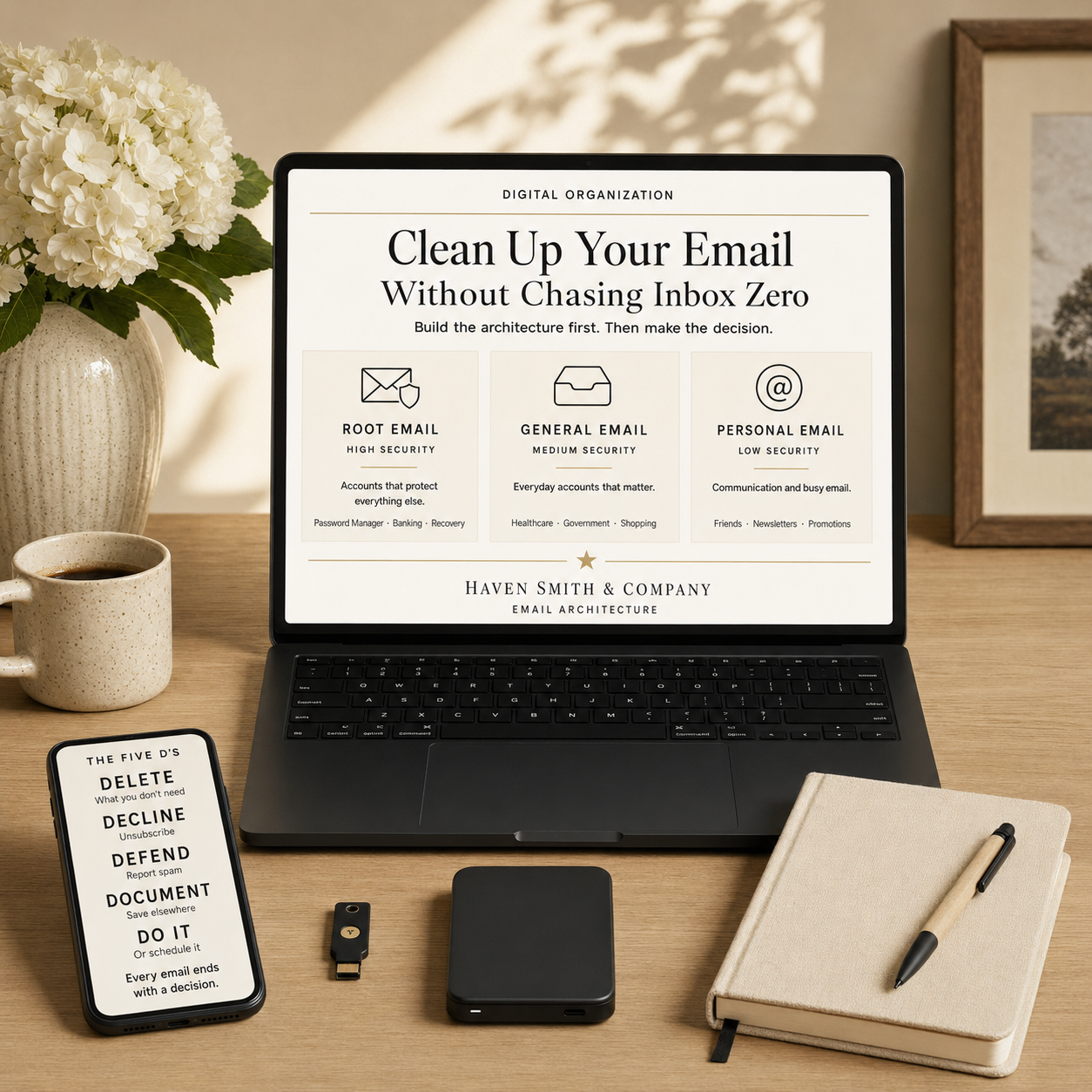
A well-designed email architecture helps organize your digital life by assigning different jobs to different email accounts.
For most people, three thoughtfully managed email accounts provide a useful balance between simplicity and function:
Root Email — High Security
General Email — Medium Security
Personal Email — Low Security
These labels do not mean that any account should use a weak password or careless protection. Every email account should receive appropriate security.
The security levels describe the role, expected exposure, and degree of isolation. The Root Email is the most restricted. The Personal Email is expected to be the busiest and most widely shared.
Root Email — High Security
Your Root Email should be used only for the accounts that protect everything else.
These may include:
Password manager
Primary banking
Apple ID, Google Account, or Microsoft Account
Primary financial recovery accounts
Domain registration, when applicable
Primary cloud recovery
The Root Email should not be used for ordinary communication, shopping, newsletters, social media, community groups, promotions, or random registrations.
Its value comes from isolation. Fewer people and companies know the address. It appears on fewer mailing lists. It receives less promotional email. Important account and recovery notices are therefore easier to recognize.
The Root Email should use:
A strong, unique password
Appropriate multifactor authentication
Current recovery information
Securely stored recovery codes
Regular review of active sessions and trusted devices
Limited third-party access
Consistent monitoring
Avoid forwarding the Root Email into a busier inbox if doing so undermines the separation you created. Do not publish the address or use it as your everyday contact information.
You do not need to move every important account immediately. Begin with the accounts that support access to other parts of your digital life:
Password manager
Primary identity account
Primary banking
Primary cloud account
Primary financial recovery accounts
Domain registrar, if applicable
Record which accounts have been updated and which still require attention.
General Email — Medium Security
Your General Email supports the everyday accounts that matter but do not require the same isolation as the Root Email.
These may include:
Healthcare portals
Government services
Insurance and utilities
Schools
Employers
Professional organizations
Shopping
Airlines and travel
Streaming services
Subscriptions
Most online accounts
This will probably be your busiest administrative email account. It may receive receipts, appointment notices, statements, account updates, travel information, school communication, renewal notices, and routine messages from services you use regularly.
The General Email still requires a strong, unique password, appropriate multifactor authentication, current recovery information, and regular review. “Medium Security” describes its greater everyday exposure compared with the Root Email. It does not mean the account should receive weaker protection.
Because this inbox supports several active responsibilities, it benefits from a small number of useful folders, carefully chosen filters, and regular application of the Five D’s.
Personal Email — Low Security
Your Personal Email is used for personal communication and email you do not mind becoming busy.
These messages may include:
Friends
Family
Community groups
Clubs
Newsletters
Promotional email
Mailing lists
Random sign-ups
Social invitations
This account can absorb the messages most likely to increase in volume or be shared broadly. Separating that traffic helps prevent promotional email and mailing lists from obscuring Root Email notices or important administrative communication in the General Email.
“Low Security” does not mean this account should use weak protection. It describes the account’s expected exposure and lower need for isolation.
The Personal Email should still use a unique password, appropriate multifactor authentication, current recovery information, and regular spam review.
Transition Into the Architecture Gradually
Do not create three new email addresses and attempt to change every connected account in one afternoon.
Begin with the accounts you already have. Decide whether an existing address can serve each role and create a missing address only when necessary.
A practical transition process is:
Inventory current email accounts.
Assign each account a role.
Create a missing account when needed.
Move the highest-priority accounts first.
Update recovery information.
Continue monitoring old addresses.
Record completed changes.
Retain, transition, or close old accounts after review.
An email address used for many years may still be connected to banking, healthcare, government services, cloud storage, subscriptions, and password recovery. It should not be closed simply because it no longer fits the new architecture.
Review Connected Services Before Retiring an Address
Before abandoning or closing an email account, review connections to:
Financial services
Healthcare portals
Government accounts
Cloud storage
Shopping accounts
Travel services
Subscription services
Social media
Business platforms
Password recovery
Family or shared services
Continue monitoring the old address during the transition. Incoming messages may reveal accounts or responsibilities you overlooked during the initial inventory.
Assign the account one of three statuses:
Retain
The account has a clear, active role. Continue monitoring and protecting it.
Transition
Important accounts, records, contacts, or recovery connections still need to be moved.
Close
The account no longer serves a useful purpose, and its connected services, records, recovery information, and responsibilities have been addressed.
Removing an email account from a phone or computer does not necessarily close it with the provider. Follow the appropriate closure process only after the transition is complete.
Part Two: Inventory and Edit Your Inboxes
Treat the Inbox as a Workspace
Once the email accounts have clear roles, address the messages inside them.
Your inbox is where information arrives—not where every message and record permanently belongs. It should remain focused on what requires attention next.
Most email does not require a response. Many messages simply need to be:
Deleted
Declined
Unsubscribed from
Reported
Documented
Archived
Completed
Scheduled
Avoid opening and rereading the same message without deciding what happens next. Every email should end with a decision.
The Five D’s provide that decision process.
The Five D’s of Email Cleanup
D1: Delete What You Don’t Need
Delete messages that no longer provide practical, personal, administrative, financial, legal, or historical value.
Examples may include:
Expired promotions
Old delivery notifications
Duplicate automated notices
Obsolete event reminders
Routine confirmations no longer needed
Temporary reference messages
Newsletters already read and no longer useful
Notifications whose purpose has passed
Do not delete messages merely because they are old. An older email may document a payment, agreement, decision, responsibility, or relationship that still matters.
Evaluate the message according to its value and the responsibility it supports.
Delete in Batches
If the inbox contains thousands of messages, do not begin by reading each one from oldest to newest.
Work in groups:
Search for one sender.
Review one message category.
Group messages by subject.
Filter by date.
Begin with recognizable promotional senders.
Review repeated automated notices.
Work in short, defined cleanup sessions.
Batch processing allows you to make the same decision about several similar messages without repeatedly reconsidering the category.
Delay permanently emptying deleted items until you have reviewed the cleanup results and understand the provider’s recovery process.
D2: Decline & Unsubscribe
Deleting an old promotional email removes one message. Unsubscribing reduces future volume.
Use Decline & Unsubscribe for:
Newsletters you no longer read
Retail promotions
Community updates no longer relevant
Mailing lists
Product announcements
Recurring offers
Social invitations
Clubs or groups you have left
Notifications that can be disabled at the source
“Decline” also includes requests, invitations, groups, and recurring commitments you no longer wish to receive or participate in.
Unsubscribe from legitimate senders you recognize. If the email appears suspicious, do not select an unfamiliar unsubscribe link. Use the email provider’s spam, junk, or phishing-reporting tools instead.
When possible, review notification settings at the source. A service may allow you to retain important account or security notices while stopping promotional email.
D3: Defend & Report Spam
Suspicious messages should not be handled like ordinary newsletters.
Use the provider’s spam, junk, or phishing-reporting controls when a message appears deceptive or malicious. Reporting can help the provider filter related messages and remove the message from the normal inbox workflow.
When handling a suspicious email:
Do not reply.
Do not select unfamiliar links.
Do not download unexpected attachments.
Do not use an unsubscribe link in the message.
Report it through the provider’s controls.
Block the sender when appropriate.
Verify unexpected requests through a separate trusted channel.
Review account activity when the message appears connected to a real account.
A message may use the name of a company, colleague, friend, or family member without actually coming from that person or organization. Verify through contact information you already trust rather than responding through the suspicious message.
Email cleanup and email protection overlap here. The objective is not simply to remove unwanted messages from view. It is to recognize when the appropriate decision is to defend the inbox and report the message.
D4: Document & Save Elsewhere
Important information often arrives through email, but the inbox should not be its only permanent home.
Messages and attachments may need to be documented elsewhere when they contain:
Financial records
Healthcare information
Insurance documents
Contracts
Business receipts
School records
Property information
Travel documents
Warranty information
Estate planning information
Instructions another person may someday need
When a record should be retained:
Download the appropriate document.
Give it a clear filename when needed.
Move it into the permanent folder connected to the responsibility.
Confirm that it is appropriately backed up.
Record the storage location when it is important.
Archive or delete the email according to its remaining value.
The email may still need to be retained when it documents context, a decision, or a conversation. Document & Save Elsewhere does not automatically require deleting the original message.
It means the mailbox should not be the only place where an important record can be found.
For help building the permanent storage structure, see How to Organize Computer Files and Folders So You Can Find What You Need and How to Organize Cloud Storage and External Drives Without Creating More Confusion.
D5: Do It or Schedule It Now
Messages requiring action should not remain in the inbox indefinitely as vague reminders.
When an email requires something from you, either:
Complete the task
Send the response
Make the decision
Add the task to an appropriate list
Schedule time on the calendar
Set an appropriate reminder
Move the message into a clearly defined waiting or follow-up location
The email itself is not always the best place to manage the task. If the work will be completed later, record what needs to happen and when you will return to it.
After the task is complete, archive or delete the message according to its remaining value.
The goal is to stop reopening the same message and making the same incomplete decision.
Use Folders, Labels, and Filters to Support the Five D’s
Use a Small Number of Useful Folders
Folders or labels can support decisions made through the Five D’s. They should not replace those decisions.
A practical structure might include:
Action or Scheduled
Messages connected to work already placed on a task list, calendar, or other appropriate location.
Waiting or Follow-Up
Messages related to something another person must complete or a matter that needs to be checked again.
Records to Save
A temporary holding area for documents that still need to be downloaded, renamed, stored, or recorded elsewhere.
Reference
Messages that remain useful inside email and are likely to be needed again.
Archive
Completed communication worth retaining for future search or reference.
Not everyone needs all of these folders. You may need only Waiting and Archive, or you may need another category related to business, school, caregiving, or household responsibilities.
Avoid creating a folder for every sender, company, topic, and minor project. Too many folders create another filing burden.
A folder should support a recurring decision. If it only postpones the decision, it is another inbox.
Use Filters and Rules Carefully
Filters and rules can automatically direct predictable messages, but they can also hide important information.
Useful candidates for filtering may include:
Routine newsletters
Receipts from a recognized provider
Community announcements
Automated reports
Low-priority notifications
Be careful about automatically hiding:
Financial notices
Security alerts
Healthcare messages
Government communication
School notices
Time-sensitive business communication
Review filters and rules periodically. A rule created years ago may still be moving messages into a folder no one checks, or a sender may begin delivering a different type of information.
Automation should reduce repetitive sorting without making important messages invisible.
Understand Archive Versus Delete
Archiving removes a message from the active inbox while retaining it in the email account. Deleting moves the message toward removal according to the provider’s trash and retention process.
Use:
Inbox for messages still requiring attention or a decision.
Folder or label for a defined workflow or reference need.
Archive for completed messages worth retaining.
Delete for messages that no longer provide sufficient value.
Archiving every message automatically is not the same as making a decision. It removes the visible clutter but does not reduce unnecessary subscriptions, save important records elsewhere, or identify current responsibilities.
Do Not Use Unread Status as Your Task List
Unread does not necessarily mean unhandled. A message may have been reviewed through a notification, while an opened message may still require significant action.
Use a clear folder, flag, task list, calendar, or reminder for work that still needs to be completed. Do not rely on repeatedly marking messages unread and hoping the visual indicator will remain meaningful.
The objective is to know what requires attention and when—not simply whether the message appears bold.
How to Clean Up Thousands of Emails
A large backlog does not need to reach zero before the inbox becomes useful.
Begin with one email account. Confirm its role in the three-account architecture, then apply the Five D’s in batches.
A practical sequence is:
Choose one email account.
Confirm whether it serves as Root, General, or Personal Email.
Review obvious promotional senders.
Unsubscribe from legitimate sources you no longer want.
Report suspicious messages.
Delete high-confidence clutter in groups.
Search for important records.
Save necessary documents elsewhere.
Identify messages requiring current action.
Do or schedule those tasks.
Archive completed communication worth retaining.
Stop after a defined cleanup period.
You might work by sender, year, subject, or message category. Twenty focused minutes spent making clear decisions is more useful than several hours spent opening messages without resolving them.
If the oldest messages no longer affect current responsibilities, you may decide to archive a historical group and concentrate on recent email first. That choice depends on what the messages contain and whether important records still need to be removed or documented.
Maintain Your Email Architecture and Inboxes
Daily or on Working Days
Apply the Five D’s to current messages:
Delete What You Don’t Need
Decline & Unsubscribe
Defend & Report Spam
Document & Save Elsewhere
Do It or Schedule It Now
The inbox does not need to be empty at the end of the day. The messages that remain should have a reason to be there.
Weekly
Review Action or Scheduled messages.
Review Waiting or Follow-Up messages.
Process the Records to Save folder.
Archive completed communication.
Unsubscribe from unnecessary legitimate email.
Complete one small batch of accumulated cleanup.
Monthly
Review recurring newsletters and automated notices.
Check filters and rules.
Review mailbox storage when relevant.
Confirm that important records have been moved elsewhere.
Process a batch of historical email.
Review accounts still in transition.
Quarterly
Review the roles of Root, General, and Personal Email.
Confirm recovery email addresses and phone numbers.
Review active sessions and trusted devices.
Review forwarding rules.
Review third-party mailbox access.
Check whether important accounts use the appropriate address.
Revisit email accounts marked for transition.
Annually
Update the complete email inventory.
Confirm that the three-account architecture still supports your responsibilities.
Review connected services.
Close accounts that have completed the transition process.
Update the Digital Life Management Workbook™.
Confirm that the Root Email remains restricted.
Common Email-Cleanup Mistakes
Beginning With the Unread Count
The unread count does not show whether your accounts have appropriate roles, important records are stored correctly, or messages requiring action have been scheduled.
Begin with the email architecture and then make decisions about messages.
Using the Root Email for Everyday Accounts
Shopping, newsletters, promotions, mailing lists, and random sign-ups increase exposure and traffic. Reserve the Root Email for the limited accounts that protect everything else.
Treating “Low Security” as Permission to Use Weak Protection
Every account should use appropriate security. The label describes exposure and isolation, not the quality of the password or authentication.
Moving Every Message Into Folders
Folders can hide a backlog without resolving it. Use the Five D’s before filing messages.
Unsubscribing From Suspicious Email
Use unsubscribe controls for recognized, legitimate senders. Report suspicious email instead of interacting with unfamiliar links.
Leaving Important Documents Only in Email
Download important records, store them with the responsibility they support, confirm backup, and record the location when necessary.
Using the Inbox as a Task List
A message requiring future work should be completed, scheduled, or moved into a defined workflow. Repeated rereading is not task management.
Closing an Old Email Account Too Quickly
Review connected accounts, recovery relationships, records, contacts, and incoming messages before closing an address.
Creating More Accounts Than You Can Manage
The three-account architecture is designed to balance separation with simplicity. Additional accounts may be appropriate for business or specialized responsibilities, but every account must have a clear role and be monitored.
Build an Email Architecture You Can Maintain
The Digital Organization Course is Month One of the Digital Life Management System™. It guides you through inventorying your email accounts, assigning appropriate roles, editing accumulated messages, saving important records, and documenting the accounts and responsibilities connected to your digital life.
Cleaning one inbox may reduce immediate clutter. Building the right email architecture helps prevent important access, everyday administration, and high-volume communication from becoming mixed together again.
Explore the Digital Organization Course
The Digital Life Management Workbook™ provides a practical spreadsheet for recording your email addresses, Root–General–Personal roles, connected accounts, recovery information, transition decisions, and digital responsibilities.
Explore the Digital Life Management Workbook™
Your Root Email may support your password manager, primary identity account, banking, financial recovery accounts, domain registration, and primary cloud recovery. The Digital Safety Course provides practical education for protecting the accounts, devices, information, and access points that matter most.
Explore the Digital Safety Course
If you have several overlapping email accounts, years of accumulated messages, personal and business email mixed together, or an overexposed address connected to important accounts, a Digital Life Strategy Session can help you understand the current arrangement and determine where to begin.
Book a Digital Life Strategy Session
You can also download the free Digital Organization Quick Start Guide for a practical introduction to organizing your accounts, files, devices, and digital records.
Frequently Asked Questions
How many email accounts should I have?
For most people, three thoughtfully managed accounts provide a useful balance: Root Email for accounts that protect everything else, General Email for important everyday accounts, and Personal Email for communication and higher-volume messages.
Additional accounts may be appropriate for a business or specialized responsibility, but each one should have a clear role and be monitored.
What is a Root Email?
A Root Email is a highly restricted address reserved for the accounts that protect other parts of your digital life. These may include your password manager, primary identity account, primary banking, financial recovery accounts, domain registration, and primary cloud recovery.
Does Personal Email use weaker security?
No. Every email account should use appropriate security. “Personal Email — Low Security” describes its expected exposure and role, not permission to use a weak password or skip available protections.
Do I need to reach inbox zero?
No. The goal is to make decisions, reduce unnecessary incoming volume, save important information appropriately, and keep the inbox focused on what requires attention next.
What are the Five D’s of email cleanup?
The Five D’s are:
Delete What You Don’t Need
Decline & Unsubscribe
Defend & Report Spam
Document & Save Elsewhere
Do It or Schedule It Now
They provide a decision for the common types of email arriving in an inbox.
How do I clean up thousands of emails?
Work in batches by sender, date, subject, or message type. Begin with high-confidence clutter, unsubscribe from legitimate sources, report suspicious messages, save important records outside the inbox, and identify current actions.
How many inbox folders should I use?
Use only the folders that support recurring decisions. These might include Action or Scheduled, Waiting or Follow-Up, Records to Save, Reference, and Archive. Remove folders that merely postpone decisions.
Should I save important documents in email?
Email may retain useful context, but it should not be the only home for an important record. Download the document, give it a clear filename, move it to permanent storage, confirm that it is backed up, and record the location when appropriate.
Is archiving the same as deleting?
No. Archiving removes a message from the active inbox while retaining it in the account. Deleting moves it toward removal according to the provider’s retention process.
Should I close old email accounts?
Close an old account only after reviewing its records, connected services, recovery relationships, contacts, and incoming messages. A transition period can help identify important connections before the account is retired.
Build the Architecture First. Then Make the Decision.
A manageable email life does not begin with an empty inbox. It begins with knowing which accounts you have and assigning each one a clear job.
Use the Root Email for the accounts that protect everything else. Use the General Email for important everyday accounts. Use the Personal Email for communication and messages you do not mind becoming busy.
Then apply the Five D’s to what arrives: delete it, decline it, defend against it, document it, or do it.
When every account has a role and every message ends with a decision, email becomes easier to understand, protect, and maintain.