
The Complete Digital Back-to-School Checklist for Families
How to Organize School Accounts, Devices, Calendars, Records, Contacts, and Digital Safety Before the New School Year
Families usually prepare for a new school year by purchasing supplies, completing forms, reviewing schedules, and returning to familiar household routines. But much of modern school life now happens somewhere else: inside parent portals, student accounts, learning platforms, email inboxes, calendar apps, payment services, and connected devices.
Those digital responsibilities deserve their own back-to-school checklist.
A well-managed school year begins with knowing which accounts your family uses, where important records belong, how devices and access are protected, and what another responsible adult would need if the person who normally manages everything were unavailable.
The goal is not to achieve perfect digital organization before the first day of school. The goal is to make the accounts, information, devices, and responsibilities your family relies on easier to manage throughout the year.
Why Families Need a Digital Back-to-School Checklist
Back-to-school preparation once revolved primarily around paper forms, printed calendars, telephone numbers, and supplies. Families now interact with an expanding collection of digital resources that may include:
School and district websites
Parent and student portals
Learning platforms
Classroom communication apps
Transportation accounts
School lunch and payment services
Athletic and extracurricular platforms
Digital calendars
Medical and accessibility records
School-issued computers and tablets
Email, text, and emergency notifications
Online registration and permission forms
These resources are rarely introduced together. A parent creates one account during registration, downloads another app for classroom communication, receives a separate login for school lunches, and later joins additional platforms for transportation, sports, music, or after-school care.
Each resource may work independently, but the family is left to determine how all the pieces fit together.
That is why digital back-to-school preparation should address more than installing applications or reviewing screen-time rules. Families need a practical way to organize what they have, protect what matters, and prepare for the changes and interruptions that can occur during the school year.
The Complete Digital Back-to-School Checklist
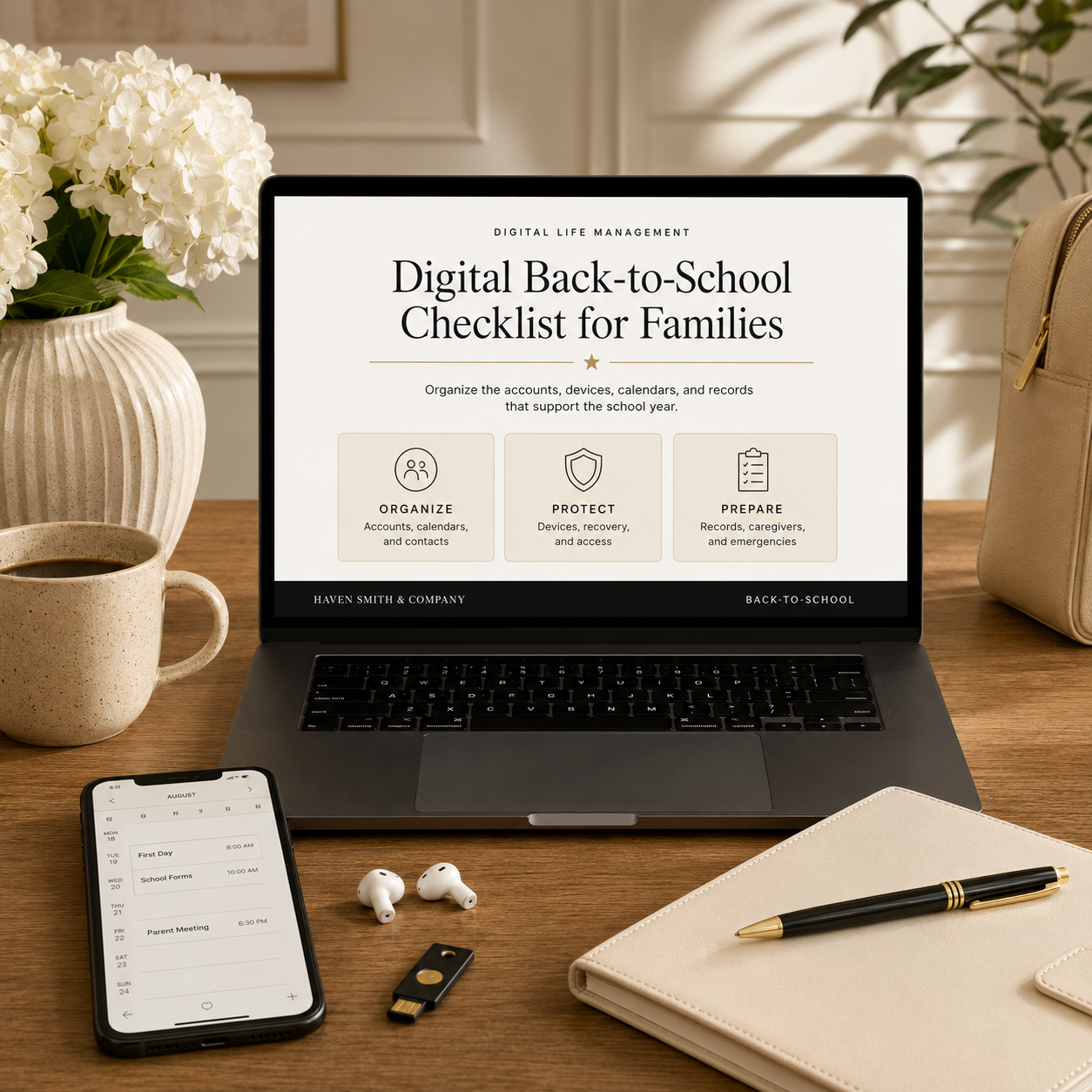
The following checklist follows the same three-part framework used throughout the Digital Life Management System™: Organize, Protect, and Prepare. Begin with what your family will use most, and work through the remaining tasks as time allows.
Progress matters more than completing everything at once.
1. Inventory Your School-Related Accounts and Resources
Before reorganizing anything, identify what your family will actually use during the coming school year.
Start by listing every school-related account, portal, application, device, and communication channel associated with each child. You are not trying to document every detail immediately. You are creating a reliable picture of what exists and who is responsible for it.
School account inventory
School or district parent portal
Student portal
Learning platform
Classroom communication application
School email account
Transportation or bus account
School lunch account
Tuition, fee, or payment portal
Library account
Athletic or extracurricular account
After-school care account
Volunteer account
Testing or assessment platform
College application or financial-aid account, when applicable
For each account, record:
The name of the platform
Its official website or application
Whether the account belongs to a parent or student
Which parent or caregiver manages it
The email address connected to it
The mobile number receiving alerts
Whether account recovery information is current
Whether another responsible adult has appropriate access
Whether the account is still needed
Do not record passwords in an ordinary spreadsheet or unprotected document. Store credentials in a reputable password manager. Your inventory only needs to record that the account exists, who manages it, and where access is maintained.
The Digital Life Management Workbook™ can provide one place to track these accounts alongside the devices, records, storage locations, and responsibilities connected to them.
2. Review and Update School Accounts
Once you know which accounts exist, review the information inside them.
School accounts created several years ago may still contain an old email address, former caregiver, outdated emergency contact, or telephone number you no longer use. Other accounts may have been created temporarily and then forgotten.
Work through the most important platforms first:
Confirm parent and caregiver names.
Update mailing addresses.
Confirm email addresses.
Confirm mobile numbers.
Review emergency contacts.
Review authorized pickup contacts.
Remove former caregivers who should no longer have access.
Add another responsible adult when appropriate.
Update account recovery information.
Reset forgotten passwords.
Enable available account protections.
Review notification settings.
Remove unfamiliar or obsolete devices from account access.
Bookmark the official login page.
Record any unresolved access problems.
Be especially careful with links received through email or text messages. When a school-related message requests payment, credentials, sensitive information, or an urgent account update, visit the school’s known website or contact the school through a verified number.
School impersonation messages can appear convincing because they reference familiar activities, teachers, fees, or deadlines. A brief independent verification can prevent a routine school task from becoming a much larger problem.
3. Create a Permanent Home for School Records
Email inboxes, text conversations, portals, and Downloads folders are places where information arrives. They should not become the only places where important school records live.
Create one clear location for education records. The exact folder structure can vary by family, but it should be simple enough that another responsible person could understand it.
For example:
Family
└── Education
    ├── Child Name
    │   ├── Current School Year
    │   ├── Medical and Accessibility
    │   ├── Activities
    │   └── Important Records
You might organize current school-year documents into additional folders for enrollment, academics, activities, transportation, or financial records. Avoid creating so many folders that filing a document becomes a complicated decision.
Records to review and organize
Enrollment confirmations
Class schedules
Report cards
Transcripts
Testing results
IEP or 504 documents
Accessibility and accommodation records
Immunization records
Medical forms
Medication authorizations
Transportation information
Activity registrations
Permission forms
Receipts and payment confirmations
Custody or authorized-pickup documentation
Device agreements
Important school correspondence
Move important documents out of temporary locations. Give each retained file a descriptive name, include a date when helpful, and remove unnecessary duplicate downloads.
Sensitive medical, educational, and family records should be kept in an appropriately protected location. They should not remain indefinitely in an unprotected Downloads folder, email attachment, or message thread simply because that is where they first arrived.
At the end of each school year, archive the records worth retaining. This keeps current work separate from prior years without requiring you to delete information that may still be useful.
4. Bring School Calendars and Schedules Together
A family may receive dates from the district, individual schools, classrooms, sports teams, music programs, childcare providers, and community organizations. When those dates remain scattered across emails, PDFs, applications, and printed notices, it becomes difficult to see the complete week.
Choose a shared family calendar or another reliable location where the appropriate people can see what is coming.
Calendar checklist
Subscribe to the official school calendar.
Add district closures and holidays.
Add early-release and minimum days.
Add teacher conferences.
Add registration deadlines.
Add tuition, lunch, and activity payment deadlines.
Add medical, IEP, or 504 meetings.
Add athletic practices and games.
Add arts, music, and club schedules.
Add transportation changes.
Add recurring pickup arrangements.
Add testing dates.
Add application and financial-aid deadlines.
Add device, textbook, and library return dates.
Remove expired calendars from previous school years.
Confirm that relevant caregivers can see the right information.
Whenever possible, subscribe to an official calendar rather than manually copying every event. Subscribed calendars can reflect updates made by the school, although you should still review important dates independently.
Avoid maintaining several conflicting versions of the same schedule. Decide which calendar serves as the family’s primary reference and use the others only when they provide information that cannot be combined.
5. Clean Up School and Family Contacts
Back-to-school season is an excellent time to review the people involved in your family’s daily schedule and emergency planning.
Search your Apple and Google contacts for:
School office
Attendance office
Teacher or classroom contacts
School nurse
Transportation office
After-school program
Coaches and activity leaders
Childcare providers
Carpool families
Authorized pickup contacts
Emergency family contacts
Healthcare providers
Parents with whom you regularly coordinate
Then complete the following tasks:
Merge duplicate contacts.
Delete obsolete or empty records.
Confirm names and organizations.
Update telephone numbers.
Update email addresses.
Add the school, district, or organization name.
Remove former caregivers when appropriate.
Create a school-related list or label.
Confirm that emergency contacts are still willing and available.
Avoid placing passwords or highly sensitive information in contact notes.
A clean contact list is useful during ordinary school days, but it becomes especially valuable when there is a schedule change, missed pickup, medical concern, or other time-sensitive situation.
6. Prepare School-Issued Devices
School-issued computers and tablets should be treated as borrowed property with their own access, return, and privacy responsibilities.
Record what your child has received:
Device type
Make and model
Asset or identifying number
Charger
Case
Stylus
Hotspot or network accessory
Date issued
Expected return date
School contact for technical support
Review the school’s policies concerning:
Damage
Loss
Acceptable use
Monitoring
Software installation
Personal accounts
Photography and recording
Device use outside school
Required accessories
Return procedures
Designate one location at home for charging and storing the device. Teach the student how to report a technical problem, loss, or damage rather than waiting until the device is urgently needed.
Keep unnecessary personal information off school-issued equipment. Families should understand that a school-owned device may be managed, filtered, or monitored by the school and should not be treated like a private family computer.
7. Prepare Family-Owned Devices
If a child uses a family-owned computer, phone, or tablet for school, review the device before classes begin.
Device checklist
Install current operating-system updates.
Update important applications.
Confirm that a screen lock is enabled.
Remove applications that are no longer used.
Review available storage.
Delete unnecessary downloads.
Test the charger and charging port.
Test headphones, microphone, and camera.
Review notification settings.
Review application permissions.
Confirm device-location features where appropriate.
Confirm that important files and photos are backed up.
Record warranty and support information.
Decide when and where the device may be used during school hours.
Also review the school’s current personal-device policy. Rules concerning phones, watches, tablets, and earbuds can change from one school year to the next.
The goal is not merely to make the device look clean. It is to make sure it is updated, protected, functional, and ready for the work it will support.
8. Protect the Accounts That Support the School Year
Back-to-school digital safety involves more than choosing a better password. Families should consider the email accounts, recovery paths, devices, and communication channels that control access to school information.
Account and device protection checklist
Use a unique password for every important account.
Store passwords in a reputable password manager.
Enable multifactor authentication where available.
Update account recovery information.
Protect the parent email connected to school portals.
Protect the student’s school email.
Remove obsolete devices from important accounts.
Install device and application updates.
Review household Wi-Fi protections.
Enable automatic locking on portable devices.
Teach children not to approve unexpected login requests.
Discuss suspicious links and attachments.
Verify unusual school payment requests independently.
Know how to report a lost device.
Know whom to contact if a school account is compromised.
Pay particular attention to the parent email account connected to school portals. That email may receive financial information, medical communication, student records, password resets, and security notifications. If someone gains control of it, the problem can extend far beyond the inbox.
Children should also know that they can bring a strange message, unexpected login request, or account problem to a responsible adult without being punished for asking. Early reporting makes it easier to respond before the issue spreads.
If your family needs a fuller approach to account, device, recovery, and access protection, the Digital Safety Course provides practical education that goes beyond password advice.
9. Review Student Privacy and Information Sharing
School platforms may request names, birthdates, photographs, location information, medical details, and access to a device’s camera, microphone, files, or contacts.
Some access will be required for legitimate educational purposes, but families should still understand what is being collected and why.
Review:
Which applications the school requires.
Which permissions those applications request.
Whether the application is installed on a school or personal device.
Whether a parent account is available.
Which student information appears publicly.
Whether location access is needed.
Whether contacts, photos, or microphone access is needed.
Whether old applications can be removed.
Whether personal accounts are connected to school services.
Where completed schoolwork and student files are stored.
This does not require rejecting every digital resource. It means understanding the role each platform plays and limiting unnecessary access where the family has a choice.
10. Prepare for Changes, Emergencies, and Parent Unavailability
In many families, one parent carries most of the operational knowledge. That person knows which application sends classroom announcements, how to add money to the lunch account, which entrance is used for pickup, where the medical forms are stored, and whom to contact when the bus does not arrive.
That arrangement may work until the knowledgeable parent is traveling, ill, unreachable, or dealing with another emergency.
Preparation does not mean giving everyone unrestricted access to every account. It means making sure another responsible person could complete the essential tasks your child depends on.
Family preparation checklist
Confirm emergency contacts with the school.
Review authorized pickup information.
Update medical and accessibility information.
Make sure another adult knows how to reach the school.
Share appropriate calendar access.
Document transportation arrangements.
Record recurring school and activity responsibilities.
Identify where important school records are stored.
Identify which parent or caregiver manages each major account.
Establish a plan for a lost phone or computer.
Establish a plan for a missed pickup or transportation change.
Decide how urgent school messages will be handled if the primary parent is unavailable.
Review which responsibilities need to be communicated across households.
Use secure access-sharing or recovery options instead of broadly sharing passwords.
Families managing medical needs, disabilities, allergies, medications, IEPs, 504 plans, or specialized transportation should give this section additional attention. The relevant information should be current, available to the right people, and stored somewhere more reliable than one person’s memory.
11. Establish School-Year Maintenance Habits
The work does not end when the first day of school arrives. Small maintenance habits can prevent the family’s digital responsibilities from becoming scattered again.
Daily
Review time-sensitive school communication.
Move important dates to the family calendar.
Complete, delegate, or schedule messages requiring action.
Return devices to their charging location.
Weekly
Review the coming week.
File important school documents.
Clear temporary downloads.
Check balances, forms, and approaching deadlines.
Review transportation and activity changes.
Charge and update devices.
Monthly
Review school account access.
Remove obsolete downloads and duplicate files.
Record new platforms or responsibilities.
Update contact information when something changes.
Review device storage and available updates.
Confirm that backups are working.
Quarterly or at the end of a term
Archive completed records.
Review subscriptions and recurring fees.
Check school-issued device condition.
Update the family’s digital inventory.
Confirm that another responsible person still has the information they need.
Remove accounts or applications that are no longer required.
An Organize With Me session can provide a practical time block for completing one of these reviews. Five, ten, or fifteen focused minutes can be enough to clear downloads, file school records, update the calendar, or review one set of accounts.
A One-Hour Digital Back-to-School Reset
If the complete checklist feels like too much to address before school begins, start with one focused hour.
First 15 minutes: Inventory
List the accounts, portals, devices, calendars, and communication channels your family expects to use.
Next 15 minutes: Organize
Create or update the school folder, family calendar, and school contact list. Move the most important current records into their permanent location.
Next 15 minutes: Protect
Check the parent email account, school portals, password manager, multifactor authentication, device updates, and screen locks.
Final 15 minutes: Prepare
Update emergency contacts and make sure another responsible adult knows where essential school information is located.
You may not complete every task during this hour. You will, however, understand what your family has, what needs attention first, and what can be scheduled for later.
Common Digital Back-to-School Mistakes
Several patterns make school-year responsibilities harder to manage than they need to be.
Depending on one parent to remember everything
Knowledge that exists only in one person’s memory is difficult to transfer during travel, illness, custody changes, or emergencies. Record the essential responsibilities and make appropriate information available to another adult.
Reusing passwords across school accounts
One exposed password can place multiple accounts at risk. Use unique passwords and store them in a reputable password manager.
Leaving important records inside email attachments
Email is useful for delivery, but it is a poor permanent filing location. Save important final records somewhere organized, protected, and backed up.
Treating Downloads as permanent storage
Downloads folders commonly accumulate forms, screenshots, installers, PDFs, and duplicate documents. Move important records to their permanent location and remove what is no longer needed.
Using an old email address for important portals
A rarely checked or poorly protected address can cause missed communication and recovery problems. Confirm that important accounts are connected to an appropriate email address.
Keeping outdated caregivers and contacts
Former caregivers, old telephone numbers, and obsolete emergency contacts should be reviewed. Access and authority should reflect the family’s current circumstances.
Maintaining conflicting calendars
When parents and caregivers work from different versions of the schedule, events are easily missed. Choose a primary family calendar and keep it current.
Failing to record school-issued property
Record devices, chargers, hotspots, instruments, textbooks, and other property your child is expected to return. Keep return dates on the family calendar.
Assuming synchronization is a backup
A synchronized file can sometimes be changed or deleted across every connected device. Confirm that important records and family information have an appropriate backup.
How Digital Responsibility Changes as Children Grow
The right level of responsibility depends on the child’s age, abilities, and circumstances.
Elementary school
Parents generally manage accounts, forms, devices, calendars, transportation, and communication. Children can begin learning where devices belong, how to ask for help, and why they should not share passwords or approve unfamiliar requests.
Middle and high school
Students can take greater responsibility for calendars, files, assignments, devices, and school communication. Parents should retain appropriate oversight while teaching the student how to manage information and recognize account problems.
College and independent living
Students need a more mature approach to academic accounts, financial access, healthcare information, devices, recovery information, and emergency communication. Parents can shift from managing every task to helping the student build a digital life they can manage themselves.
This transition should happen gradually. The objective is not simply independence from the parent; it is responsible management of the accounts and information that support adult life.
When Back-to-School Preparation Reveals a Larger Problem
A family may begin this checklist expecting to update a few school accounts and discover a much larger collection of scattered files, old devices, forgotten subscriptions, reused passwords, incomplete records, and responsibilities known by only one person.
That discovery does not mean you have failed at digital organization. Most people have never been taught how accounts, information, devices, records, security, family responsibilities, and future preparation fit together.
Back-to-school season simply gives you a useful reason to begin.
Haven Smith & Company offers several ways to continue:
Digital Life Management Workbook™
Use a practical spreadsheet to inventory your accounts, records, devices, storage locations, and digital responsibilities as you work.
Explore the Digital Life Management Workbook™
Digital Organization Course
Learn how to inventory what you have, make informed decisions, and create a foundation for accounts, files, devices, and records that you can maintain.
Explore the Digital Organization Course
Digital Safety Course
Learn how to strengthen the accounts, devices, information, recovery paths, and access points that support your family’s digital life.
Explore the Digital Safety Course
Digital Life Management Course Bundle
Work through the complete Initial Cleanup across Digital Organization, Digital Safety, and Digital Legacy and Estate Planning.
Explore the Complete Course Bundle
Digital Life Strategy Session
Receive personalized guidance based on the accounts, devices, records, responsibilities, and concerns affecting your household.
Book a Digital Life Strategy Session
Begin With What Your Family Will Use Most
A better-managed school year does not require a perfect digital life. Begin with the accounts, devices, records, contacts, and responsibilities your family will rely on most. Organize what you have, strengthen the protections around it, and make sure another responsible person could help if necessary.
Then continue in manageable steps.
The work you complete for the school year will support more than homework, transportation, and classroom communication. It will help your family build a digital life that is easier to manage now and better prepared for what comes next.