
What a Trusted Person Should Know Before You Leave Town
A Practical Guide to Sharing the Right Information, Access, Contacts, and Instructions Before You Travel
A delayed return, lost phone, household repair, sick pet, urgent client request, or unexpected family concern can create a simple but important question:
Who knows where to begin?
The person helping while you are away does not necessarily need to solve every problem. They need to understand their responsibility, know how to reach you, locate the appropriate information, and contact someone qualified when the situation falls outside their role.
The purpose of choosing a trusted person is not to give someone control over your accounts, records, home, family, or business while you travel. It is to make sure the right person has a clear place to begin when something requires attention.
That preparation can make an ordinary vacation or business trip easier. It can also reveal whether your household, family, business, and digital responsibilities are prepared for a longer period of unavailability.
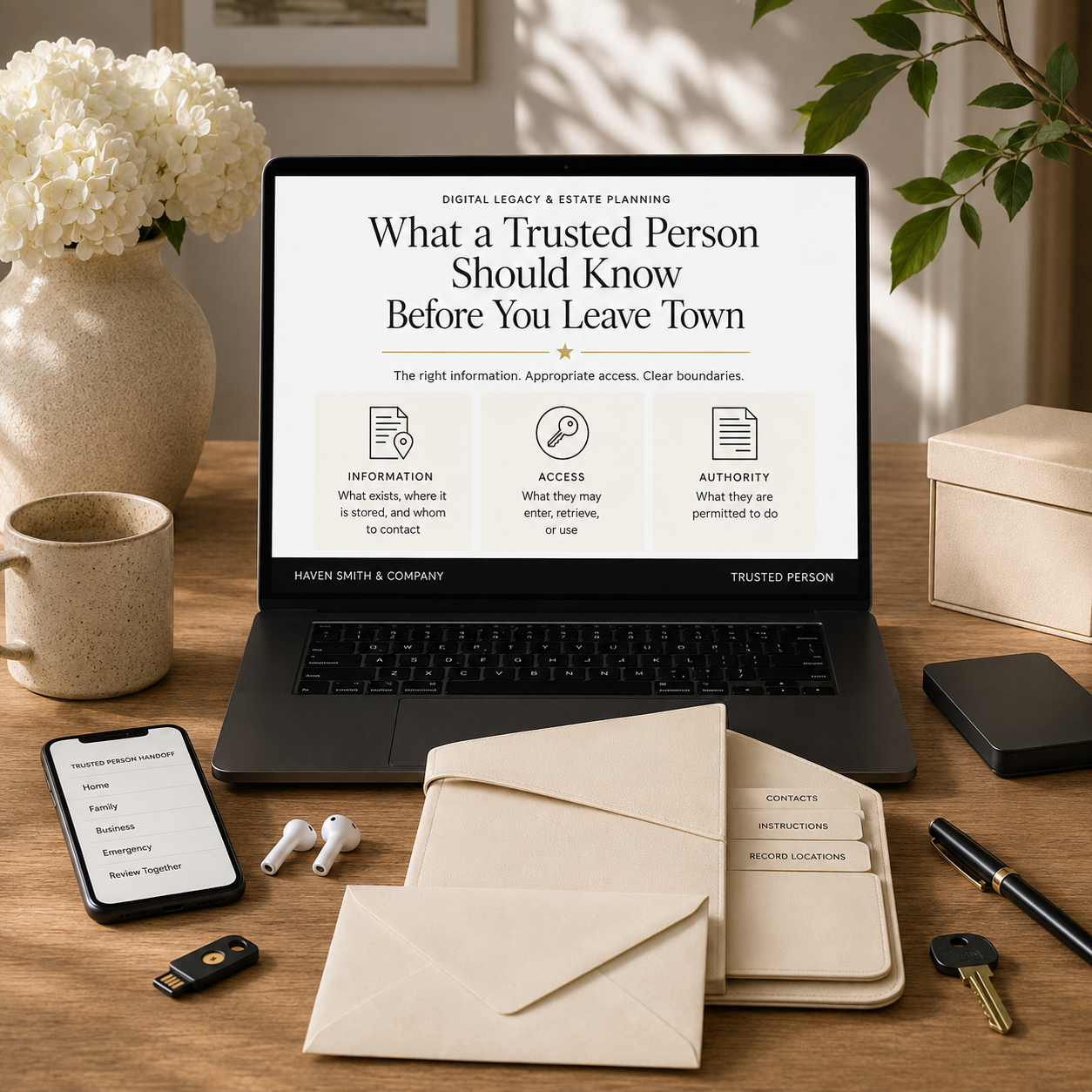
Information, Access, and Authority Are Different
Before deciding what to share, distinguish among three separate concepts.
Information
Information explains what exists, where it is stored, what is scheduled, and whom to contact.
A trusted person may need to know that insurance information is stored in a particular folder or that a veterinarian should be contacted if a pet becomes ill. Knowing where that information is located does not automatically give the person permission to manage an account or make a decision.
Access
Access is the practical ability to enter a home, retrieve a record, open a shared folder, use an application, or complete a defined responsibility.
Examples include a house key, temporary smart-lock code, shared calendar, guest account, protected folder, or business platform login created for the person’s role.
Access should be limited to what the responsibility requires. A person checking the mail does not need access to financial records, private messages, or business files.
Authority
Authority is the legal or formal permission to make a decision, manage an account, obtain protected information, spend money, approve care, or act for another person.
A person may possess a password without having the legal right to use an account. They may know where a healthcare record is stored without having authority to make medical decisions. They may have a key to the home without having permission to access every document or device inside it.
Information, access, and authority are not interchangeable. Personal instructions should support appropriate legal, financial, healthcare, and estate documents—not attempt to replace them.
Choose the Right Person for the Responsibility
One person does not need to handle everything while you are away.
You might choose:
A neighbor for packages and property concerns
A family member for family communication
A pet sitter for animal care
A caregiver for a child or dependent adult
A business colleague for clients or employees
A property manager for building concerns
An attorney, accountant, or financial professional for specialized matters
A different person for an extended emergency
The appropriate person should be reliable, available, able to follow instructions, respectful of privacy, and comfortable asking questions.
Trust should not be based only on how close someone is to you. The person must also be willing and able to perform the specific responsibility.
Ask before assigning the role. Confirm that the person understands what may be required and has enough time to review the information with you before departure.
Decide Which Situation You Are Preparing For
Your trusted person may need different information depending on what happens.
Routine Responsibilities
Routine responsibilities might include:
Bringing in packages
Feeding a pet
Watering plants
Checking the home
Monitoring a scheduled repair
Responding to a defined client request
Confirming that a household service occurred
The trusted person generally needs specific instructions, appropriate access, useful contacts, and a clear schedule.
An Urgent Problem
An urgent problem might include:
A pet requiring medical care
A household repair
A failed payment
A child or family member needing assistance
A device or account problem affecting the traveler
A business issue that cannot wait
The trusted person needs to know what constitutes an urgent problem, whom to contact, what decisions they may make, and when they should try to reach you.
Extended Unavailability
A longer disruption might occur if:
Your return is significantly delayed
You are hospitalized
You cannot communicate
Household responsibilities continue longer than expected
Business decisions cannot wait
Another person must work with your advisers
Extended unavailability may require information, access, and formal authority beyond an ordinary vacation handoff.
This is where travel preparation connects to digital legacy and estate planning. A short trip asks what another person would need while you are away. Longer-term preparation asks what they would need if you could not return to those responsibilities yourself.
What Your Trusted Person Should Know
The exact information will depend on the person’s role. Give each person what they need without sharing unrelated details.
How to Reach You
Provide:
Your primary contact method
An alternative contact method
Basic itinerary information
Lodging contact when appropriate
Relevant time-zone information
A travel companion’s contact information
Times when communication may be limited
A trusted person does not necessarily need an hour-by-hour itinerary or continuous access to your real-time location.
Explain when they should contact you and what they should do if you cannot respond. If you will be in a location with limited service, say so before leaving.
Who Else to Contact
Create a short contact list based on the responsibilities involved.
Possible contacts include:
Family member
Neighbor
Pet sitter
Veterinarian
Property manager
Landlord
Homeowners association
Plumber or electrician
Healthcare provider
Pharmacy
Insurance provider
Employer
Business partner
Employee
Attorney
Accountant
Financial adviser
For each contact, explain why the person or organization might need to be called. A list of unexplained names creates more searching during an urgent situation.
Verify telephone numbers and email addresses before departure. Remove outdated contacts and identify any provider that requires an account number or other information before discussing a matter.
What Is Scheduled While You Are Away
The trusted person may need to know about:
Deliveries
Pet-care visits
Household services
Child or family schedules
Medical appointments
Bills
Contractors
Guests
Property access
Business deadlines
Expected account or property alerts
Include only what is relevant to the person’s role.
A neighbor bringing in packages does not need your client schedule. A business colleague does not need private healthcare information. A pet sitter does not need a complete copy of your travel records.
Where Important Information Is Stored
Record the location of relevant information rather than distributing unrestricted copies of every record.
This may include:
Travel itinerary
Insurance information
Pet records
Household contacts
Healthcare information
Business instructions
Legal documents
Emergency information
Digital Life Management Workbook™
Keys and access devices
Backup contact information
Be specific about the location. “In my office” may not help if the room contains several cabinets, folders, computers, and storage drives.
Instead, an instruction might explain that the pet insurance record is in a labeled folder inside a particular drawer or that household contacts are stored in a protected shared document.
What Access Is Being Provided
Document the access the trusted person will receive.
Examples include:
House key
Building fob
Garage access
Temporary smart-lock code
Guest application access
Shared calendar
Protected folder
Business platform
Pet-care application
Emergency contact information
Where possible, use temporary, guest, or limited access rather than a primary password.
Confirm that the access works before leaving. Do not wait for an urgent situation to discover that a key does not open the correct door, a code has expired, or a shared folder requires approval from your unavailable phone.
What the Person May Do
Instructions should define the trusted person’s role and decision boundaries.
Depending on the responsibility, they may be permitted to:
Contact the veterinarian
Bring packages inside
Contact the property manager
Notify a business partner
Respond to a defined client issue
Access a particular folder
Contact an attorney or adviser
Call emergency services
Approve a limited household or pet expense
Arrange a necessary repair
If a spending limit, escalation process, or additional approval applies, record it clearly.
Do not ask the trusted person to guess how much responsibility they have. Unclear instructions can cause hesitation when a response is needed or lead someone to take action outside the role you expected.
What the Person Should Not Do
Boundaries are part of good preparation.
Depending on the role, instructions may include:
Do not access unrelated accounts
Do not use financial credentials without appropriate authority
Do not share information with other people
Do not post travel details
Do not make non-urgent purchases
Do not change passwords
Do not delete files or messages
Do not contact clients unless instructed
Do not make legal, financial, healthcare, or business decisions outside the defined role
Clear limits protect both you and the person helping you.
Do Not Hand Over Your Entire Digital Life
Preparing a trusted person does not mean automatically giving someone every password and recovery code you possess.
Avoid casually sharing:
Your password-manager master password
Primary email credentials
Complete banking credentials
Full device passcodes
Every recovery code
An unsecured spreadsheet containing passwords
Sensitive client or employee information
Unrestricted healthcare records
Complete legal or financial files
Instead, consider the narrowest appropriate way to support the responsibility.
Options may include:
Temporary access
Guest access
Shared folders
Emergency-access features offered by an appropriate service
Sealed physical instructions
Protected records
A direct contact for the relevant professional
Formal legal documents
The right method depends on the type of information, the service involved, the person’s role, and any legal authority required.
A password is not a substitute for thoughtful preparation. It can also become outdated, misunderstood, or used in a way that conflicts with an account’s terms or applicable law.
Create a Role-Based Handoff
Instead of creating one enormous emergency document, prepare a smaller handoff for each role.
This limits unnecessary access and makes the instructions easier to follow.
Home Handoff
Include:
How to enter
What to monitor
Expected visitors or services
Property contacts
Locations of relevant supplies
What constitutes an emergency
When to contact you
Pet-Care Handoff
Include:
Feeding schedule
Medication
Veterinary contact
Emergency clinic
Location of supplies
Behavioral information
Spending or decision limits
How to reach you
Family or Caregiving Handoff
Include:
Schedules
Transportation
Relevant contacts
Healthcare information
School or activity information
Emergency instructions
Applicable authorization
Formal authorization may be required for some healthcare, travel, financial, or caregiving decisions. Review your circumstances with qualified professionals when necessary.
Business Handoff
Include:
Current priorities
Urgent contacts
Client boundaries
Employee responsibilities
Vendor or payment deadlines
Payroll responsibilities
Escalation process
Matters that should wait
Avoid giving another person access to unrelated client, employee, financial, or proprietary information.
Extended-Emergency Handoff
This may include:
Locations of important records
Trusted professionals
Legal documents
Household responsibilities
Business responsibilities
Digital property requiring attention
Family contacts
Information about ongoing payments and services
An extended-emergency handoff should be reviewed alongside legal and estate-planning documents. It is not simply a longer vacation checklist.
How to Share the Information
No single storage method is appropriate for every type of information.
Depending on the content and responsibility, you might use:
A protected shared folder
A password manager’s emergency-access feature when appropriate
A sealed physical document
A secure record stored in a known location
A printed Emergency Information Record
A protected spreadsheet
A direct conversation followed by written instructions
When choosing a method, consider:
How sensitive the information is
How quickly it may need to be accessed
Whether it will still work if your phone is unavailable
Whether the person understands how to use it
Whether access can be removed later
Whether the information must be available without internet access
Whether formal legal authority is required
Avoid sending sensitive information through a large group message or ordinary email simply because it is convenient.
Do not create a document so heavily protected that the trusted person cannot access it when needed. Preparation requires both protection and practical accessibility.
Review the Handoff Together
Do not send instructions and assume everything is clear.
Before leaving, review:
Dates
Responsibilities
Contacts
Access
Boundaries
Emergency definitions
Information locations
How to reach you
What to do if you cannot respond
Ask the person to open the shared folder, test the temporary code, locate the key, or find the relevant contact while you are available to help.
This conversation may reveal that a telephone number is outdated, a folder is not actually shared, an instruction is unclear, or the person is uncomfortable with part of the role.
Correct those problems before the trip rather than during an urgent situation.
What to Do After Returning
A temporary handoff should have a clear end.
After returning:
Confirm that responsibilities are complete
Collect keys and access devices
End temporary codes
Remove guest access
Review household or business activity
Archive trip-specific instructions
Update information that proved inaccurate
Record improvements for the next trip
Thank the person who helped
Do not leave temporary access active indefinitely because you may use it again someday. Review what should remain and remove what no longer serves a purpose.
What Not to Leave With a Trusted Person
Avoid giving a person information or access merely because it might be useful.
Do not leave:
Every password you own
A complete financial profile
Unrestricted access to primary email
Sensitive records unrelated to the role
Unexplained keys or codes
Instructions without verified contacts
Access that has never been tested
Conflicting versions of the same document
A list of names without their roles
Legal or healthcare responsibilities the person cannot perform
Client or employee information unrelated to an assigned business task
The trusted person should receive a defined role, the information required for that role, and clear guidance about when to contact someone else.
The Larger Question Travel Preparation Reveals
Preparing for a trip may reveal that important information exists only in one person’s memory.
You may discover that:
No one knows where legal documents are stored
Household responsibilities cannot continue without you
Important accounts have no recovery plan
Digital property has never been inventoried
Family members do not know whom to contact
Business responsibilities cannot be delegated
Trusted people lack appropriate instructions
Existing estate documents do not address digital life
Important records are scattered or inaccessible
Travel preparation answers the question:
What would someone need while I am away?
Digital legacy and estate planning asks the larger question:
What would someone need if I could not return to these responsibilities myself?
If the answer is unclear, the trip has identified important work that deserves attention after you return.
Prepare Your Digital Life for the People You Love
Digital Legacy & Estate Planning Course
The Digital Legacy & Estate Planning Course helps you identify your digital property, consider who may be affected, make appropriate decisions, and document important information for the people you love.
The course goes beyond vacation instructions. It helps you prepare accounts, records, devices, information, digital property, and responsibilities for emergencies, incapacity, and the future.
Explore the Digital Legacy & Estate Planning Course
Digital Life Management Workbook™
The Digital Life Management Workbook™ is a practical spreadsheet for recording accounts, devices, records, storage locations, digital property, important contacts, and responsibilities.
Instead of leaving critical information scattered across devices, inboxes, paper files, and memory, you can create a maintainable record of what exists and where it can be found.
Explore the Digital Life Management Workbook
Digital Life Strategy Session
If you are unsure what information to share, which responsibilities require attention, or where to begin, a Digital Life Strategy Session can help you work through your personal, family, or business situation.
Book a Digital Life Strategy Session
Complete Initial Cleanup
If your preparation reveals gaps across organization, digital safety, recovery, and future planning, the Digital Life Management Course Bundle guides you through the complete Initial Cleanup.
Start the Complete Initial Cleanup
Frequently Asked Questions
Who should be my trusted person when I travel?
Choose someone reliable, available, respectful of privacy, and appropriate for the responsibility. You may choose different people for household, family, pet, business, and emergency matters.
Should I give my trusted person all my passwords?
Usually not. Provide only the information and access required for the person’s defined responsibility. Consider temporary access, protected records, emergency-access features, or professional contacts when appropriate.
What information should I leave before going on vacation?
Provide basic itinerary information, emergency contacts, relevant household or care instructions, important record locations, and a clear way to reach you. The exact information depends on the person’s role.
Is a trusted contact the same as a power of attorney?
No. A trusted contact, account access, and legal authority are different. Consult a qualified attorney about powers of attorney and other legal documents.
Should one person handle everything while I am away?
Not necessarily. Different responsibilities may be better assigned to a neighbor, family member, caregiver, business colleague, property professional, or adviser.
How should I store emergency information?
Use a method that balances protection and accessibility. Depending on the information, options may include a protected digital record, sealed physical document, secure shared folder, protected spreadsheet, or printed Emergency Information Record.
What should I do with temporary access after returning?
End temporary codes, remove guest access, collect keys, review activity, and update any instructions that proved unclear or inaccurate.
Can Haven Smith & Company help me prepare this information?
Yes. You can enroll in the Digital Legacy & Estate Planning Course, use the Digital Life Management Workbook™, complete the Course Bundle, or book a Digital Life Strategy Session.
Give Someone a Clear Place to Begin
A trusted person does not need unrestricted control over your accounts, records, home, family, or business. They need an appropriate role, a clear place to begin, and enough information to respond without guessing.
Decide what the person should know, what they may need to access, whom they should contact, and where their responsibility ends. Then review the handoff together before you leave.
That preparation can make an ordinary trip easier. It can also reveal the larger work needed to prepare your digital life for emergencies, incapacity, and the future.
Prepare the Information Someone You Trust May Need