

For two people and one household · focused guide
If one of you could not get to it, could the other?
The joint accounts, the passwords only one of you keeps, the beneficiary forms that outrank your will, and the bills arriving at an address the other cannot open. This guide works through what you share, who really owns it, and what happens in the week one of you cannot answer. By the end you both know where things are, and so does one person you trust.
This guide is one of the titles in The Digital Life Management Library. The Library is $299 and includes everything we publish.
- What you share, and who really owns it — what each family plan gives you, the account in one name that holds everything, and the ownership audit
- Passwords, and the way back in — two private vaults and one shared one, the codes all going to one phone, and being each other’s way back in
- The paperwork that outranks your will — beneficiary forms, where the law protects a spouse and where it does not, and the settings screen that beats the lawyer’s document
- When one of you cannot — the first two weeks in order, what opens, what needs a court, and survivor benefits
- Being able to untangle — what is genuinely hard, the clocks attached to each, and thirty minutes once a year together
- An ebook — PDF, instant download, no login
It downloads the moment you pay. There is no account to make and nothing to log back into, and you have seven days to change your mind.
What it is for
One evening, both of you, and then it is done.
It is for the evening you sit down together and find out which accounts are in one name.
It is for the week one of you is in hospital and the other can reach the bank.
It is for the thirty minutes once a year that keeps all of it true.
What is in it
Six parts, and every one of them is a conversation you have once.
A household accumulates accounts under two names and one set of assumptions. The order here is ownership first, then access, then the paperwork, then what happens if one of you cannot, then being able to untangle it if that is ever what you need. Nothing in it requires both of you to be equally interested in the subject.
What you share, and who really owns it
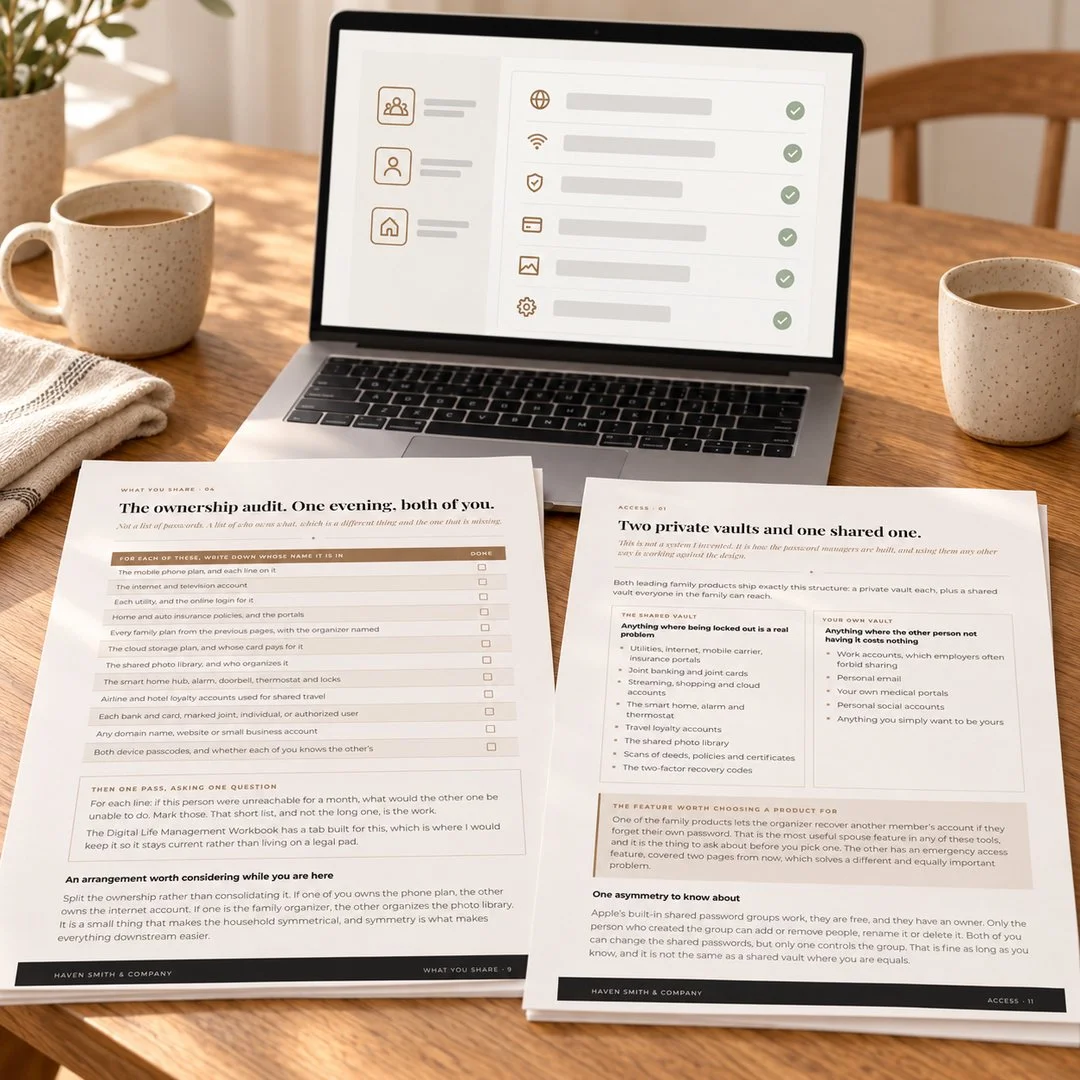
What each family plan really gives you, and what it does not. The account that holds everything in one person’s name. Why there is no such thing as our photos, and what Apple and Google offer in its place. Then the ownership audit: one evening, both of you, one list.
Passwords, and the way back in
Two private vaults and one shared one, and six things a shared vault does not solve. What to do when all the codes are going to one phone. How to be each other’s way back in, and the arrangement for the week one of you cannot answer.
The paperwork that outranks your will
Three real cases, including the one that cost a widow $124,558. Where the law protects a spouse and where it does not. If the wedding is recent, one page is written for you specifically. And why the settings screen beats the lawyer’s document.
Sharing well
What to share, what to keep separate, and the difference between the two: who can undo it. Plus a page for the situation where any of this is not a choice you made, including a federal protection worth knowing about.
When one of you cannot
The first two weeks in order. What opens, what needs a court order, and what is simply lost. Survivor benefits, and the two process facts that cost people money. Three documents, three jobs, no overlap.
Being able to untangle
What is genuinely hard to separate and the clocks attached to each. Then thirty minutes once a year, together, which is the part that keeps it true.
Why this conversation does not happen on its own
Ninety-one percent believe they can. Twenty-nine percent regularly do.
In a study of 3,193 married and partnered adults, 91 percent said they believe they can talk openly about money with their spouse. Twenty-nine percent said they regularly do.
That gap is the whole problem, and it is not a communication failure. It is that nothing ever forces the conversation, so it stays permanently available and permanently postponed. There is no renewal notice for deciding who can reach the brokerage account.
So the guide is built as a set of conversations with an end to each one. One evening for the ownership audit. One sitting for the vaults. One afternoon for the beneficiary forms. Thirty minutes once a year after that.
Honestly
Who this is for, and who it is not.
This is for you if
- You are married, or getting married, and the accounts have grown up around whoever set them up first.
- One of you handles the money, the logins or the technology, and the other could not step in tomorrow.
- One phone is the second factor for the bank, the brokerage, the insurance and the email.
- You have never looked at the beneficiary forms on the retirement accounts.
- You would rather have this conversation on a quiet evening than during a bad week.
This is not for you if
- What you want is your own accounts in order first. The Digital Life Management System is $179.
- You are helping a parent rather than sorting out a household. Caring for an Aging Parent’s Digital Life is $29.
- You need a will or a trust drafted. This is education about access and organization, and it is not the drafting of any legal document.
If you want more than this
The full method, and the record that goes with it.
This guide is one conversation at a time. If you want the whole thing structured across three months, that is the System.
The Digital Life Management System $179
Three months, two hours a week, with the Workbook and the Emergency Information Record.
The Emergency Information Record $29
The one page either of you could pick up and act on, printable and filled in by hand.
Digital Legacy & Estate Planning $49
The third month of the System on its own. What each account is for, and the record that makes a will possible to execute.
Before you buy
The questions people ask.
Do both of us have to read it?
No, and that is deliberate. One of you can read it and bring the other in for the parts that need two people, which are the ownership audit, the shared vault and the beneficiary forms.
Is this about divorce?
No. One part covers being able to untangle accounts, because that is a practical question whatever the reason, and one page covers the situation where sharing was not a choice you made. The rest is about a household that works.
We already have a will. Is this still useful?
Yes, and this is the part most couples have not looked at. A retirement account, a life insurance policy and anything with a beneficiary named on it do not pass through your estate. They pass by contract, to whoever the form names, regardless of what the will says.
Does it cover photos?
Yes, with an honest answer. Nothing in 2026 merges two photo libraries into one jointly owned library. The guide covers exactly what Apple and Google do offer and where the ownership sits.
Is this legal advice?
No. It is education about organizing information and about who can reach what. A will, a trust or a power of attorney is a lawyer’s job.
Do we need an account to open it?
No. It downloads the moment you pay and it is yours on your own computer.
Can I get a refund?
Yes. Write to us within seven days and we will refund you.
One evening, and the household stops depending on one person’s memory.
Ownership, access, the paperwork that outranks your will, and the week one of you cannot answer. One evening, and it is written down. One payment of $29.
Instant download · No login · Seven-day guarantee