
The Complete Holiday Season Digital Preparation Checklist
How to Organize Holiday Calendars, Contacts, Shopping, Travel, Devices, Records, and Family Responsibilities Before the Season Gets Busy
Holiday preparation usually begins with a familiar collection of lists: people to visit, gifts to purchase, cards to send, meals to prepare, events to attend, and places to travel.
But much of the work behind those lists now happens digitally. Addresses are stored in contact applications. Gifts are purchased through online accounts. Travel details arrive through email. Family plans develop across group messages. Photographs accumulate on several devices. Receipts, confirmations, and return instructions remain scattered across inboxes and shopping applications.
A complete holiday preparation checklist should account for that part of modern life.
The purpose of digital holiday preparation is not to make the season more complicated. It is to organize the information, accounts, devices, and responsibilities your family already relies on so they are easier to manage from Thanksgiving through Advent, Christmas, and the New Year.
Why the Holiday Season Needs a Digital Checklist
Holiday planning once depended largely on paper calendars, address books, handwritten gift lists, and printed travel documents. Those tools may still play an important role, but they now exist alongside a much larger collection of digital resources.
Your family may use:
Shared calendars
Apple or Google Contacts
Retailer accounts
Payment applications
Package-tracking services
Airline and hotel applications
Family group messages
Shared documents
Photo libraries
Streaming accounts
Smart-home devices
School and church calendars
Digital tickets and reservations
Healthcare portals
Home, pet, or childcare information
These resources are rarely managed together. A Christmas card address may live in a contact record, a gift idea may remain in a text message, an order confirmation may be buried in email, and a travel reservation may exist only inside one person’s phone.
The goal of this checklist is to bring those pieces into a practical structure. You do not need to finish everything in one sitting. Begin with the areas that support your family’s most important plans and continue as time allows.
The Complete Holiday Digital Preparation Checklist
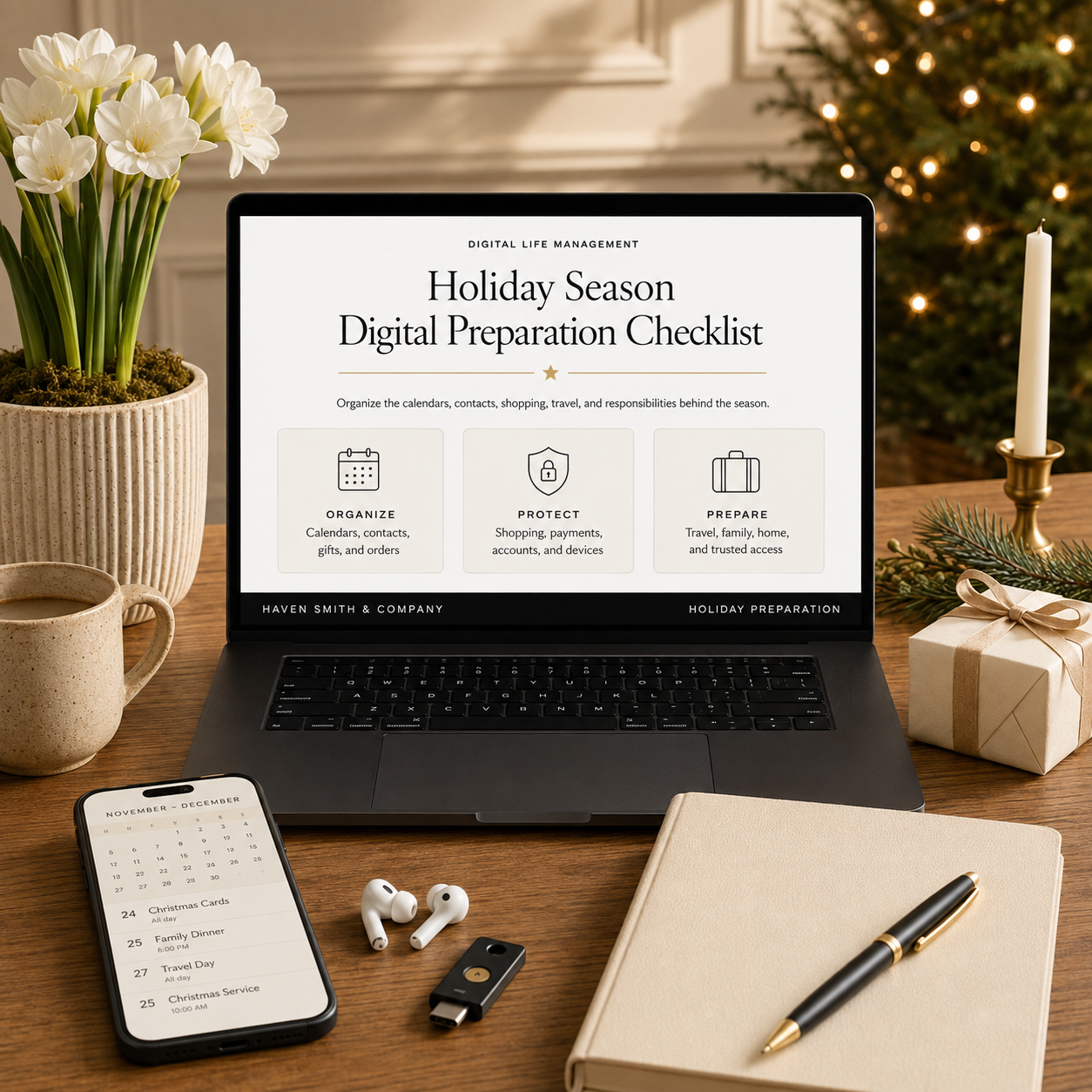
This checklist follows the three pillars of the Digital Life Management System™: Organize, Protect, and Prepare. It also includes simple maintenance practices and a post-holiday closeout so the information created during the season does not become another collection of forgotten files.
1. Inventory the Digital Resources Supporting Your Holiday Season
Before creating another list or downloading another application, identify what your family expects to use.
Holiday digital inventory
Primary family calendar
School calendars
Church calendar
Workplace calendars
Christmas card list
Contact applications
Gift list
Shopping accounts
Payment services
Package-tracking applications
Travel accounts and applications
Family group messages
Shared planning documents
Photo libraries
Healthcare information
Home, pet, or childcare information
Devices being used for travel
Devices being purchased as gifts
Streaming or entertainment accounts
Charitable-giving records
As you review these resources, ask four questions:
Where does this information currently live?
Who is responsible for managing it?
Who else needs appropriate access?
Will it remain useful after the holiday season?
You do not need to record account passwords in this inventory. Credentials belong in a reputable password manager, not in an ordinary spreadsheet, contact note, or shared holiday document.
The Digital Life Management Workbook™ can help you track the accounts, devices, records, storage locations, and responsibilities involved without turning your holiday checklist into a place for sensitive credentials.
2. Create One Holiday Planning Overview
A family does not need one complicated holiday dashboard. It needs one dependable overview of the dates, responsibilities, and deadlines that affect the season.
Choose a calendar, spreadsheet, or task list as the family’s primary holiday reference. The format matters less than knowing where to look.
Include:
Thanksgiving plans
Advent and Christmas services
School performances
School closures
Workplace events
Volunteer commitments
Family gatherings
Houseguest dates
Travel dates
Shipping deadlines
Christmas card deadlines
Gift-purchasing deadlines
Meal or hosting responsibilities
Healthcare appointments
Childcare and pet-care arrangements
Return deadlines
New Year’s commitments
Keep this overview practical. Do not place account passwords, payment-card details, medical records, identification documents, or other highly sensitive information inside a general holiday planning file.
3. Bring Holiday Calendars Together
The season may be shaped by several different calendars: family, school, church, work, travel, sports, performances, volunteer events, and medical appointments.
Review each source and move the dates your household needs into its primary calendar.
Holiday calendar checklist
Add Thanksgiving gatherings and travel.
Add Advent and Christmas services.
Add school performances and celebrations.
Add school closures and early-release dates.
Add workplace events and deadlines.
Add volunteer commitments.
Add family gatherings.
Add houseguest arrival and departure dates.
Add flights, trains, or driving days.
Add hotel and rental-car reservations.
Add shipping and ordering deadlines.
Add Christmas card deadlines.
Add gift-exchange dates.
Add medical appointments.
Add childcare and pet-care arrangements.
Add return deadlines.
Remove obsolete events and expired calendar subscriptions.
Whenever possible, subscribe to an official calendar instead of manually copying every event. Continue checking important dates independently, particularly when travel, school, church, or family plans may change.
Most importantly, decide which calendar serves as the household’s primary reference. Several conflicting versions of the same schedule create more work, not more organization.
4. Review Contacts Before Sending Christmas Cards
Holiday cards, invitations, travel plans, and family gatherings all depend on accurate contact information. This makes early November an excellent time to review Apple Contacts, Google Contacts, or whichever contact application your family uses.
Contact checklist
Merge duplicate contacts.
Remove empty records.
Delete contacts you no longer need.
Update mailing addresses.
Confirm family names and household relationships.
Add missing email addresses.
Add missing mobile numbers.
Review contacts who have moved.
Create a Christmas card list or label.
Separate personal contacts from marketing contacts.
Remove sensitive information that does not belong in ordinary contact notes.
Back up your contact library before making extensive changes.
Remember that a personal contact is not automatically a marketing subscriber. If you use your holiday contact cleanup to identify people for a business mailing list, keep confirmed marketing permission separate from your personal address book.
For the complete contact-cleanup process, read How to Organize Your Contacts Before Sending Holiday Cards.
5. Prepare Your Christmas Card List
Once the contact library is current, decide who will receive a card this year.
Christmas card checklist
Confirm each recipient’s mailing address.
Confirm the name that should appear on the envelope.
Identify cards being sent internationally.
Note cards that require a personal message.
Select the family photograph.
Confirm that the photograph is high resolution.
Save the final card design.
Record the quantity ordered.
Save the order confirmation.
Add addressing and mailing dates to the calendar.
Record returned cards and address corrections.
Preserve the final card in the family archive.
If you receive new addresses through texts, emails, or social media messages, update the actual contact record. Do not leave corrections scattered across several conversations where they will have to be found again next year.
After Christmas, save the final card design and selected family photograph in the appropriate family archive. These records can become part of the family’s annual history rather than disappearing inside a retailer account.
6. Build a Manageable Digital Gift List
Gift planning becomes difficult when ideas and purchases are distributed across browser tabs, screenshots, retailer applications, group messages, handwritten notes, and email confirmations.
Create one central gift list that tracks each purchase from idea through delivery.
Suggested fields include:
Recipient
Gift idea
Retailer
Purchased
Order number
Expected delivery
Arrived
Wrapped
Given or shipped
Gift receipt
Return deadline
Thank-you needed
Do not include passwords or full payment-card numbers. If the list is shared with other people, also avoid adding information that would unnecessarily reveal sensitive purchases or spoil surprises.
Review the list before placing another order. A quick check can prevent duplicate gifts, overlooked recipients, missed delivery problems, and expired return periods.
7. Review Shopping Accounts Before Making Purchases
Holiday shopping often brings people back to accounts they have not used since the previous year. Those accounts may contain an old address, expired payment method, reused password, or obsolete membership.
Review the shopping accounts you expect to use before purchasing begins.
Shopping account checklist
Identify the retailer accounts you still use.
Close accounts you no longer need when appropriate.
Update shipping addresses.
Remove obsolete addresses.
Remove expired or unwanted payment methods.
Review stored gift-card balances.
Update reused or weak passwords.
Enable multifactor authentication where available.
Review account recovery information.
Remove unfamiliar or obsolete devices.
Review memberships and subscription renewals.
Confirm which email receives receipts and security alerts.
Avoid creating unnecessary accounts for one-time purchases.
Purchasing as a guest can be appropriate when you do not expect to use the retailer again. Each new account creates another password, privacy relationship, recovery path, and responsibility to manage.
If your shopping accounts are only one part of a larger collection of accounts, files, devices, and records, the Digital Organization Course can help you inventory what you have, make informed decisions, and build a foundation you can maintain.
Explore the Digital Organization Course
8. Protect Holiday Shopping and Payments
The holiday season creates a high volume of legitimate advertisements, receipts, delivery notices, payment requests, fundraising appeals, and family messages. Fraudulent messages can hide inside that ordinary activity.
The answer is not to distrust every communication. It is to slow down when a request involves money, credentials, sensitive information, or unusual urgency.
Online holiday shopping checklist
Visit retailers through known websites or applications.
Check the full website address before signing in.
Be cautious with unusually large discounts.
Review unfamiliar marketplace sellers.
Verify unexpected payment requests independently.
Never use gift cards to pay a supposed debt or emergency.
Avoid entering payment information through an unsolicited link.
Use unique account passwords.
Enable multifactor authentication where offered.
Protect the email account connected to shopping and payment accounts.
Turn on transaction alerts.
Review purchases and financial statements.
Save important receipts and confirmations.
Contact retailers and carriers through their known websites.
Report compromised accounts promptly.
Be especially cautious with messages claiming that a package cannot be delivered until you pay a small fee or provide additional information. Open the retailer or carrier’s known application or website and check the order directly.
Family impersonation can also appear during holiday travel. If someone claims to be a relative who lost a telephone, is stranded, or urgently needs money, contact that person or another family member through a number you already know.
Digital safety is more than choosing better passwords. The Digital Safety Course teaches a practical approach to protecting the accounts, devices, information, recovery paths, and access points that support everyday life.
Explore the Digital Safety Course
9. Organize Orders, Confirmations, Receipts, and Returns
A busy shopping period can quickly fill an inbox with advertisements, purchase confirmations, shipping notices, delivery updates, return instructions, and review requests.
Use a temporary email label or folder for active holiday purchases. This gives you one place to review outstanding deliveries without turning the email folder into permanent storage.
Order and receipt checklist
Create a temporary holiday-purchase email label.
Move active order confirmations into it.
Track delivery dates in the gift list.
Investigate delayed or missing orders.
Save gift receipts.
Record return deadlines.
Save warranties for important purchases.
Move long-term purchase records into permanent folders.
Save business or tax-related receipts appropriately.
Delete routine shipping notifications after they are no longer useful.
Remove promotional email you do not want to keep receiving.
The active-order label is a temporary workspace. Important receipts and warranties should eventually move to their permanent home, while routine delivery notices can be removed once the purchase is complete.
10. Prepare Devices for the Holiday Season
Phones, tablets, computers, watches, headphones, cameras, and entertainment devices often play a larger role during holiday travel and gatherings. Preparing them in advance can prevent avoidable problems.
Device checklist
Install current operating-system updates.
Update important applications.
Confirm that screen locks are enabled.
Review available storage.
Remove unnecessary downloads.
Back up important files and photographs.
Test chargers and charging ports.
Pack appropriate cables and adapters.
Review device-location features.
Record important device information.
Remove sensitive files that do not need to travel.
Download tickets and travel documents.
Download entertainment needed offline.
Decide which devices children will bring.
Confirm that school-issued devices can travel.
Review public charging and Wi-Fi practices.
If you are giving a device as a gift, decide how much setup should happen before it is wrapped. Updates, parental settings, account preparation, cases, screen protectors, and data transfers may require more time than expected.
Do not create accounts for another adult without their participation. A device that controls personal email, financial services, photographs, healthcare information, or account recovery should be configured with the owner’s knowledge.
11. Prepare the Family Photo Library
Holiday photographs become easier to organize when the family prepares before taking hundreds of new pictures and videos.
Holiday photo checklist
Confirm the family’s primary photo library.
Verify that current photographs are backed up.
Free enough device storage for new photos.
Remove screenshots and obvious clutter.
Decide how relatives will share photographs.
Avoid unnecessary duplicate shared albums.
Confirm who will take important group photographs.
Save the final Christmas card image.
Preserve photographs received from older relatives.
Schedule a post-holiday photo review.
Avoid trying to organize the entire family photo history the night before a gathering. Begin by verifying the backup, creating enough space for new photographs, and knowing where the holiday collection will eventually live.
For a fuller method, read How to Organize and Clean Up Digital Photos Without Losing What Matters.
12. Organize Holiday Travel Information
Travel information frequently remains divided among email, airline applications, text messages, digital wallets, and one person’s memory.
Create a concise travel overview containing the information the family needs. Keep highly sensitive documents in an appropriately protected location rather than an ordinary shared note.
Holiday travel checklist
Transportation reservations
Confirmation numbers
Lodging details
Rental-car information
Destination addresses
Tickets and passes
Identification requirements
Medication information
Healthcare and insurance contacts
Accessibility information
Emergency contacts
Childcare arrangements
Pet-care arrangements
Home-care information
Device and charger list
Family communication plan
Weather and schedule contingencies
Do not depend entirely on one email inbox or one person’s phone. The people traveling should know where the relevant details are located, and someone outside the traveling group should have the information appropriate to their role.
For the complete travel process, read The Complete Digital Travel Preparation Checklist and What to Organize Before Leaving for Vacation.
13. Prepare Information for a Trusted Person
If your family travels, hosts guests, manages several households, or supports children, pets, aging parents, or relatives with disabilities, another trusted person may need certain information.
That person does not need unrestricted access to your digital life. They need the information and authority required to carry out the responsibilities you have asked them to handle.
A trusted person may need to know:
Where you are staying
How to reach you
How to reach another family member
Who is caring for the home
Who is caring for children or pets
Where essential records are stored
Which service providers may need to be contacted
How household access works
Which responsibilities are time sensitive
What should happen if you cannot be reached
Use secure sharing, delegated access, and documented recovery options rather than broadly distributing passwords.
For a more complete preparation process, read What a Trusted Person Should Know Before You Leave Town.
If you need help determining what your household should organize before travel or the holiday season, a Digital Life Strategy Session provides personalized guidance based on your accounts, devices, records, responsibilities, and family needs.
Book a Digital Life Strategy Session
14. Review Digital Responsibilities Before Hosting Guests
Hosting creates its own collection of access and information responsibilities.
Hosting checklist
Prepare an appropriate guest Wi-Fi option.
Confirm building, gate, or door access.
Review temporary smart-home access.
Decide where guests can charge devices.
Protect work devices and sensitive records.
Make relevant healthcare contacts available.
Record dietary, medical, or accessibility information needed for hosting.
Decide how family photographs will be shared.
Remove temporary access after guests leave.
Update access codes when appropriate.
Be especially thoughtful when hosting children, aging parents, or guests with medical or accessibility needs. The relevant information should be easy for the right people to find without being exposed more broadly than necessary.
15. Schedule a Weekly Holiday Digital Review
Holiday plans change. Orders are delayed, events move, travel details are updated, and new responsibilities appear.
Schedule a brief weekly review from early November through New Year’s.
Weekly review checklist
Review the next two weeks of the calendar.
Check outstanding purchases.
Confirm delivery dates.
Review travel changes.
File important receipts.
Check unusual account activity.
Update the Christmas card list.
Confirm upcoming family responsibilities.
Clear completed tasks.
Decide what no longer needs to happen.
A five-, ten-, or fifteen-minute Organize With Me session can provide the time block needed to review one category. You do not need an open afternoon to make useful progress.
A Holiday Preparation Timeline
A chronological plan can make the complete checklist easier to manage.
Four to Six Weeks Before Christmas
Create the holiday planning overview.
Consolidate family calendars.
Review contacts.
Prepare the Christmas card list.
Select the Christmas card photograph.
Begin the gift list.
Review travel plans.
Check shopping accounts.
Review important devices.
Two to Three Weeks Before Christmas
Mail Christmas cards.
Review orders and delivery dates.
Organize active receipts.
Prepare travel devices.
Confirm hosting arrangements.
Update trusted-person information.
Verify home, pet, or childcare plans.
Review unusual payment and delivery messages carefully.
The Week Before Christmas
Review final schedules.
Download travel information.
Confirm home and pet care.
Back up devices and photographs.
Check available phone storage.
Confirm family communication.
Prepare charging cables and travel accessories.
Remove tasks that no longer matter.
After Christmas
Complete returns and exchanges.
Organize receipts and warranties.
Record new devices.
Protect and back up new devices.
Remove temporary guest access.
Organize holiday photographs.
Archive the final Christmas card.
Reconcile holiday expenses.
Cancel unwanted trials and subscriptions.
Prepare for the New Year digital reset.
Complete a Post-Holiday Digital Closeout
The end of the season is when temporary holiday information either becomes useful family history or turns into forgotten digital clutter.
Post-holiday checklist
Complete returns and exchanges.
Save long-term receipts.
Save warranties.
Delete routine shipping notifications.
Record new devices.
Add new accounts to the family inventory.
Protect and back up new devices.
Remove temporary household access.
Organize holiday photographs.
Save the final Christmas card.
Reconcile holiday spending.
Cancel unwanted trials.
Review new subscriptions.
Record remaining gift-card balances.
Remove obsolete holiday calendar entries.
Record useful notes for next year.
Update the Digital Life Management Workbook™.
This review creates a natural starting point for The Complete New Year Digital Life Reset. Instead of carrying the season’s unfinished work into January, you can close what is complete and identify what deserves attention next.
Frequently Asked Questions
What should be included in a holiday preparation checklist?
A complete holiday checklist should include calendars, contacts, Christmas cards, gifts, shopping accounts, orders, receipts, travel details, devices, photographs, home responsibilities, and post-holiday follow-up. The digital checklist addresses where that information is stored, who manages it, and how it is protected.
When should I begin digital holiday preparation?
Begin four to six weeks before Christmas, ideally in early November. Start with calendars, contacts, Christmas cards, travel, and shopping accounts before moving into active orders and final logistics.
How can I organize holiday purchases and receipts?
Use one gift list to track purchases and deadlines, one temporary email label for active orders, and one permanent location for receipts, warranties, and records worth retaining. Delete routine shipping messages after they are no longer useful.
How do I protect myself while shopping online?
Use known retailer websites, check domains, use unique passwords, protect your email account, enable available account protections, and verify unexpected payment or delivery requests independently. Review transaction alerts and account statements throughout the season.
What information should I prepare before holiday travel?
Organize reservations, transportation, lodging, identification requirements, healthcare information, emergency contacts, device information, home care, pet care, and trusted-person responsibilities. Make sure relevant information does not exist only inside one person’s phone or email account.
What should I do with holiday files after the season?
Archive the Christmas card and photographs worth keeping, save important receipts and warranties, delete routine shipping messages, record new devices, and remove temporary access or unwanted subscriptions. Then update your digital inventory before beginning the New Year review.
When Holiday Preparation Reveals a Larger Digital Life to Manage
You may begin this checklist expecting to organize Christmas cards and online orders, then discover a larger collection of old accounts, scattered records, unprotected devices, duplicated contacts, incomplete backups, and responsibilities known by only one person.
That discovery is useful. It shows you where practical preparation can make everyday life easier long after the decorations are put away.
Haven Smith & Company offers several ways to continue.
Digital Life Management Workbook™
Use a practical spreadsheet to inventory accounts, records, devices, storage locations, and digital responsibilities as you work.
Explore the Digital Life Management Workbook™
Digital Organization Course
Learn how to inventory what you have, make informed decisions, and build a manageable foundation for your accounts, files, devices, and records.
Explore the Digital Organization Course
Digital Safety Course
Learn how to strengthen the accounts, devices, information, recovery paths, and access points that support your family’s digital life.
Explore the Digital Safety Course
Digital Life Management Course Bundle
Work through the complete Initial Cleanup across Digital Organization, Digital Safety, and Digital Legacy and Estate Planning.
Explore the Complete Course Bundle
Digital Life Strategy Session
Receive personalized guidance based on the accounts, devices, records, responsibilities, travel plans, and concerns affecting your household.
Book a Digital Life Strategy Session
Haven Smith & Company Gift Card
Give someone the flexibility to choose from available courses, workbooks, private sessions, workshops, and other products and services.
Prepare the Digital Parts of the Season
A well-managed holiday season does not require a perfect calendar, an empty inbox, or every photograph filed before Christmas morning. It begins with knowing what your family is managing, where important information belongs, and who is responsible for the next step.
Organize the calendars, contacts, accounts, orders, and records that support your plans. Protect the accounts, payments, devices, and access points involved. Prepare the information another responsible person may need during travel, hosting, or an unexpected change.
Then allow the work to support the season rather than take it over. The purpose of better digital preparation is not to complete more tasks. It is to make more room for the people, traditions, worship, rest, and celebration that matter.